USER ACQUISITION
Mobile Games Creative Strategy 2026: How to Cut CPI and Boost Growth

Maria de la Puente
15 mins read
18 Nov 2025
Let's be honest. No one cares about creative strategy but they should.
What most studios care about is acquiring players and the KPIs that matter, e.g., Number of installs, CPI, and LTV. However, while this may have been easy in 2021 and 2022, the playing field has become a little more challenging to conquer.
The ultimate strategic goal, however, remains crafting a strategy that attracts payers at the lowest possible price, allowing a studio to buy time to increase LTV.
And those metrics are primarily driven by these critical factors;
Quality of the game
UA Strategy
ASO
AND of course, Creative Strategy - which is often neglected
Why is creative strategy often devalued?
There are a few reasons for this neglect.
First, creative work has traditionally been seen as subjective — the “art” side of marketing rather than the “science.” Studios often assume creative excellence can’t be systematized or measured as precisely as bid strategies or audience segmentation.
Second, creative strategy requires cross-team collaboration — between UA managers, designers, analysts, and product marketers — and that level of integration isn’t easy to maintain under pressure. Finally, the velocity of mobile ad cycles in the post-IDFA era has forced teams to prioritize volume over strategy, essentially pushing out more assets faster.
But here’s the paradox: creative is now the single biggest lever you can control.
If 2025 taught marketers anything, it’s that creative fatigue arrives fast. SocialPeta's Mobile Gaming report give us more insight into what's playing out.
High Volume and Refresh Rate:
The number of monthly advertisers grew 17.2% YoY, exceeding 78,1KCreative Lifetime Shrinks:
Over 81% of advertisers launched new creatives monthly up 18.2% YoY.New Creatives:
The average share of new creatives reached 57.2% (up 5.7% YoY), meaning constant refresh is no longer optional.
But how can studios succeed with their creative strategy for mobile games in 2026?
The 7 BIGGEST Trends for Mobile Gaming Creative Strategy in 2026
Creative as a Growth Engine
With data targeting restrictions, platform parity, and rising ad fatigue, the difference between a profitable and an unprofitable campaign often comes down to creative performance. The ads themselves are the algorithmic advantage.
So while most studios still focus on performance KPIs, the smartest ones are realizing that the real growth engine isn’t just the product or the targeting—it’s the system behind their creative strategy.
David Vargus says forget chasing viral ads — build a creative testing system that scales.
“Creative testing should focus on scalable, repeatable processes — not post-hoc explanations of ad performance. Teams should establish clear baseline KPIs like CAC, spend, and conversion events, and adapt testing setups based on budget to optimize creative volume and to increase ‘shots at goal’.”
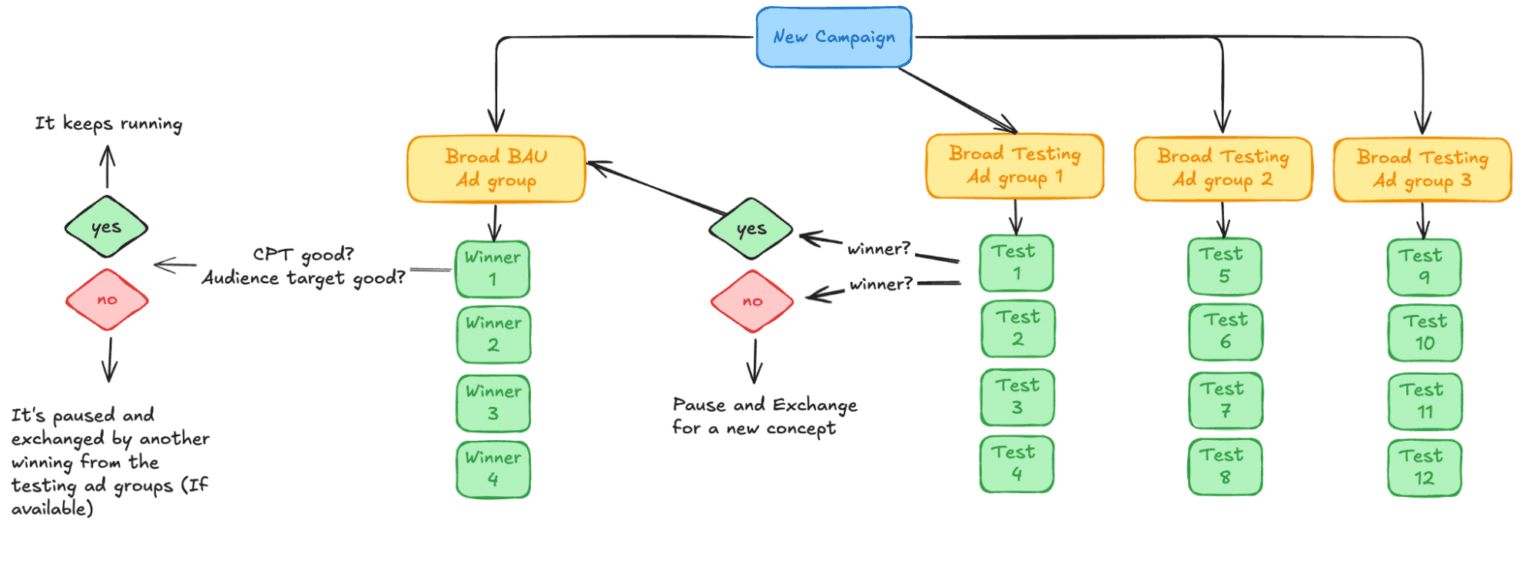
Source: RevenuCat
Shamanth M. Rao, CEO of Rocketship HQ echoes this sentiment, saying that creative will evolve from being an output to becoming a growth engine in 2026.
“The strongest studios will treat creative as a data system that compounds learnings over time, making each week’s ads smarter and more effective than the last.”
Play with Playables
Playables were the next biggest thing after video in 2025 and will continue to dominate because, at the end of the day, engagement always wins!
Trial gameplay creatives (Playable Ads) are highly strategic and a no-brainer because they demonstrate the lowest conversion costs (CPA) compared to traditional video and image formats.
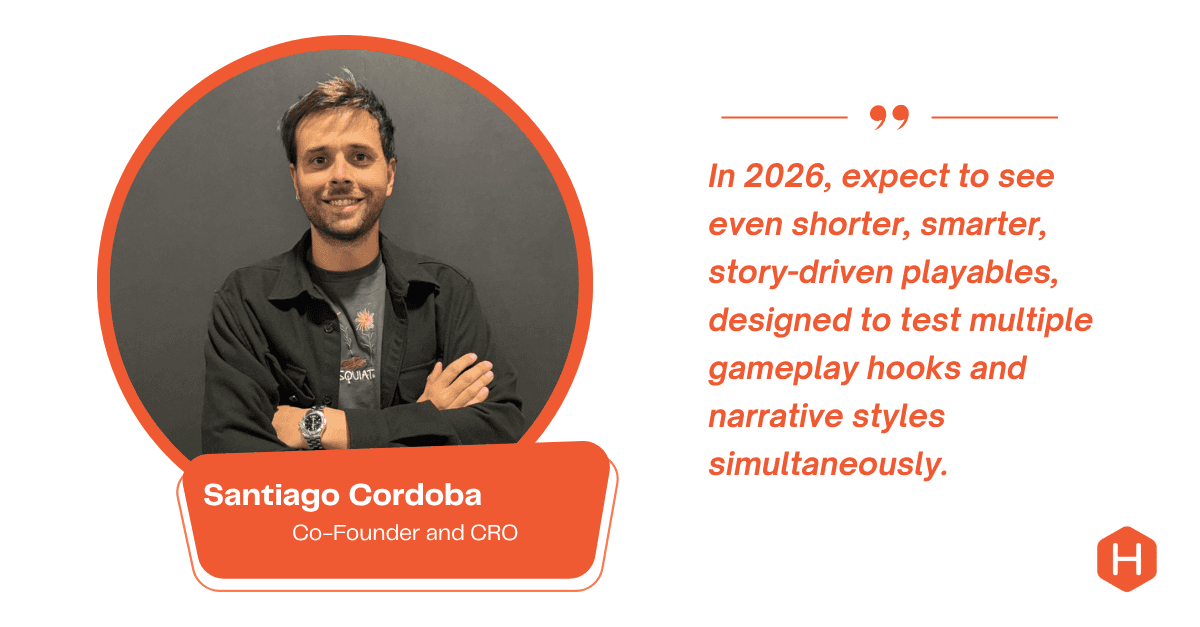
“The magic behind playable ads is the interaction — letting users try the experience, even briefly. Nowadays, if a studio doesn’t have a playable ad, it’s not that they’re not competitive — but they’re definitely missing an important part of the business.” - Santiago Cordoba, Co-founder and CRO at Adsmood.
"In 2026, expect to see even shorter, smarter, story-driven playables, designed to test multiple gameplay hooks and narrative styles simultaneously.”
Santiago and Co-founder Sergio Mastandrea, along with their team at Adsmood, have just launched Adsmood Gen AI—a new framework that combines generative AI with human creative direction to deliver high-quality video ads and playable ads at speed.
Smart Testing, Testing, Testing
Rocketships CEO Shamanth says smarter testing will matter more than bigger testing.
“AI will automate production, but what separates the best studios is structured testing systems that drive learning every week.”
AI can scale creative output, but without a clear testing framework — hypotheses, control groups, and iteration cadence — you’re just creating noise. The winners will be those who use automation to learn faster, not just produce faster.
SLG Evolution

Source: Adsmood
In strategy titles (SLG), mini-game mechanics like gates, parkour, and merging have become the go-to entry points for curiosity before showing core gameplay. These lighter, more approachable challenges act as a gateway to deeper gameplay — teasing the fun before revealing the whole experience.
As 2026 unfolds, expect these “meta hooks” to evolve into their own creative subgenres, blurring the line between ad and gameplay itself.
It's Brand + Performance, not one OR the other.
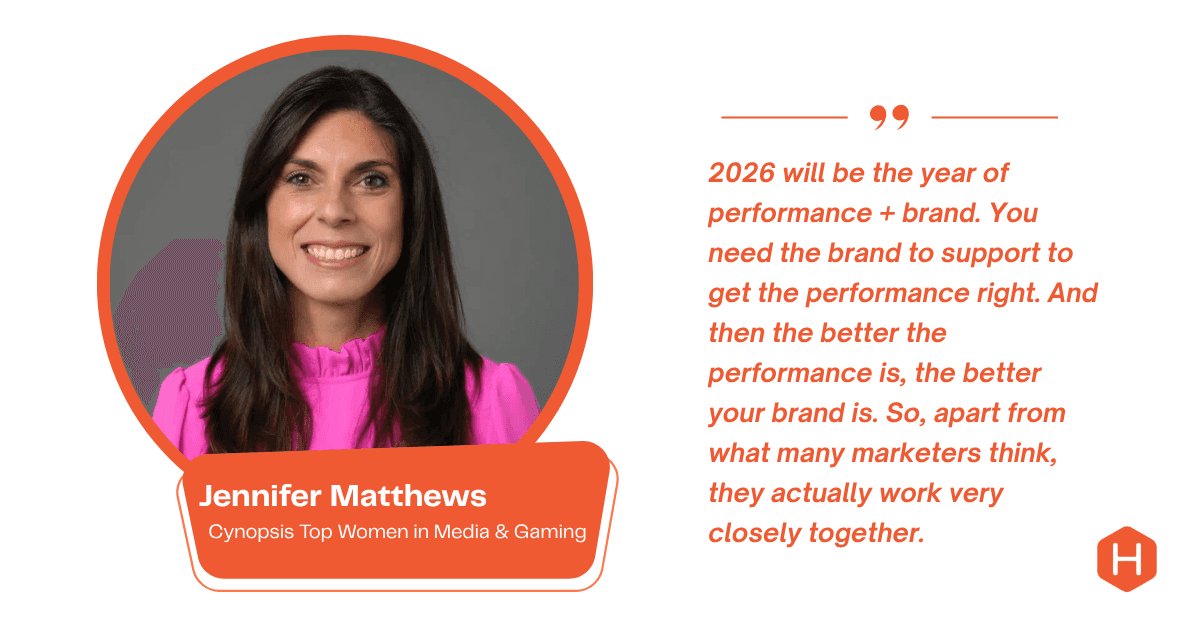
Jennifer Matthews, former VP of Brand Strategy at FanDuel and Cynopsis Top Women in Media & Gaming, states that in 2026 you're going to be seeing brand and performance teams working more closely than ever.
You need to know your consumer, right? And you need to make sure you're putting them first essentially, which is really hard when you're a brand person because you wanna put your brand first.
Savvy marketers know that the more the brand speaks to customers' needs and wants, the more likely it is to result in a transaction, which is how the brand will evolve in the creative in 2026 - and keep the performance people happy too!
“ You need the brand to support to get the performance. And then the better the performance is, the better your brand is. So, apart from what many marketers think, they actually work very closely together.”
But Jennifer emphasises that this doesn't mean the brand talking about themselves but rather about tying the brand to the customer.
The Shift Toward Authenticity
The fake “UGC” era is fading. Players recognize AI-generated facecams instantly. Real creators and influencers — even micro-influencers — drive stronger engagement and trust.
Recognizable IPs, familiar characters, and even niche celebrity collaborations are increasingly leveraged to cut through ad clutter and appeal to loyal fan bases.
Emotional Storytelling and Curiosity
AI hasn't killed the human, nor the storytelling element. In fact, in 2026, they're going to need to work closer together than ever.
The best-performing ads will continue to evoke emotion or intrigue through;
Failure Challenge: “I can do better than that!”
Before/After Contrast: LV.1 vs. LV.99 transformations
Conflict Hooks: Immediate drama or rivalry
Visual Surrealism: Unexpected or illogical visuals that spark curiosity
“The best teams will be part human, part agent. AI will handle analysis, concept extensions, and repetitive production work, while human strategists focus on emotional storytelling and insight. The pairing of the two will define the next era of creative velocity.”
- Shamanth M. Rao, CEO, Rocketship HQ
AI for Data-Driven Testing and Acceleration
AI’s true power in 2026 isn’t just faster creative production — it’s smarter creative validation. Marketers must stay agile and use data to verify decisions, distinguishing whether performance issues lie in the quality of advertising, product messaging, or the product itself.
Studios that win will use AI not just to make more ads, but to understand what works, why it works, and how fast they can act on that learning.
Using AI-driven tools, marketers can:
Detect creative fatigue early by predicting performance drops before they show up in dashboards.
Model audience reactions through lookalike behavioral data, testing multiple variations virtually before launch.
Optimize testing cadence — using machine learning to balance control groups, test budgets, and hypothesis validation automatically.
Still, marketers must resist the illusion of scale or that AI is a problem solve for all. Overproducing AI-generated assets without strategic depth can drown learning signals in noise.
AI is a multiplier — not a substitute for creative clarity.
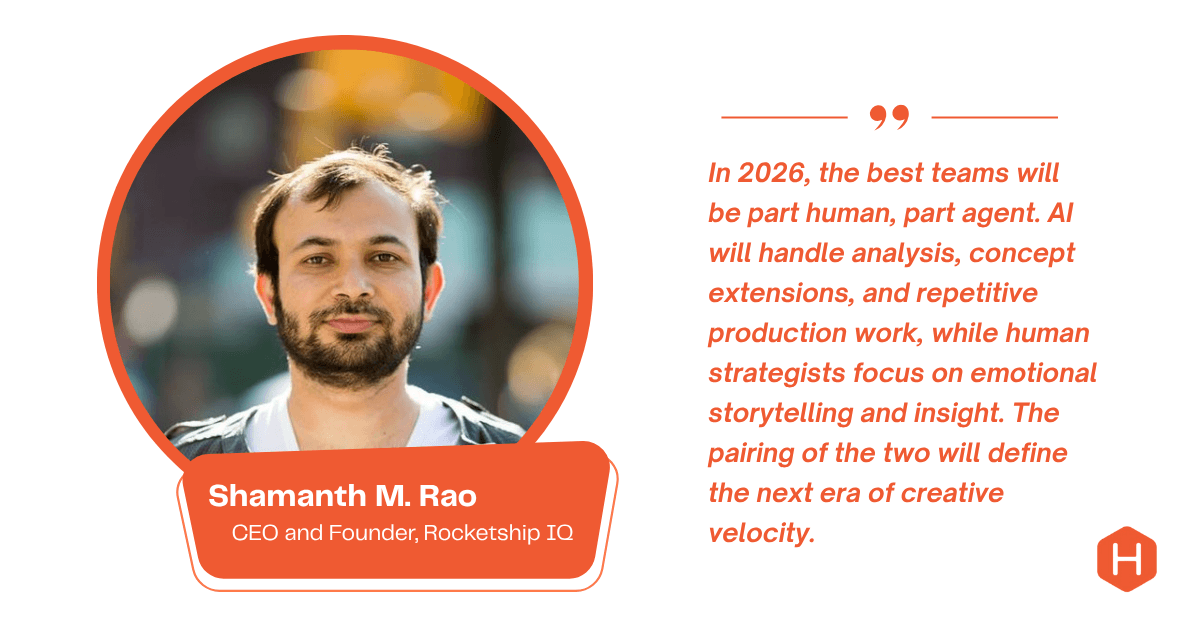
“The best teams will be part human, part agent. AI will handle analysis, concept extensions, and repetitive production work, while human strategists focus on emotional storytelling and insight. The pairing of the two will define the next era of creative velocity.” - Shamanth M. Rao, CEO, Rocketship HQ
The winners in 2026 will merge AI’s analytical precision with human creative intuition, creating feedback loops that get sharper, faster, and more aligned with real player behavior every week.
Apart from the trends, what core philosophies remain relevant in creative strategy for mobile game marketing?
The creative hook is everything.
You have about 2 seconds to grab people’s attention, and that’s not a lot of time. This is the TikTok generation, after all.
Video!
In Casual games, videos account for 40% of total spend, with vertical videos representing a significant proportion.
Don't forget the cats!
Meme culture — from “Toilet Man” to cat memes and AI-generated clips are still in! These timely cultural hooks make ads feel part of the feed, not an interruption.
“King of the Hill” Format
Gated progression — where the viewer sees a character trying (and often failing) to clear a gate — remains one of the most effective structures across genres like idle merge and 4X strategy.
The Bottom Line? Creative Strategy as a Competitive Edge
In the end, 2026 will reward the studios that treat creative not as a cost center but as a compounding system of growth. The strongest teams will merge data and intuition — leveraging AI for acceleration while keeping the human touch at the heart of storytelling.
The winners won’t necessarily be those with the biggest budgets, but those with the sharpest learning loops. Authenticity, experimentation, and emotional resonance will continue to define what cuts through in feeds increasingly flooded with sameness.
As creative cycles shorten and audiences grow more discerning, the challenge for marketers isn’t just keeping up — it’s building a process that never stops evolving. In mobile gaming, change is the only constant.
But adaptation will be a constant — that’s no lie.
Produced by Hubapps.team for reference and strategic inspiration. For more insights into building scalable creatives for your mobile games and apps and smarter UA pipelines, visit hubapps.team