Why creative volume, signal quality, and algorithmic learning now decide your UA success.
For years, user acquisition teams believed their job was to find the right audience.
Interests, lookalikes, exclusions, layered targeting. Entire strategies were built around manually defining who should see an ad.
That approach no longer works.
Modern ad platforms have changed the rules, and most studios have not fully adapted yet. In 2026, the teams that scale are not the ones trying to outsmart the algorithm. They are the ones who understand how it actually learns and feed it the right inputs.
They’re the teams that feed algorithms the right signals and deliver creative volume so the system can find the audience for you.
At Hubapps, we see this pattern across every scaled game and app.
This article explains:
Why audience-finding is dead
How modern ad algorithms actually work
Why creative volume is now your true “targeting”
What “signaling” means — and how to do it properly
How to train algorithms to find high-value users
The 2026 UA playbook for growth teams
Finding the Right App Users | adjoe GamePro 2024 is one of the greatest challenges for UA Teams. Here's how to make it easier.
And maybe you don't even need to. Let's debunk the myths.
You don't need to find your audience
This is uncomfortable for many UA teams, but it is the truth. Platforms already know your audience better than you do.
Meta, TikTok, Google, Unity, and AppLovin do not rely on declared interests or demographics. They observe real behavior at a level no advertiser can replicate:
which genres users actually play
how they spend, churn, and return
which creatives trigger installs and long-term engagement
who monetizes early versus late
who drops after day one
They know genre affinity, spend behavior, session habits, creative preferences, formats they click, times they engage, and which ads keep them in-app longer.
They do not need your help identifying users. They need your help understanding your game.
And the way you “explain” your game to an algorithm is through:
Creative volume
Signal quality
This is now the entire UA game.
Ad algorithms don’t target audiences; they target patterns
This is the shift most studios misunderstand.
Algorithms no longer match:
“Show this RPG ad to 18–24-year-old men who like fantasy.”
They match:
“Show this ad to people who behave like those who engaged with this creative in the past.”
The targeting unit is no longer:
interests
age
Gender
Lookalikes
demographic segments
The targeting unit is:
BEHAVIORAL PATTERNS.
This is why creative and creative strategy have become the most powerful lever in user acquisition. Every creative is not just a message. It is a hypothesis about which behavior pattern you want to attract.
Creative volume is the new targeting
If algorithms target patterns, then your job is to produce creative that unlocks those patterns.
One creative = one signal
Ten creatives = ten signals
Fifty creatives = fifty signals
This is why top-performing games produce massive creative throughput.
Creative volume gives you:
more entry points into the algorithm
more “pattern matches”
more possible user pockets to explore
more chances to find strong creative-audience fit
A single mediocre creative limits the algorithm.
Twenty variations let it discover your audience at scale.
This is why volume beats precision:
The algorithm cannot optimize if you give it one or two angles. It thrives when you give it creative diversity across:
Hooks
Visual themes
Characters
Angles
Pacing
Messaging
Art styles
Gameplay snippets
Humor vs serious tone
Feature spotlights
UGC vs high polish
Every creative is a new “intention signal” to the algorithm. The more signals, the faster it learns.
Signaling is the missing skill most studios don’t know they need
Signal quality is the second half of this equation — and it’s just as important as creative volume.
Signaling means:
Teaching the algorithm who your real high-value players are.
Not via targeting via interests but via conversion behavior.
The algorithm optimizes toward the signals you choose so choose carefully.
Signals you can train on include:
install
complete tutorial
D1 retention
D3 retention
add payment method
first purchase
ROAS-day events
level 20 reached
FTUE completion
register account
add to wishlist
subscribe
Most studios make the fatal mistake:
They optimize for the easiest signal, not the right signal.
That produces:
cheap installs
wrong audience
weak retention
poor monetization
declining algorithmic quality
In 2026, the algorithm needs clarity. If you send mixed signals, you get mixed results.
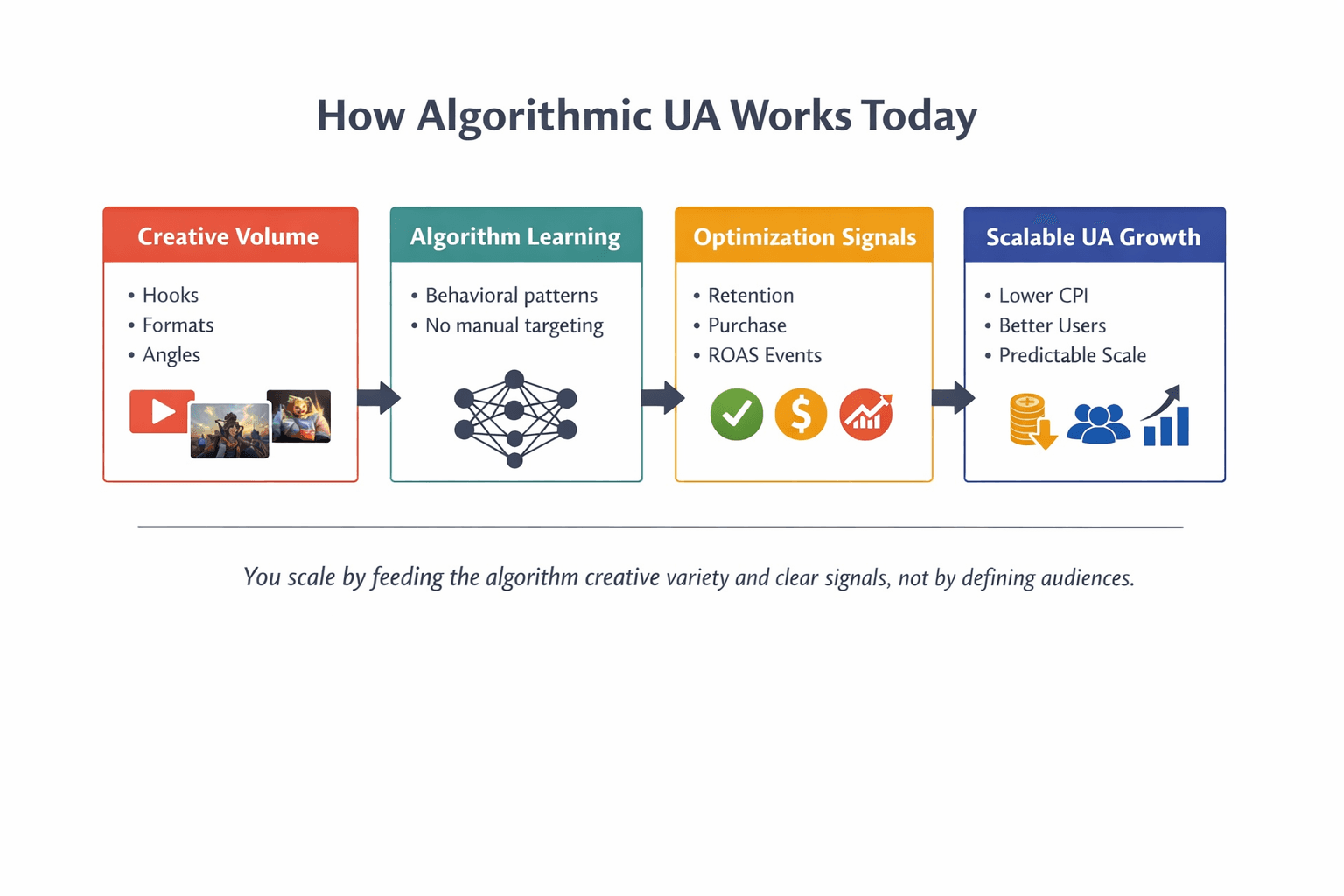
How to scale UA? High creative volume × Strong Signals
Think of creative as “what audience is this ad FOR” and signals as “what audience do we want MORE OF”. Algorithms combine both.
When creative volume is high:
Platforms cast a wide net → find many potential patterns.
When signal quality is high:
Platforms filter aggressively → find your best users.
When both are high, you unlock compounding growth:
lower CPI
improved CVR
higher retention
predictable ROAS
more stable scaling
faster learning
This is what building “algorithmic alignment” means.
Don't do Old-School Audience Targeting
We still see teams:
Targeting 15 interest groups
Layering demographics
Excluding countries manually
Creating “audience lists” that break optimization
Over-optimizing to a narrow niche too early
Running 2–3 creatives per test
Sticking to the same creative concept for months
In 2026, this is like playing an RTS with map vision turned off.
Your UA strategy must match the platforms we have, not the platforms we used to have.
Bottom line: the algorithm already knows your audience better than you
Your job is not to outsmart the algorithm; it is to collaborate with it.
Give it volume
Give it diversity
Give it clarity
Give it strong signals
Optimize for behavior, not targeting
Let the machine learn patterns you cannot see
You’re no longer a “hunter of audiences.”You’re a teacher of algorithms and the better you teach, the faster you scale.
Conclusion: creative drives discovery, signals drive value, and algorithms drive growth.
If UA before 2020 was “find the right people,” UA in 2026 is:
“Give the algorithm enough creative variation and the right signals and let it find the right people at scale.”
Your job as UA is to
producing creative volume
designing strong optimization signals
letting the platforms learn
maintaining freshness
embracing broad targeting
feeding the system clarity, not confusion
At Hubapps, we help studios build UA systems through optimizing algorithmic performance, creative throughput, and signal-driven growth.
👉 Ready to scale with modern UA, not outdated targeting logic?
Let’s talk.
FAQs
1. What is algorithmic user acquisition in mobile games?
Algorithmic user acquisition is a UA approach where platforms like Meta, TikTok, Google, AppLovin, and Unity use machine learning to find users automatically based on behavior signals — not manual audience targeting or interests.
2. Why is manual audience targeting no longer effective for mobile game UA?
Modern ad platforms already understand player behavior better than advertisers. Manual targeting limits algorithm learning, reduces scale, and often leads to higher CPIs and weaker long-term performance.
3. What matters most for scaling mobile game UA in 2026?
Creative volume and signal quality. High creative diversity helps algorithms discover patterns, while strong optimization signals (retention, purchases, ROAS events) train platforms to find high-value players.

Mobile gaming UA specialist since 2011. A female pioneer in the industry, Maria has scaled games across every major platform and genre, from indie puzzle games to massive strategy titles. Known for straight talk and results that actually matter.
Share
Related Articles