Most ASO guides are written by ASO tool companies. They walk you through keywords, screenshots, and icons — and then pitch their platform.
This one is different.
We’ve spent 14+ years running user acquisition for mobile games, and over that time we’ve seen what happens when ASO works in sync with UA and what happens when it doesn’t. The difference isn’t marginal. It’s the difference between a $2 CPI and a $5 one. Between a soft launch that gives you clean data and one that wastes your first three months.
If UA is the “paid booster pack” for growth, ASO is your game’s core loop: the mechanic that quietly compounds, session after session, install after install. Done right, ASO doesn’t just help players find your game, it becomes the shopkeeper, the tutorial, and the daily reward chest of your entire growth engine.
This guide covers ASO from the perspective of performance teams — the people who need store page conversion to actually impact their bottom line, not just look good in a presentation.
Whether you’re preparing a soft launch, scaling globally, or trying to squeeze more out of a UA budget that isn’t getting any bigger, this is the ASO playbook we wish someone had given us when we started.
Key Takeaways: The “UA-First” Perspective for ASO
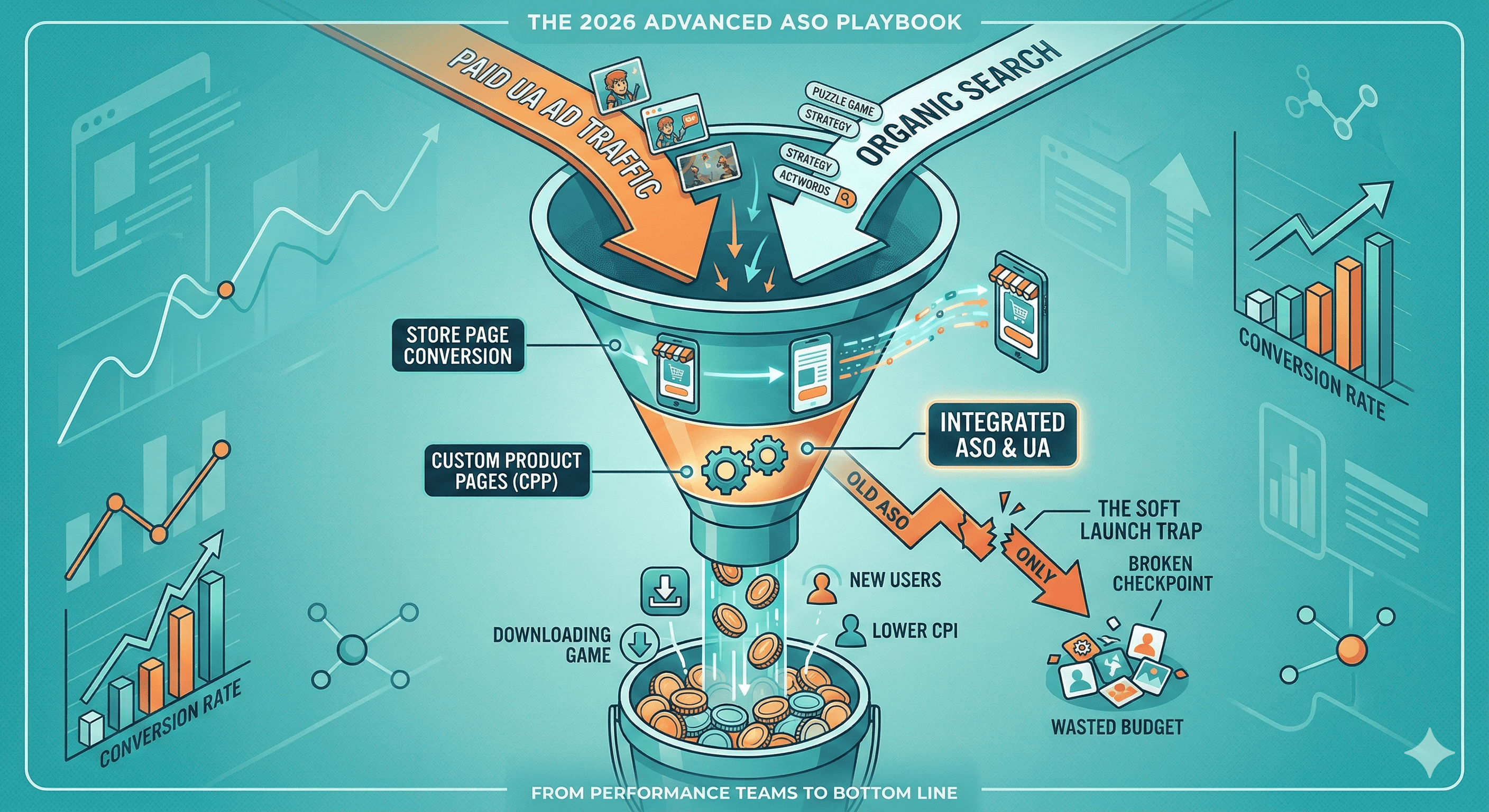
The Conversion Bottleneck: ASO is the final conversion point for all paid traffic. If your UA ads are great but your store page is poor, you are “paying full price for half the result.”
Creative Alignment: High CPIs are often caused by “invisible” friction—where the ad creative (e.g., frantic gameplay) doesn’t match the store screenshots (e.g., peaceful landscape art).
Custom Product Pages (CPPs) are King: In 2026, the biggest lever is using Apple’s CPPs and Google’s CSLs to create specific store pages that match specific ad themes.
The Soft Launch Trap: Studios often waste soft launches by not optimizing the store page for those specific markets, leading to “contaminated” CPI data that looks higher than it actually is.
Post-ATT Importance: Since precise targeting is harder on iOS, ASO provides a “durable floor” for acquisition by capturing high-intent organic users.
What Exactly Is ASO?
App Store Optimization (ASO) is the process of improving visibility, relevance, and conversion inside app marketplaces — Apple App Store, Google Play, and emerging regional stores.
But ASO for games is more layered than ASO for apps.
The 5 components of ASO for games and apps:
1. Metadata
Your title, subtitle, short description, long description, keyword list (iOS), and long-tail keyword structure.
This is how the store understands your game.
2. Creative Assets
Your icon, screenshots, app preview video, feature graphic (Google Play), and promotional graphics are what make up your creative assets.
This is how the player understands your game.
3. Ratings & Reviews
This is your reputation layer, strongly tied to retention, support workflows, and live-ops cadence. It’s how you gain audience trust.
4. Localization & Cultural Adaptation
The single biggest multiplier of ASO ROI. ASO for Japan ≠ ASO for France ≠ ASO for Brazil. You need to localize ASO per country or at least per region.
5. Store Experiments & Advanced Features
Custom Product Pages (iOS), Custom Store Listings (Play), experiments, and in-app events.
In short:
ASO = organic UA + conversion optimization + genre mastery + creative excellence.
Why Most Studios Get ASO Wrong
Most studios treat ASO and User Acquisition (UA) as two separate departments, two separate meetings, two separate strategies. That’s a mistake - they’re integrally connected.
Your store page is the final conversion point for every paid install. Every single ad click, every impression that leads to a tap, they all end on your App Store or Google Play listing. If that page doesn’t convert, you’re paying full price for half the result.
And yet, in most organizations, the UA team runs campaigns while the ASO team optimizes keywords, and neither has visibility into the other’s work. The result is predictable: ads that promise one experience and store pages that show another. Creative misalignment between what the user saw in the ad and what they see on the store listing. Conversion rates that silently erode performance.
The studios that win in 2026 are the ones treating their store page as an extension of their UA funnel — not a branding exercise managed in isolation.
Why ASO Matters for Mobile Games & Apps
Good ASO for your mobile app or game ensures enhanced app visibility, maximizes click-throughs, increases installs, and helps studios reach their app install KPIs.
But ASO has jumped in importance for several reasons:
01. Organic traffic is still the highest-quality acquisition source
Organic players install intentionally — not impulsively — which means:
higher D1 retention
higher D7 retention
higher LTV
lower early uninstall
stronger cohort quality
Organic installs are the foundation of a stable game.
02. Store creatives now influence store ranking
Apple and Google now evaluate:
tap-through rates
dwell time on screenshots
video start rate
scroll depth
screenshot engagement
install conversion
These behavioral signals are ranking factors, not just CVR factors.
03. Advanced ASO tools mean you can “personalize the storefront”
Custom Product Pages (iOS) and Custom Store Listings (Google Play) allow you to:
Match ads → store page perfectly
Show different creatives to different audiences
Tailor pages for events, demographics, locations
Improve CVR for specific campaigns
04. Localization is no longer optional
Case studies from App Radar, Storemaven, Sensor Tower and others show that localized visual assets (not just text) can increase conversion by 20–40%.
Players only install what feels “made for them.
05. ASO and UA are now inseparable
Paid traffic boosts organic ranking.
Organic CVR reduces paid CPI.
Creative tests in UA reveal ASO winners.
The ASO Fundamentals (Yes, it still matters in 2026)
Before we get into the advanced stuff, let’s be clear: the basics haven’t changed. They’ve just become table stakes. If you’re not doing these well, nothing else matters.
Keywords: The Foundation You Can’t Skip
Keyword optimization remains the single most impactful lever for organic discoverability. But doing it right in mobile games is different from doing it for a productivity app.
For the Apple App Store, you get 100 characters in the keyword field, plus your title (30 characters) and subtitle (30 characters). Every character matters. Generic terms like “fun game” burn valuable space. You want terms that balance search volume with competitive density — and that means thinking like a player, not a marketer.
How to use keywords for ASO?
Think in genre-specific terms: “tower defense strategy,” “idle RPG offline,” “merge puzzle.” These are how real players search — they combine genre with a modifier that describes how or when they play.
Use localization as a keyword multiplier. If you’re only optimizing in English, you’re ignoring the fact that keyword fields in localized versions give you additional indexing opportunities in every market you support. Japanese, Korean, Portuguese, German — each localization is another 100 characters of keyword real estate.
Monitor weekly, not monthly. Keyword rankings shift constantly, especially around seasonal events, competitor launches, and featuring. If you’re reviewing keywords once a month, you’re operating on outdated data.
For Google Play, the algorithm weighs your full description heavily, not just the short description and title. This means your long description should naturally incorporate target keywords without feeling stuffed. Google’s algorithm has become sophisticated enough to penalize obvious keyword stuffing while rewarding natural language that demonstrates topical relevance.
ASO Store Comparison: Apple vs. Google (2026)
Feature | Apple App Store (iOS) | Google Play Store (Android) |
Keyword Weight | Heavy focus on Title (30), Subtitle (30), and Keyword Field (100). | Full description is heavily indexed; uses natural language processing. |
Customization | CPPs: Up to 35 unique pages for specific ad campaigns. | CSLs: Tailored by country, traffic source, or pre-reg status. |
Visual Emphasis | First 1-3 screenshots are vital; must show gameplay immediately. | Google rewards “freshness” and frequent updates more aggressively. |
Social Proof | Prompt reviews after “moments of achievement.” | Responding to reviews is a direct algorithmic ranking signal. |
Indexing Speed | Fast; changes reflect in a few days. | Slower; takes time to process the long description context. |
Visuals: Your Screenshots Are Sales Tools, Not Art
Your icon, screenshots, and preview video aren’t decoration. They’re the highest-impact conversion elements on your entire store page.
Icons need to work at thumbnail size — the size users actually see when scrolling through search results. Test readability at 32x32 pixels. If you can’t tell what the game is about at that size, iterate.
Screenshots should follow a clear hierarchy. The first three are the only ones most users see before deciding. Those three need to communicate genre, core gameplay loop, and emotional hook — in that order. The remaining screenshots can go deeper into features, social proof, or content variety.
Preview videos are where many studios waste an opportunity. The first three seconds determine whether someone watches or scrolls. Lead with gameplay, not logos. Show the moment of satisfaction — the combo, the explosion, the unlock — immediately.
A critical point that most ASO guides overlook: your store creative and your UA creative strategy should feel like they belong to the same game. If your TikTok ad shows frantic puzzle gameplay and your screenshots depict serene landscape art, you’ll see high click-through rates from ads but terrible install conversion. That mismatch is invisible in most dashboards — it shows up as a high CPI that nobody can explain.
Ratings and Reviews: The Social Proof Loop
Games with ratings below 4.0 see significantly lower conversion rates. But most studios approach reviews reactively — they respond to negative ones and hope for positive ones.
The smarter approach is designing review prompts into your game’s flow. Prompt after a moment of achievement — after completing a level, unlocking a reward, or winning a match. The player’s emotional state at the moment of the prompt directly influences whether they leave a review, and what that review says.
On Google Play, responding to reviews also signals to the algorithm that the developer is active and engaged, which can positively influence ranking.
How ASO Connects to UA in Gaming
Watch on
Grow Your App in 24 Hours with These Proven Google Play ASO Techniques
This is where we part ways with the generic ASO guides and get into what actually moves the needle for performance teams.
Custom Product Pages and Custom Store Listings
This is arguably the most underused ASO feature in mobile gaming.
Apple’s Custom Product Pages (CPPs) let you create up to 35 unique store page variants, each with different screenshots, preview videos, and promotional text. You can assign a specific CPP to a specific ad campaign, meaning users who clicked on a strategy-focused ad see strategy-focused screenshots, while users who clicked on a social-focused ad see community and multiplayer visuals.
Google’s Custom Store Listings (CSLs) offer similar functionality, allowing you to tailor store pages by country, pre-registration status, or specific traffic sources.
The impact on CPI can be dramatic. When the store page experience matches the ad creative that brought the user there, conversion rates improve — and because the ad platforms optimize on conversion signals, your cost per install decreases in response.
Most studios either don’t know about CPPs/CSLs or don’t prioritize them because they require additional creative production. That’s short-sighted. Even two or three custom pages aligned to your top-performing ad themes can meaningfully reduce acquisition costs.
ASO During Soft Launch: Where Most Studios Leave Money on the Table
Soft launch is when your store page matters most and gets the least attention.
During soft launch, you’re running UA tests in limited geos to validate your game’s early-game KPIs — retention, monetization, CPI. But if your store page isn’t optimized for the soft launch markets, your CPI data is contaminated by poor store conversion. You end up thinking your CPI is $3.50 when it’s really $2.50 with a properly optimized page.
What to do during soft launch:
Start with localized store listings for your test markets. If you’re soft launching in the Philippines and Australia, don’t run with an English-only, US-optimized listing.
Run A/B tests on your icon and first three screenshots before you start scaling UA spend. Google Play Experiments and tools like SplitMetrics or StoreMaven let you test store page variants and isolate their impact on conversion.
Treat your soft launch store page as a testing ground. The version you launch with globally should be the winner from multiple rounds of soft launch store page experiments.
The Privacy Factor: What ATT and SKAN Mean for ASO
Here’s something almost nobody talks about in ASO guides: the post-ATT world has made ASO more important than ever, not less.
When Apple’s App Tracking Transparency reduced the precision of paid UA targeting, it simultaneously increased the value of every organic install. Organic users don’t carry attribution costs, don’t require SKAN postbacks, and tend to have higher retention because they self-selected.
At the same time, SKAdNetwork’s limited conversion value schema means you have less post-install data from paid campaigns. This makes store page conversion rate one of the few clean, directly measurable signals you still have.
Studios that invest in ASO are building a floor under their acquisition costs. When UA gets expensive or targeting becomes less precise — both of which are ongoing trends in the 2026 UA landscape — a well-optimized store page continues to deliver organic volume at zero marginal cost.
Advanced ASO: The 2026 Playbook
Seasonal and LiveOps-Driven Store Updates
The app stores reward freshness. Regular updates to your store listing — new screenshots reflecting seasonal content, updated descriptions highlighting new features, refreshed icons for events — signal to the algorithm that your game is actively maintained.
This matters because both Apple and Google consider update frequency and recency when determining search rankings and editorial featuring opportunities. A game that hasn’t updated its store page in six months is sending a signal that development has slowed.
Tie your store page updates to your LiveOps calendar. Halloween event? Update your icon and first screenshot. Major content drop? Refresh your preview video to showcase it. This creates a virtuous cycle: the update improves conversion, the improved conversion boosts rankings, the higher rankings drive more organic installs.
Competitor Intelligence as an Ongoing Practice
ASO isn’t a set-and-forget exercise. Your competitors are constantly updating their keywords, testing new screenshots, and adjusting their positioning.
Build a monthly competitor review into your workflow. Track the top 5–10 games in your genre across both stores. Note changes to their icons, screenshot order, keyword focus, and description messaging. Tools like AppTweak, MobileAction, and data.ai can automate parts of this, but the strategic interpretation — understanding why a competitor changed their approach and what it means for your positioning — requires human judgment.
Pay special attention to games that recently got featured or experienced a download spike. Reverse-engineering what they did differently on their store page in the weeks before can give you actionable insights for your own listing.
Localization: Not Translation
This is one of the highest-ROI ASO activities and one of the most poorly executed.
Localization is not running your English description through a translation tool. It’s adapting your store presence to reflect how players in each market search, what visual styles resonate, and what cultural references land.
Japanese players often respond to different screenshot compositions than Western players. Korean app store users engage more with detailed feature callouts. Brazilian Portuguese search terms differ significantly from European Portuguese.
If you’re serious about international growth, invest in native-speaker keyword research and culturally adapted creative for your top five markets. The incremental cost is small relative to the impact on conversion rates in those geos.
What does Good ASO Practice Look Like?
Rather than treating ASO as a one-time optimization project, the studios that get the best results treat it as a continuous loop:
Research → Analyze your category, competitors, keyword opportunities, and current conversion funnel.
Implement → Update keywords, refresh visuals, align store page with current UA creative and LiveOps content.
Test → Run A/B experiments on icons, screenshots, and descriptions. Use Google Play Experiments or third-party tools for Apple.
Measure → Track organic install trends, keyword rankings, conversion rates by source, and the impact on blended CPI. Strong UA analytics make this possible.
Iterate → Feed learnings back into the next cycle. The best ASO practitioners run this loop every two to four weeks, not quarterly.
The ASO Tools We Actually Use
No ASO strategy works without the right data. Here’s what we rely on:
AppTweak — keyword intelligence, competitor tracking, and store listing analysis. Strong for both Apple and Google.
MobileAction — good for creative intelligence and understanding what visual approaches competitors are testing.
SplitMetrics / StoreMaven — A/B testing platforms for store page creative. Essential for pre-launch and soft launch testing.
App Store Connect / Google Play Console — the native analytics remain your source of truth for impression-to-install conversion, traffic sources, and keyword performance.
SensorTower — market-level data for understanding category trends, download estimates, and revenue benchmarks.
The Hubapps ASO Checklist for mobile games and apps
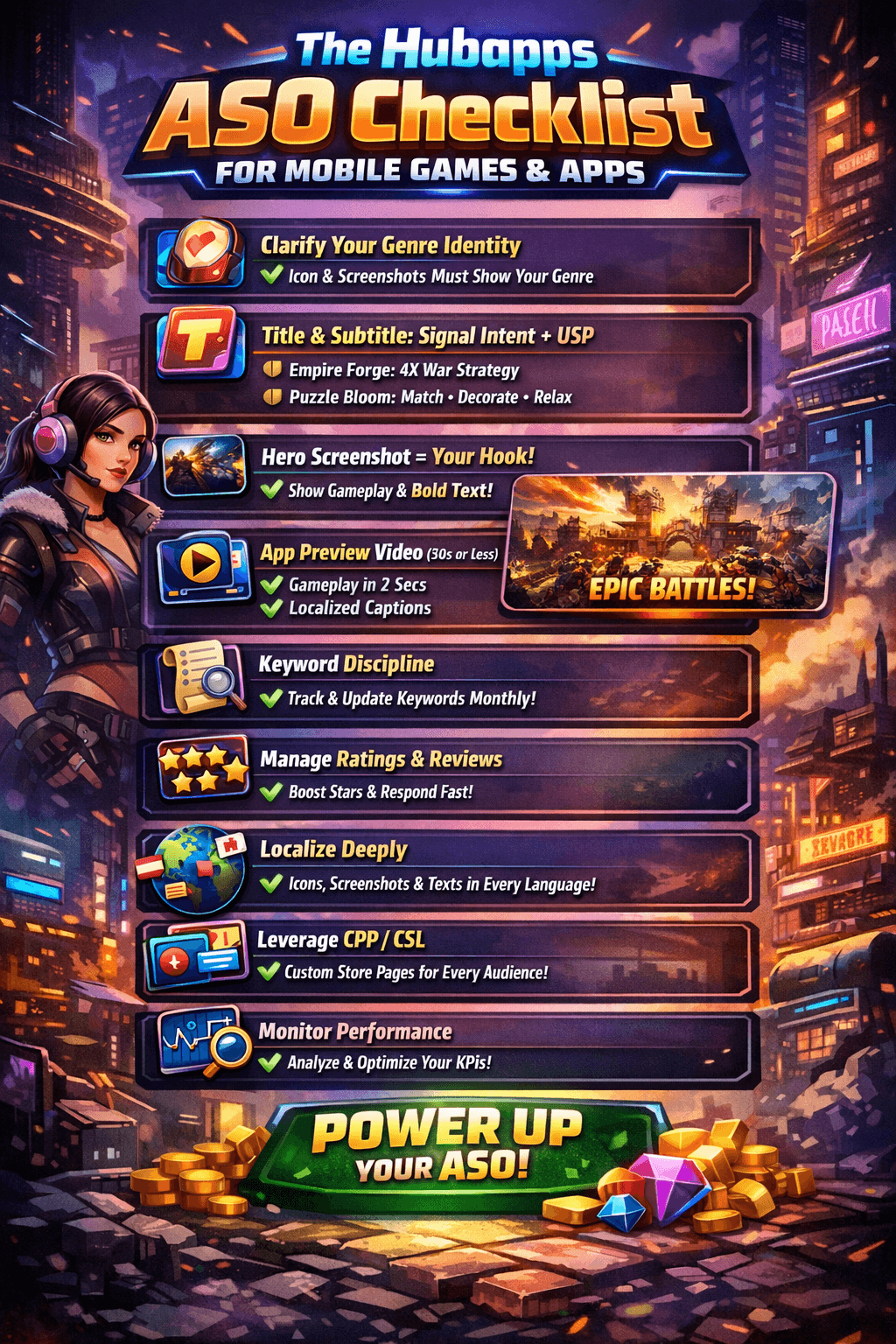
When gaming studios ask us about ASO, we share this checklist;
✔️ 1. Clarify your genre identity
Players (and algorithms) must recognize the genre instantly.
Ask:
“Does the icon tell the genre?”
“Do the first two screenshots show the core loop?”
If the answer is no → fix this first.
✔️ 2. Title & subtitle: signal intent + USP
Be obvious! Your game name shouldn’t be mysterious and your subtitle shouldn’t waste characters.
Examples:
“Merge Magic: Garden Adventure”
“Empire Forge: 4X War Strategy”
“Puzzle Bloom: Match • Decorate • Relax”
Use one high-intent keyword + one clear benefit.
✔️ 3. Hero screenshot = your hook
Best screenshot practices:
Show actual gameplay
Use bold copy overlays (5–6 words)
Use zoomed-in UI for clarity
Lean into genre expectations
And don’t forget to name your screenshot properly for organic search.
✔️ 4. App Preview Video (30s or less)
Gameplay in first 2 seconds.
No cinematic-only videos.
Localize captions.
Video improves conversion across almost all categories.
✔️ 5. Keyword discipline
Keep a backlog grouped by:
high-intent keywords
long-tail variations
seasonal terms
competitor-adjacent terms
Update monthly or quarterly, not weekly.
✔️ 6. Manage ratings & reviews
Prompt happy users at moments of delight
Respond to negative reviews in under 48 hours
Automate sentiment monitoring
The store algorithm considers sentiment as a ranking factor.
✔️ 7. Localize deeply
Localize:
icons
screenshots
video
messaging
keywords
theme choices (colors, characters, UI style)
Remember: localization is not the same as simple translation.
✔️ 8. Leverage CPP/CSL
Tailor store pages for:
UA channels
creative hooks
seasonal content
returning users
specific regions
This increases funnel relevance enormously.
✔️ 9. Monitor performance
Track:
impression → product page view
product page view → install
keyword ranking
browse vs search traffic
early uninstall
CVR per asset
retention by creative cohort
Then iterate monthly.
🚀 The 5 ASO Trends (2026)
🎯 Trend 1 — Ranking Is Now Behavior-First (Not Keyword-First)
The App Store and Google Play now judge your game the same way players judge a new title: by how people behave the moment they see it.
Instead of rewarding keyword stuffing, the stores reward:
taps on your listing
scroll depth
dwell time
app preview video watch rate
install conversion
early uninstall (your “FTUE fail rate”)
In short, algorithms are treating your page performance like a retention metric — if players don’t engage, you lose visibility.
📌 Note
Your store page needs to “hook” faster than a hypercasual tutorial. If players bounce instantly, the algorithm treats your game like they rage-quit the tutorial before level 1.
🎨 Trend 2 — Creatives Are the #1 CVR Lever (and a Ranking Signal)
In 2026, your icon and first screenshot matter more than your long description ever will. Game developers spend months perfecting combat animations, but players decide in 0.3 seconds whether your store page deserves a tap.
Store preview videos and visuals are now ranking inputs, not just conversion tools.
📌 Note
Your icon is your “legendary item drop.” If it doesn’t shine in the loot chest (search results), no one taps it.
🧩 Trend 3 — CPP & CSL Are Now the Standard Loadout, Not Advanced Gear
Custom Product Pages (iOS) and Custom Store Listings (Android) used to be advanced tools. In 2026, they’re every studio’s basic equipment.
These features let you create:
unique pages per audience
unique pages per UA creative
unique pages per event
unique pages per region
This dramatically increases relevance and conversion.
📌 Note
CPP/CSL are like alternate skins for your store page — same character, different role depending on the quest.
🌍 Trend 4 — Localization Is Now Cultural, Not Linguistic
Translation is table stakes. 2026 ASO winners build culturally relevant experiences.
Players in Japan, Brazil, France, and Korea don’t respond to the same:
colors
characters
pacing
event themes
messaging
gameplay framing
Localization now includes visual adaptation, not just metadata.
📌 Note
Think of localization as building “home bases” across different regions — you can’t conquer a map using only one biome theme.
⚔️ Trend 5 — ASO and UA Have Fully Merged Into One Growth Loop
Paid UA boosts organic visibility. Organic CVR lowers paid CPI.
Creative insights flow both ways.
Treating them separately is now a game-losing strategy.
Smart studios operate ASO + UA + Creative as one ecosystem.
📌 Note UA brings players to your gate. ASO convinces them to enter. Both must be spec’d into the same skill tree.
How ASO and UA Work Together at Hubapps
When we work with a client, ASO is never a standalone project. It’s integrated into the UA strategy from day one.
During soft launch, we optimize the store listing alongside initial UA tests to ensure the CPI data we’re collecting is clean and reflects true user interest, not just a poorly converting store page.
During scale, we build Custom Product Pages aligned to our top-performing ad themes, so the user journey from ad impression to install is seamless.
And on an ongoing basis, we tie store page updates to the game’s LiveOps calendar, ensuring the listing always reflects what’s current in the game.
This approach — treating ASO as a performance discipline, not a marketing afterthought — is how we helped FunPlus improve their app store visibility and conversion when they were building out a new department from scratch. You can read the full case study here.
Conclusion: ASO Is the Meta in 2026
Mobile game discoverability in 2026 is more competitive than a Candy Crush leaderboard on a Sunday boost event. With millions of titles all trying to match three with the same players’ attention, visibility isn’t luck or just about designing better games, it’s strategy.
It’s about removing friction between the moment a player discovers your game and the moment they install it. It’s also about designing better storefronts, better creative funnels, better localized experiences, and more behavior-aligned journeys.
Treat ASO like a live ops system:
test it,
tune it,
localize it,
iterate it,
measure it,
and keep leveling it up.
Every keyword you optimize, every screenshot you test, every custom product page you create — it all compounds. And unlike paid UA, where costs rise and privacy restrictions tighten, ASO improvements are durable. They keep working long after you’ve done the work.
📌 Point to NoteThink of ASO as your game’s daily quest — small, consistent actions that deliver massive rewards over time.
If your store page isn’t converting, it doesn’t matter how good your ads are. Fix the foundation first.
The 2026 Advanced ASO Playbook
LiveOps Integration: Tie your store updates to your in-game calendar. If you have a Halloween event, your icon and screenshots should change to reflect it. This signals “active development” to the stores.
Localization vs. Translation: Don’t just translate text. Adapt visuals. Japanese players prefer different screenshot compositions than US players.
The 3-Second Rule: For preview videos, lead with the “explosion/satisfaction” moment immediately. Remove logos and cinematic intros.
Continuous Loop: ASO is no longer a “one-and-done” project. It should be a 2–4 week cycle of: Research → Implement → Test → Measure → Iterate.
Need help with your mobile game’s ASO strategy? Book a call with our team — or explore our ASO services.
FAQs on ASO
What is ASO?
ASO stands for App Store Optimization. It’s the process of improving your app or game’s visibility in the Apple App Store and Google Play Store so more people find it, click on it, and install it. Think of it like SEO but for app stores. You’re optimizing your title, keywords, screenshots, icon, description, and reviews to rank higher in search results and convert more store visitors into actual players.
Why is ASO important for mobile games?
Because there are over 700,000 games in the app stores and yours needs to stand out. Even if you’re running paid UA campaigns, every single ad click lands on your store page. If that page doesn’t convert, you’re burning money. ASO also drives organic installs which cost you nothing and tend to retain better than paid users. In the post ATT world where paid targeting is getting harder and more expensive, organic visibility through ASO is one of the few reliable growth levers you have left.
How is ASO for games different from ASO for regular apps?
Players search differently than utility app users. They search by genre, gameplay mechanics, and emotional experience (“relaxing puzzle game,” “offline RPG”) rather than by function (“budget tracker”). Your visuals also carry way more weight because games are entertainment products. Players decide based on how a game looks and feels in the screenshots and preview video, not by reading your description. And because gaming is split into dozens of subgenres, your keyword strategy and creative approach need to be tailored to your specific category and audience.
How long does ASO take to show results?
Keyword changes on Apple usually start showing ranking movement within a few days to a week. Google Play can take a bit longer because the algorithm indexes your full description and needs time to process updates. Visual changes like new screenshots or icons can impact conversion rates almost immediately once they go live. But the real value of ASO compounds over time. Studios that treat it as an ongoing practice rather than a one time project see the strongest and most durable results.
Can ASO replace paid user acquisition?
No, and it shouldn’t try to. ASO and UA work best together. Paid campaigns drive volume and give you control over scale and timing. ASO makes that paid traffic convert better (lowering your CPI) while also building a baseline of organic installs that reduce your dependency on ad spend. The smartest studios use ASO to make every dollar of UA spend more efficient rather than treating them as separate strategies.

Mobile gaming UA specialist since 2011. A female pioneer in the industry, Maria has scaled games across every major platform and genre, from indie puzzle games to massive strategy titles. Known for straight talk and results that actually matter.
Share
Related Articles


