In 2024, one in three top-grossing mobile games integrated influencer marketing into their strategy. This shows that influencer collaborations are now a core part of mobile game go-to-market and UA planning.
Since the pandemic, one thing has become pretty clear: people have a much shorter tolerance for anything that feels staged.
Audiences have grown extremely sensitive to anything that feels forced, scripted, or overly commercial. You can see it in comments, in engagement, and even in how quickly users disengage when a creator starts promoting too many products in a way that feels unnatural.
The reaction is almost instant: “Okay, so this is an ad.” And once the viewer labels it that way, trust drops fast.
And once that doubt appears, something breaks. Users begin to question whether recommendations are real or simply paid endorsements. Many will unfollow creators who constantly advertise unrelated products, especially when those promotions do not fit their usual tone or content.
This is why influencer marketing in 2026 is not just a “creative channel.” Authenticity has become a conversion advantage. It is no longer a branding buzzword, it is a performance lever.
Authenticity moved from “brand” to “conversion”
Influencer marketing works because creators lend trust. Their credibility becomes borrowed legitimacy: it reduces friction and increases intent.
But authenticity today is fragile. Audiences want creators to sound like themselves, share real experiences, and speak in a way that feels sincere. Overly structured briefs, rigid scripts, and generic ad reads are the fastest way to kill performance.
If the content does not feel organic, it does not matter how big the creator is. Trust disappears, engagement drops, and the campaign becomes expensive noise.
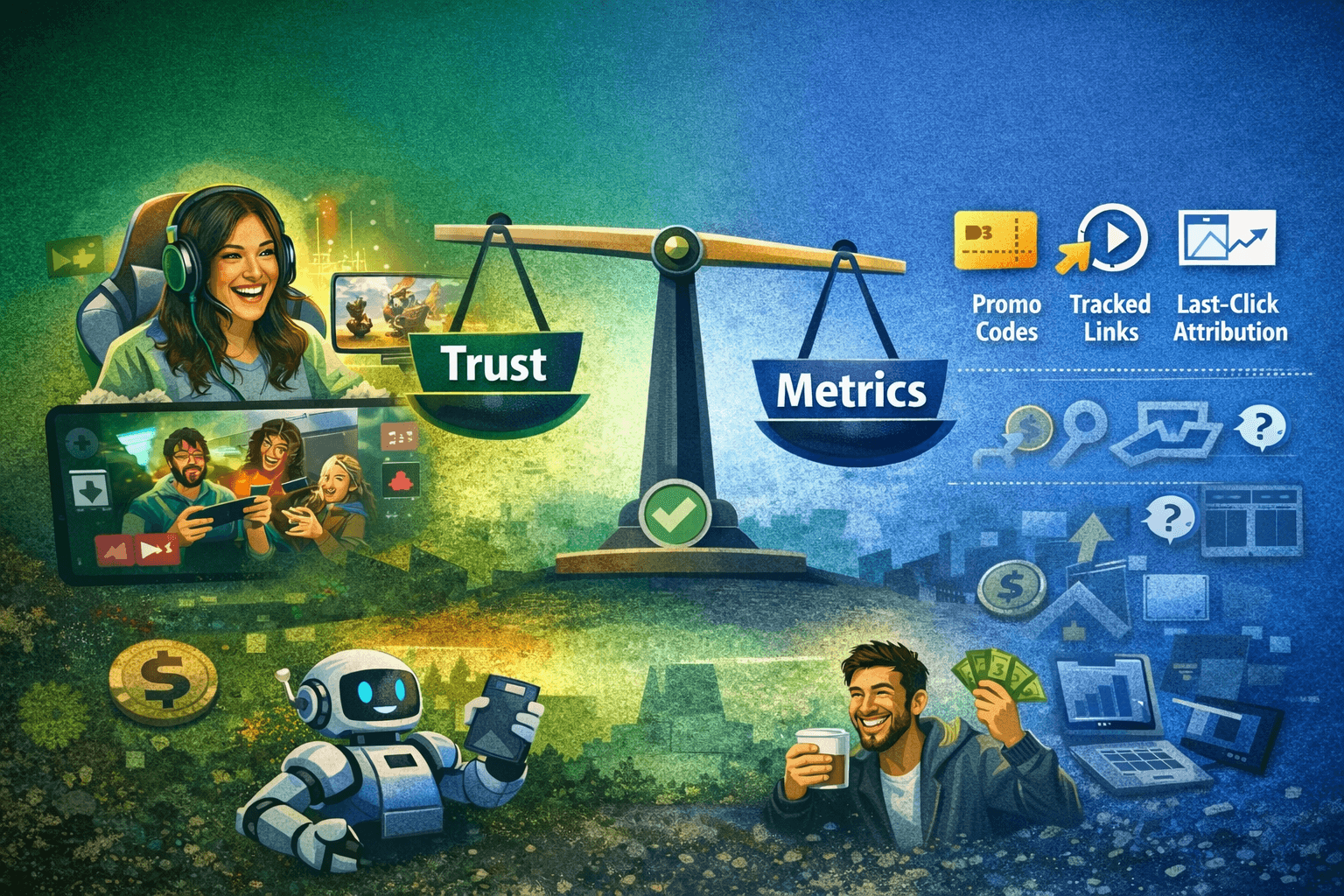
The authenticity–measurement paradox: How to measure influencer marketing?
This is where many performance teams get stuck.
The more authentic you want the content to be, the harder it becomes to measure.
Authenticity often clashes with the tools marketers rely on for clarity:
promo codes
tracked links
heavy CTAs
overly explicit “download now” structures
All of these can hurt the natural feel of the content. And when content does not feel natural, audiences resist it.
So the challenge becomes obvious: influencer marketing is not about choosing authenticity or measurement. It is about finding the right balance between content that feels organic enough to trust and measurement that is strong enough to justify the investment.
That balance will not look the same for every product, objective, audience, or channel. But ignoring the trade-off is how teams sabotage influencer performance before it begins.
Why influencer performance often looks “incomplete” in dashboards
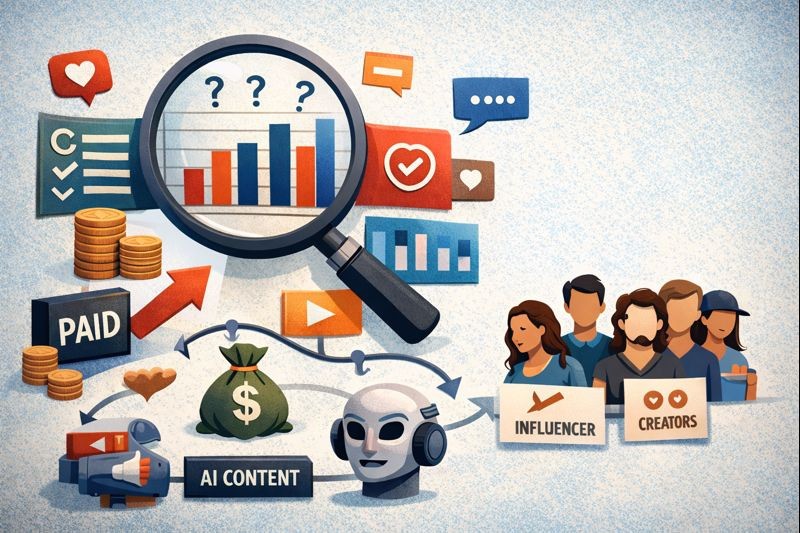
Even when measurement is in place, influencer performance can look underwhelming in the dashboard. Not necessarily because it is not working, but because attribution is incomplete by nature.
A meaningful share of influencer impact happens through:
someone watching a video then searching later
sharing content privately with friends
cross-device behaviour
delayed conversions
another channel capturing the last click
This is why last-click numbers often underreport influencer contribution. If your internal benchmark is “influencer must show the same clean attribution as paid social,” you are setting the channel up to fail.
Organic-first then paid amplification
Many brands already run influencer this way: content goes out organically first and the winners get scaled with paid. It helps preserve authenticity while still giving performance teams something they can optimise:
publish in the creator’s natural voice
spot the top-performing hooks and formats
amplify the winners through paid campaigns
It is not always the right answer, but it is one of the most dependable ways to turn authentic creator content into scalable growth.
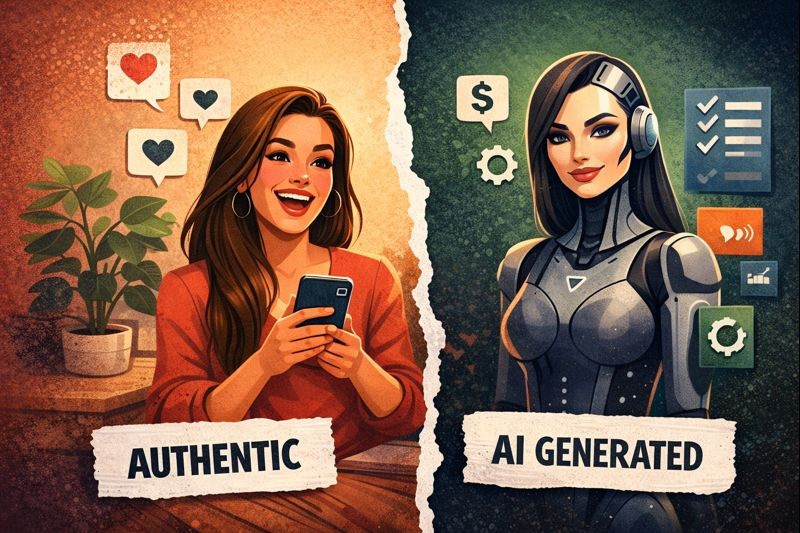
The role of AI in influencer marketing: authenticity loses, but speed wins
AI-generated content still struggles to compete against something that feels genuinely human and organic. If authenticity is the advantage, AI has a harder time breaking through when the audience is looking for a real voice and a sincere experience.
However, AI can absolutely make sense inside influencer marketing depending on the goal.
What we are seeing with multiple clients is AI being used as a testing engine:
faster concept generation
cheaper iterations
rapid experimentation with different messages, CTAs, and angles
The trade-off is clear:
you lose authenticity
but you gain speed and budget efficiency
AI becomes useful when you want to learn quickly, reduce creative risk, and narrow down what resonates before investing in creator relationships or higher production value.
AI has not penetrated the market deeply enough yet to materially influence influencer pricing. But if the authenticity barrier is reduced over time, AI could put real pressure on pricing by increasing the supply of scalable creator-style content.
Same budget, different strategies, different authenticity outcomes
To make this practical, imagine you have a fixed budget X and you want to understand how authenticity affects performance.
The question is not “what is the best strategy?” The question is “what should we test to learn where the authenticity threshold is for our product and audience?”
With the same budget, you could run very different approaches:
Option 1: One mid-to-large creator
Higher reach and potentially stronger immediate visibility, but higher dependency on one person and one execution.Option 2: AI-generated creator-style content promoted with paid media
Faster and cheaper to produce and test with more control over distribution, but weaker perceived authenticity.Option 3: A mix: several smaller creators, then boost the best-performing pieces with paid
More diversified, often more organic in tone, and scalable through media, but it requires better ops and tighter iteration.
Which one will win? If someone tells you they already know, be sceptical. The point is to test where the authenticity line sits for your product and your audience.
That is also why influencer marketing is not fundamentally different from other growth channels: the winning approach is almost always to test, iterate, and systematise what repeats.
The real challenge for 2026: finding the balance
Influencer marketing can still deliver something most channels struggle to buy: trust that feels human and organic.
The downside is obvious: it is rarely as clean to measure as channels built on clicks and last-touch attribution. So the job is not to demand perfect measurability or to chase “pure authenticity” with zero structure.
The job is to find the balance:
authentic enough to be trusted
structured enough to be optimised
measurable enough to justify
Influencer Marketing vs Paid User Acquisition in Gaming
Influencer marketing for gaming and paid user acquisition (UA) solve different problems — and perform best when used together.
Paid UA is built for speed and control. It excels at predictable scaling, rapid testing, and clear attribution. But in saturated gaming categories, paid UA often struggles with creative fatigue, rising CPIs, and declining user quality over time.
Influencer marketing, by contrast, is built on trust and context. Creators introduce games through real gameplay and personal endorsement, which reduces skepticism and increases intent. The result is often fewer installs upfront, but stronger engagement, better retention, and higher long-term player value.
Dimension | Influencer Marketing for Gaming | Paid User Acquisition (UA) |
Primary Strength | Trust and authenticity | Speed and scalability |
How Users Discover the Game | Through creator gameplay and recommendations | Through ads and targeted placements |
Audience Intent | High intent, curiosity-driven | Mixed intent, interruption-based |
Creative Format | Organic gameplay, commentary, storytelling | Ads, videos, playables, statics |
Creative Fatigue | Lower (content feels native) | High (constant refresh required) |
CPI | Often higher upfront | Often lower initially |
Retention & Engagement | Typically stronger when creator fit is right | Highly variable by targeting and creative |
Attribution | Partial, delayed, cross-channel | Strong last-click attribution |
Measurement Clarity | Moderate | High |
Scalability | Gradual, relationship-driven | Immediate and budget-controlled |
Best Use Case | Building trust, engagement, and long-term value | Driving volume, testing, and predictable growth |
Bottom line
66 % of Instagram’s gaming creators are nano-influencers (1 K–10 K followers) — demonstrating that a large majority of creators in gaming are small creators with highly engaged communities that many mobile and gaming campaigns now leverage.
Influencer on its own can be hard to isolate, but once you pair strong creator content with paid distribution, you get more control, clearer learnings, and outcomes you can actually defend internally. It does not make attribution perfect, but it makes decision-making much easier.
That is when influencer becomes a real performance lever in 2026: when teams run it with discipline and treat it like a system, not a one-off.
FAQs
What is influencer marketing for gaming?
Influencer marketing for gaming is a user acquisition and brand growth strategy where game studios partner with content creators to promote games through authentic gameplay, commentary, and personal recommendations. Unlike traditional ads, gaming influencer marketing relies on creator trust and organic integration to drive installs, retention, and long-term player value.
Why is authenticity critical in gaming influencer marketing?
Authenticity is critical because gaming audiences quickly detect scripted or overly commercial content. When promotions feel forced, engagement drops and trust breaks. Authentic creator-led content performs better because players value genuine gameplay experiences and honest opinions, making authenticity a direct performance lever—not just a branding concept.
How do you measure influencer marketing performance for games?
Influencer marketing performance in gaming is measured through a mix of direct and indirect signals: tracked links, promo codes, uplift in branded search, organic installs, and downstream retention or revenue. Because many conversions happen after delayed or cross-device journeys, influencer impact is often underreported in last-click attribution models.
Related Articles