For the past decade, every creative strategist working on playable ads has been taught the same rule: Make the user feel smart, let them enjoy a win and reward them along the way until the final big win. And finally push the CTA while they're still riding the dopamine.
And of course, it works as it is the core principle of all gaming experiences hence it also works for playables. But that is precisely the problem when seeing it from an UA perspective. Playables are not just mini games, they are not only small test runs for players to get a feeling for the real game, they are still a marketing tool at the end of the day.
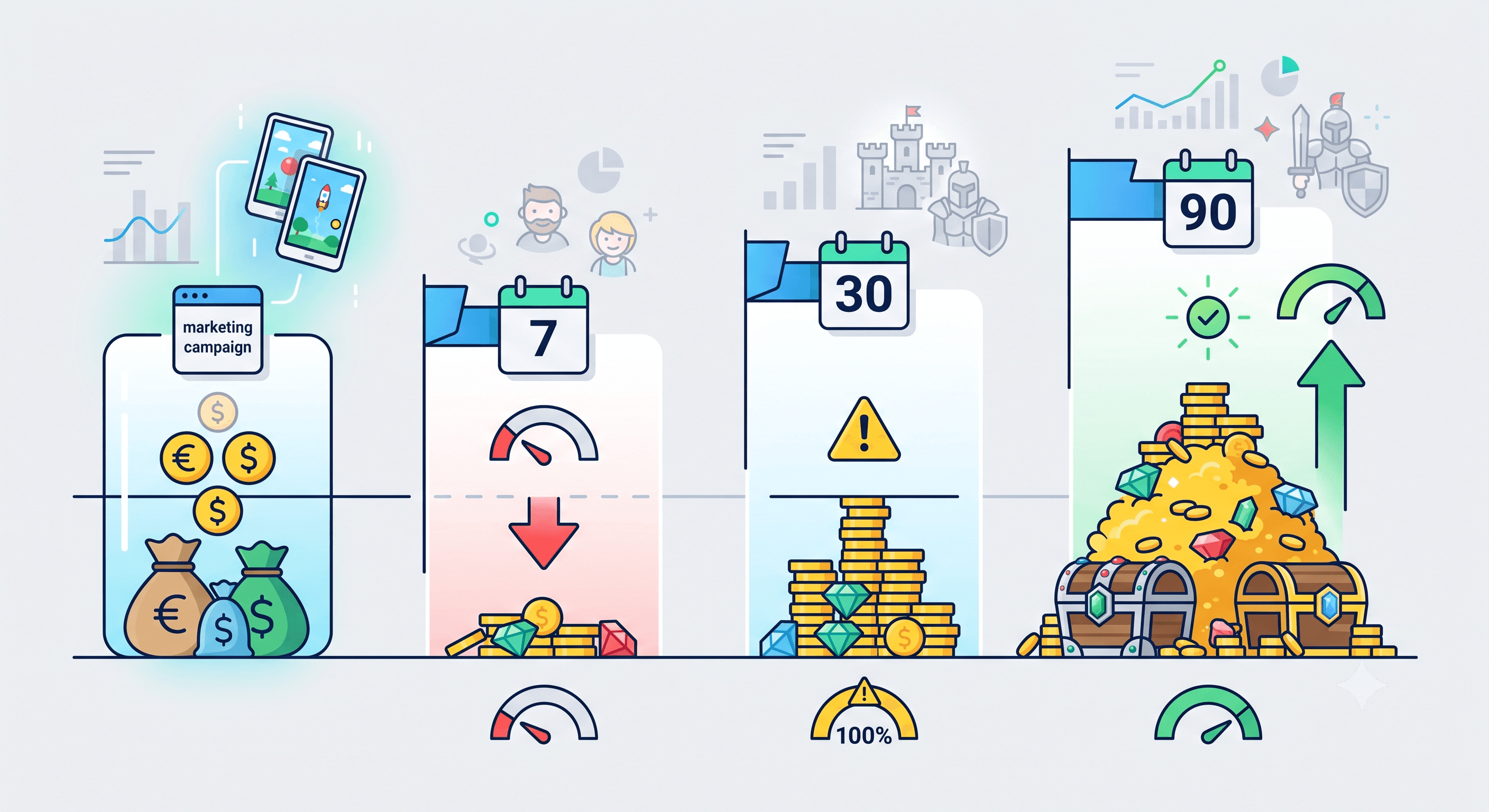
The playables that convert best at install are not necessarily the ones that retain users best at Day 30. And successful gaming studios know that prioritizing metrics such as LTV are more important than installs for the long term success of the game.
So today we're looking at playables that follow a different structure and uncover how those punishing playables help as part of the creative strategy to get the right users. Users that stay engaged in the real game after the first excitement of winning the playable has worn off.
What is a punishing playable?
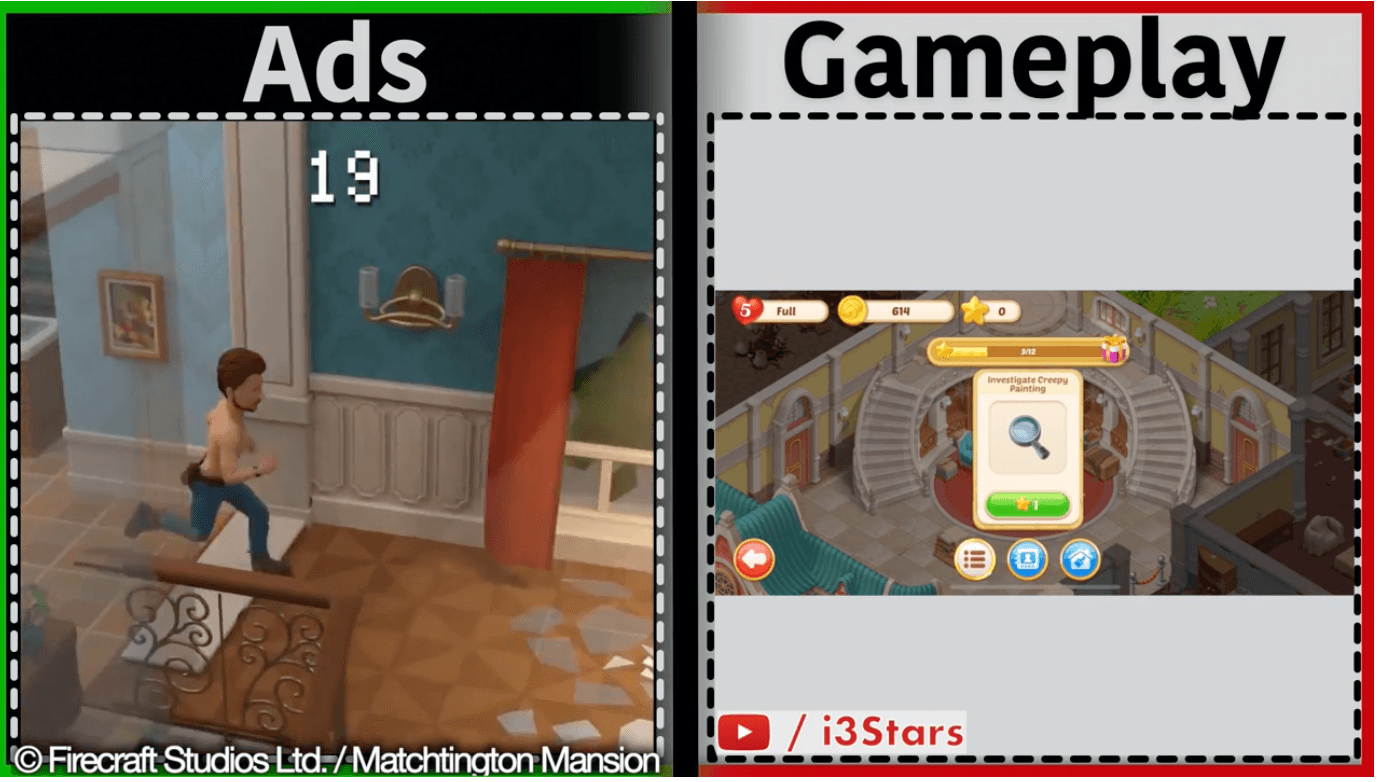
Matchington Mansion | Is it like the Ads? | Gameplay
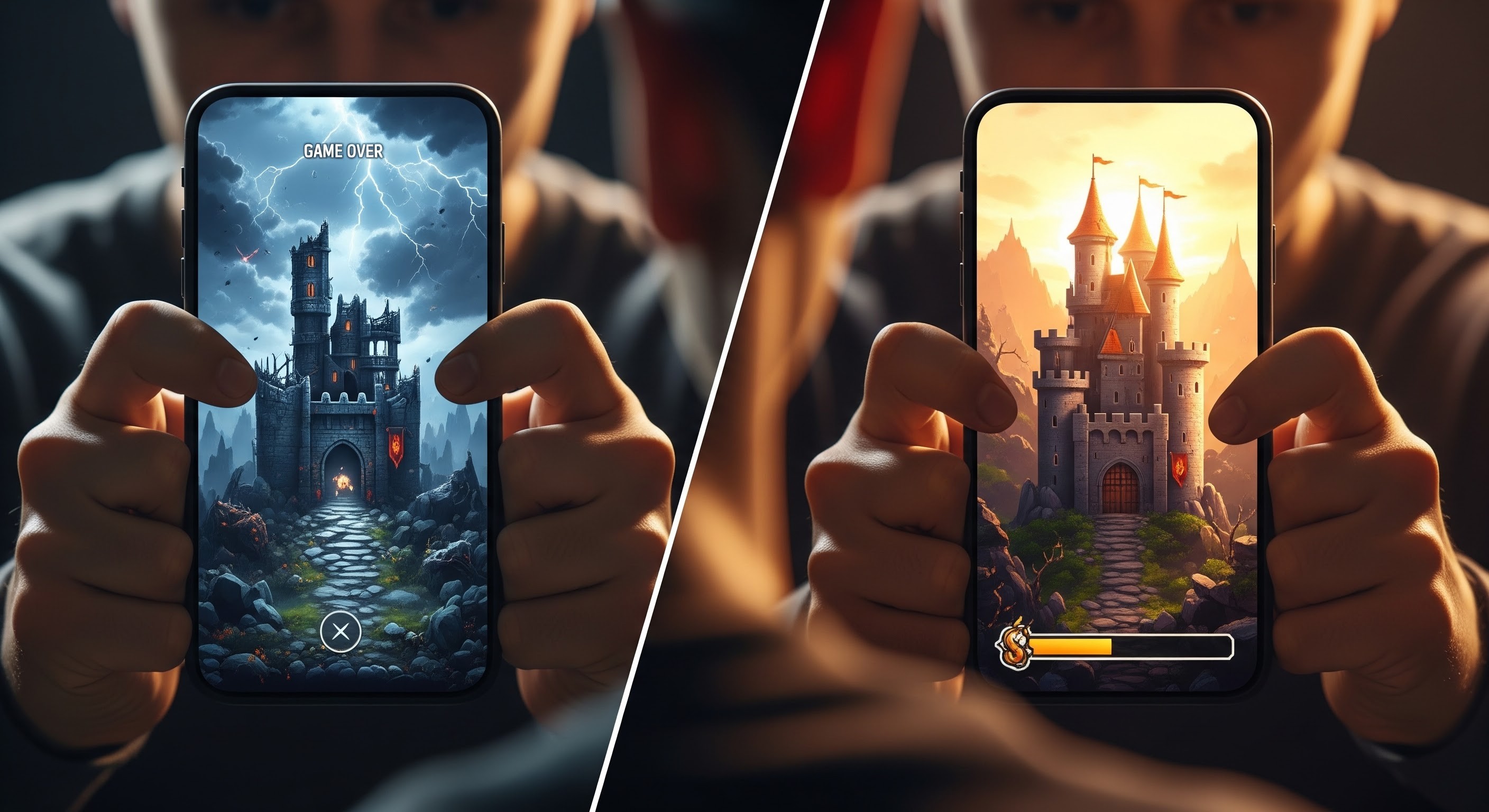
A punishing playable is a playable ad deliberately designed around a calibrated failure state that the user is likely to hit on their first attempt, and that gives them a clear reason to try again.
That does not mean the game mechanics are unbalanced, it also doesn’t mean it’s a frustrating experience. It is an honest preview of a difficult game (emphasis on difficult, as this methodology won’t work on every game), structured to filter users by intent rather than by curiosity. It’s creative targeting of a specific user group that has the highest chance of engagement in the long term.
The structure has four parts:
Seconds 0 to 10: Guided early win. Teach the core loop. Let the user succeed at the basic mechanic so they understand the controls and the goals.
Seconds 10 to 20: The decision point. Introduce a choice where the user's hyper-casual instinct, tap fast and react, leads them to fail.
Seconds 20 to 25: The diegetic loss. The failure is framed inside the game world, not as a system error. The game tells them what they did wrong.
Seconds 25 onward: The retry. A real and clean "Try Again" option, offered without pressure.
The timing matters.
The ideal playable ad length for this is around 20 seconds, the key is to immerse the player right from the beginning and come to the failure rather quick for another retry Revx.
A punishing playable stretches slightly past that window because the retry loop is the point, but the first failure still needs to land fast and land legibly.
Why do we need punishing playables?
Industry-average Day 1 retention is far below target
AppsFlyer benchmarks referenced across the industry suggest mobile games should aim for Day 1 retention of around 30%. In practice, median Day 1 retention sits at roughly 18 to 20%, falling to 3 to 4% by Day 7 and well under 1% by Day 30 Bestappstoday.
Hyper-casual retention is collapsing faster
Average Day 1 retention for hyper-casual games is under 25%, Day 7 drops below 8%, and by Day 14, only 2 to 5% of players typically remain SE-EN.
Strategy games sit at the hardest end of the curve
Strategy games have the lowest Day 1 retention rate at 25.3% Business of Apps, which should not be a surprise to anyone who has launched one.
What should be a surprise is how much of that churn is manufactured by us, the people making the ads.
When a 4X or RPG playable shows a user a simplified, guaranteed-win version of the game, we are not previewing the product, we are misrepresenting it. Day 1 churn is not a retention problem in that case. It is a creative problem where users' expectations and the actual game experience are not aligned properly. While it looks great for the upper funnel, aka installs and CTR of the playable, the churn is just pushed forward into the actual game.
What the endowment effect actually tells us
Playable ads benefit heavily from the endowment effect, the psychological principle that people value things more once they feel ownership. The idea of allowing users to interact with a game's core mechanics through playable ads fosters a feeling of ownership, making them more likely to convert because they have already begun to mentally invest in the game experience.
This is all great but there is a side of the endowment effect we almost never apply in creative strategy, and it is the more powerful one.
You do not own something by succeeding at it on the first try but sometimes rather by struggling with it. Our brain is hardwired to find solutions, to fix problems and to not stop until we get there. That emotional investment drives long-term retention, the kind that survives the Day 3 boss fight and the Day 7 paywall. Playables that made the user work, that tap into the grind of failure before win, of challenge before reward tap into this principle and filter out players that are up to the challenge.
The potential downside of punishing playables
Just to be clear, there is a difference between fake ads and punishing playables.
Fake Ads are advertisements for games that show gameplay completely unrelated to the actual game.
Punishing Playables are a subset of deceptive ads (often interactive) designed to be intentionally frustrating or impossible to solve.
The potential downside of fake ads is that;
“The cost of acquiring a user is already high enough when a publisher is finding the audience its game was built for. When that company is bringing in a flood of new users who signed up for a very different game experience based on a misleading ad, the average lifetime value of those users takes a hit.”- Brendan Sinclair, former editor of GamesIndustry.Biz
A punishing playable doesn't lie about what the game is, it simply adds a layer of difficulty.
The 3 Pillars of Punishing Playables
Built correctly, the punishing playable rests on three strategic pillars. Each one inverts a default assumption of traditional playable design.
Pillar 1: The "Rage-Quit vs. Determined" metric
Traditional playables measure success by IPM & CTRs. Punishing playables measure success by retry behavior + retention of the user in the actual game.
Retry rate is the percentage of users who voluntarily choose to play again after failing inside a playable ad. It is the single clearest in-ad signal of user intent for mid-core games, and it splits your audience into two cleanly separated cohorts:
Rage-quit users. They hit the fail state, feel friction, and leave. They do not retry. They were never going to retain in your game, and the playable has saved you the CPI.
Determined users. They hit the fail state, read what went wrong, and tap "Try Again." They are telling you, inside the ad, that they will engage with difficulty.
The tactical recommendation that follows is counterintuitive: do not surface the App Store CTA on the first failure, or even the second. Push it only after the user's third genuine attempt.
Three retries is the threshold where intent stops looking like curiosity and starts looking like commitment. We have seen retry behaviour correlate more tightly with Day 7 retention than almost any other in-ad signal we track.
A user who retries three times is not just driven by curiosity. They are already playing your game, that means the install following after is a formality.
Pillar 2: Setting the skill floor
Every mid-core game has a skill floor, the minimum level of engagement, patience, and strategic thinking a player needs to make it past the first real difficulty spike.
For a 4X, that is understanding resource trade-offs.
For an RPG, it is committing to a build and living with the consequences.
For a strategy game, it is accepting that the first three decisions will shape the next three hours.
Traditional playables hide the skill floor. They show users a version of the game that has no floor at all, because the playable is designed around a guaranteed win. The user installs expecting the experience they saw in the ad, and the actual game delivers something fundamentally different. This is the creative root of the Day 1 churn cliff.
A punishing playable does the opposite. It teaches the core, punishing & grinding loop of the real game inside the ad itself. The user loses their castle, the way they will lose their castle in the actual product. They feel the weight of a bad decision and they see that the game has depth and consequences.
This honest-preview principle does two jobs at once.
It filters out users who were never going to tolerate the skill floor, and
It pre-trains the users who will.
By the time a determined user installs, they have already accepted the terms of the game. Day 1 is no longer a shock. It is a continuation of what they already chose and know.
Pillar 3: Sacrificing volume for LTV
The number every creative strategist needs to make peace with: a well-designed punishing playable can drop install volume by roughly 30% compared to a traditional guided-win variant.
To repeat as it hurts: 30% fewer installs!
That is the trade-off and there is no version of this strategy that avoids it. The way you need to see it is using punishing playables as part of your toolbox, but not as standalone saviour of your retention. Think of it as laser focussed targeting that was once possible on all social media platforms, now carried in an interactive creative and through certain playable mechanics.
What you get in exchange is the half of the equation that actually pays the bills. In our testing, punishing variants have produced Day 30 retention lifts in the 40 to 50% range against control, with ARPDAU moving proportionally.
The install-volume loss is concentrated almost entirely in users who would have churned before monetisation ever engaged. The retention and revenue lift is concentrated in the users your game was built for.
The right way to read this trade is not in raw CPI. It is in effective CPI against qualified installs:
Traditional variant: 100 installs at €3 CPI = €300 spend. If 5% reach Day 30 and any meaningful monetization event, you have paid €60 per qualified user.
Punishing variant: 70 installs at €3 CPI = €210 spend. If 10% reach Day 30 at similar monetization intensity, you have paid €30 per qualified user.
Fewer installs. Half the effective cost per user who actually matters. And a cohort that keeps compounding rather than bleeding out by Day 7.
Why 2026 makes this non-optional
Two forces have converged to turn this from a creative preference into a strategic requirement.
The first is privacy attribution.
With Google's Privacy Sandbox and SKAN 5.0, marketers must rely on probabilistic attribution models to track performance without violating privacy laws. In a world where we cannot follow a user from install to LTV with precision, the creative itself becomes the attribution signal. In-ad behaviours, retry rate, time-to-failure, dwell time on the failure screen, are now among the most reliable quality signals we have. A playable that cannot distinguish a hyper-casual user from a mid-core user inside the ad is a playable that cannot be trusted to deliver quality cohorts in a privacy-restricted world.
The second is market maturation.
Following the financial turmoil experienced by most gaming studios in 2023, playable ads have not only recovered but reached new heights, with a 2025 performance score 16% higher than 2024's.
This recovery is attributed to better ads plus smarter targeting and the evolution from "tap fakes" to actual mini-game experiences. Session lengths of up to 7min are now accepted and users love this deep dive into the game experience without any (time) limits AppAgent.
The market is no longer rewarding deception, it is rewarding honesty at scale in creatives. The punishing playable is part of a new wave of real gameplay in playables.
The strategist's takeaway
If you run UA or creative strategy for mid-core to hard-core games and you are not currently testing punishing variants against your control, you are leaving quality on the table. The test is cheap to set up and the variants are easy to produce. The risk is bounded, because you can cap spend on the experimental cohort and compare Day 7 and Day 30 retention against your baseline within a standard testing window.
The best creative strategy in 2026 is not about getting more users to install. It is about getting the right users to install, and being willing to let the wrong ones walk away.
Use your playables as targeting tools and see the positive impact made in the creative happening in your game afterwards.
Make them lose and see who comes back; those are the users worth paying for.
Related Articles