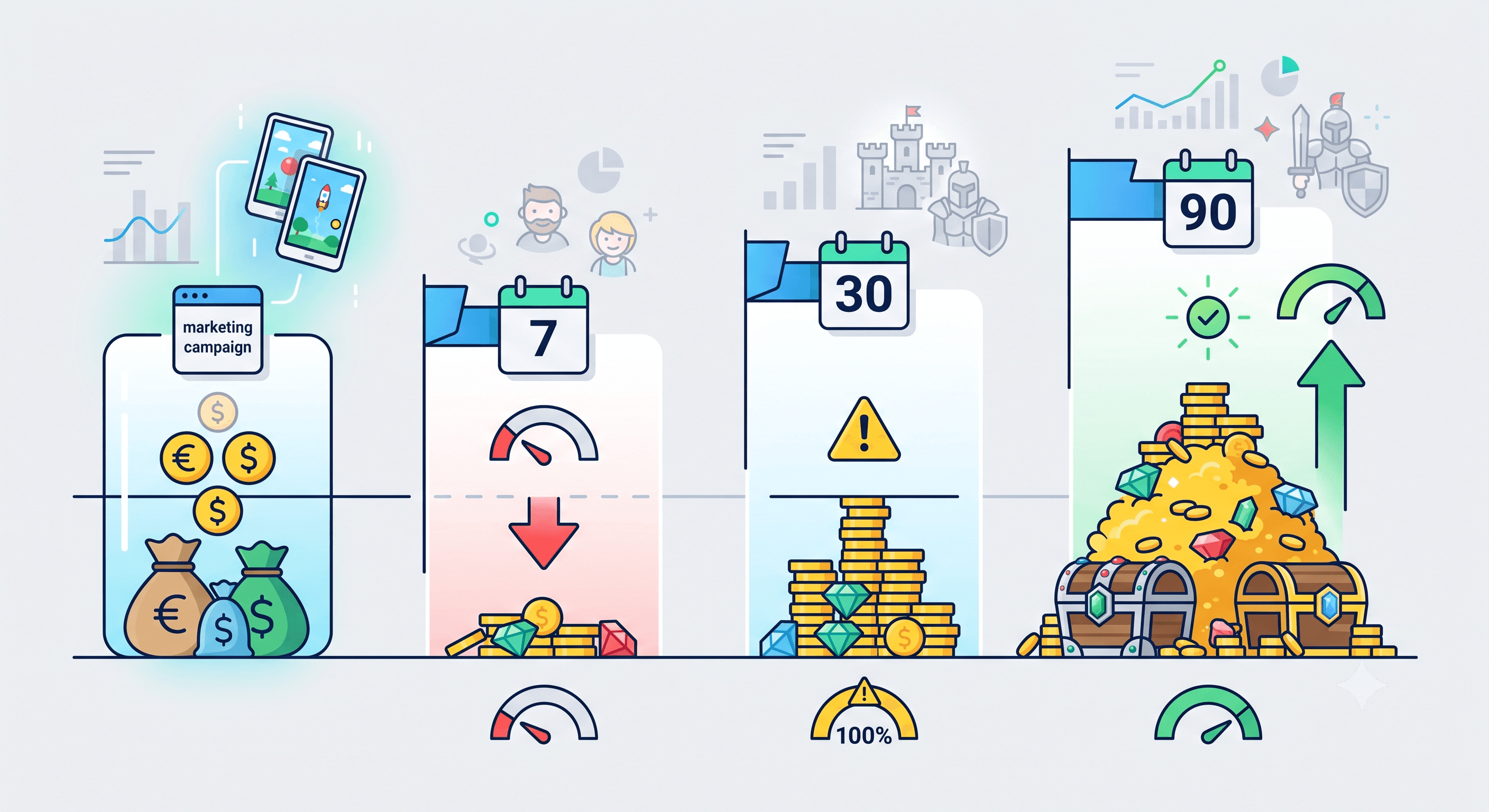
Mobile game retention is the number that determines whether your UA investment builds a business or burns a budget. Every day a player keeps coming back increases their Lifetime Value (LTV), which is the total revenue a player generates over the time they spend in your game, and LTV is what decides whether your cost to acquire that player was worth it.
Your CPI can look fantastic and your UA can still be failing.
Why? Because an install isn't the goal. It's what happens after the install.
If someone downloads your game, plays for ten minutes and never opens it again, you haven't really acquired a customer. You've bought an install.
Retention is where you start to see whether the game is actually delivering on the promise your UA made.
And this is where things get interesting for UA teams.
A bad D1 doesn't always mean the game is bad. It might mean the ad promised the wrong thing. A weak D7 might point to the core loop. A D30 problem might have very little to do with acquisition and everything to do with the lack of content waiting for players once the initial novelty wears off.
The retention number matters. But the pattern behind the number matters more.
This guide looks at what D1, D7 and D30 actually tell you, why players leave, which retention strategies are worth investing in, and how UA and product teams can work out who needs to fix what.
Key takeaways
Mobile game retention is the single most important metric that determines whether paid UA generates compounding return. Low D1 and D7 figures make every future campaign more expensive because ad network algorithms optimize toward LTV, not installs.
D1, D7 and D30 tell you different things. Don't treat retention as one number.
Retention is a UA diagnostic as well as a product metric. Segment it by channel, creative, market and cohort before deciding what needs fixing.
Onboarding is the most important retention lever the marketing team influences indirectly. If the ad sets the right expectation and the first session delivers on it, D1 improves.
Monetization and retention are connected. Aggressive monetization can create short-term revenue while damaging the player experience and increasing churn.
There is no universal “good” retention rate. Benchmarks vary by genre, platform, market and game.
The best retention strategies give players a reason to return. Rewards can help, but long-term retention depends on the core loop, progression, content, social systems and LiveOps.
Marketing and product need to look at retention together. The useful question isn't simply “Is retention bad?” It's “Where is retention breaking down, and why?”
What is player retention?
Retention is simply the number of players who keep returning to the game. As Anton Slashcev outlines in his Mobile Game Retention Cheatsheet:
Retention isn’t just about keeping players; it’s about creating an experience they can’t get enough of.

Installs tell you whether a campaign generated interest. Retention tells you whether the game delivered on it.
High retention means increased Lifetime Value, better user acquisition ROI, and stronger community and virality. Engaged players often invite friends to play together in multiplayer games, creating organic growth through social interactions.
The most commonly tracked points are:
D1 retention: Did the player return the following day?
D7 retention: Did the player return a week later?
D30 retention: Did the player return roughly a month later?
But D1, D7 and D30 aren't just three versions of the same metric.
They tell you different things.
D1: Did we give the player a good enough first experience to come back tomorrow?
D7: Was there enough here to turn initial interest into a habit?
D30: Is this game still giving the player a reason to be here a month later?
That's why looking at one retention number in isolation can be misleading.
Imagine your D1 is 30%. Great. It looks healthy against your benchmark.
But if D7 falls off a cliff, you have a very different problem from a game where D1 is mediocre but D7 and D30 hold up once people get through the first few sessions.
The curve tells the story.
Why should UA teams care about retention?
Because the people you're buying are not all worth the same.
Two campaigns can produce exactly the same number of installs at exactly the same CPI.
One might bring in players who disappear within 48 hours.
The other might bring in players who are still playing three weeks later.
Which one would you rather scale?
This sounds obvious, but it's surprisingly easy for UA teams to get trapped in install-level metrics. CPI is visible, immediate and easy to compare. Retention takes longer and forces you to look at what happens downstream.
That's precisely why it matters.
If a particular creative gives you cheap installs but terrible D7, it isn't necessarily a great creative.
It might just be a cheap way of buying the wrong users. Which is an important distinction when you're trying to scale.
What are good mobile game retention benchmarks?
Retention varies by genre, platform, market and game.
According to GameAnalytics' 2025 Mobile Gaming Benchmarks, median D1 retention across mobile games is around 22%, while the top 25% of games reach roughly 31–33% on iOS.
But don't take 22% and immediately decide that your game is healthy or unhealthy.
A puzzle game, a casino game and a midcore RPG have very different retention curves. Geography matters too. AppsFlyer's benchmark data has shown meaningful differences between markets, including particularly strong long-term retention in Japan.
So when you're benchmarking, start with:
your genre
your platform
your target markets
your business model
your previous cohorts
and, critically, your acquisition source
Your own historical cohorts are often more useful than a generic industry average.
If your D7 is 8% and your genre benchmark is 10%, that's useful context.
But if you've been consistently at 12% and suddenly drop to 8%, that's a much bigger signal, even if 8% happens to sit close to an industry benchmark.
Why do players leave after the first session?
The first session has an unfair amount of responsibility.
You've got a few minutes to convince someone that this game is worth their time.
And there are a lot of ways to get it wrong.
The tutorial is longer than the game
Okay, that's an exaggeration.
But we've all seen games where you spend five minutes being told how to play before you're allowed to actually play.
Players don't install a game because they want a tutorial. They install it because something made them curious.
Get them to the fun as quickly as possible.
Look at:
time to first meaningful gameplay
tutorial completion
tutorial abandonment
first-session duration
progression through the first few levels
If players are leaving before they've experienced the core mechanic, you don't have a D30 problem.
You have a first-session problem.
You ask for an account before giving players a reason to care
Account creation can be necessary. But if the first thing a new player sees is a registration screen before they've even experienced the game, you're asking them to make a commitment before you've given them anything in return.
Where possible, let players experience the game first.
Then give them a reason to register.
You ask for push permission immediately
Same problem.
“Would you like to receive notifications?”
Why would they?
They've been in your game for 30 seconds.
Push notifications can be incredibly useful for re-engagement, but timing matters. Give players a reason to care first, then use notifications to bring them back when there is something genuinely worth returning for.
You make the game difficult too quickly
Challenge is part of what makes games fun.
Frustration isn't.
If a player hits a difficulty spike before they've learned the mechanics or built enough confidence to overcome it, they may simply decide the game isn't for them.
Don't just look at overall D7.
Look at where players stop playing.
If there's a sudden drop at a particular level, mechanic or progression point, you've got something much more actionable than “D7 is bad.”
The ad promised one game and you delivered another
This is one of the most overlooked retention problems in UA.
Your creative doesn't just acquire the player.
It sets their expectations.
If the ad shows a puzzle mechanic that barely exists in the actual game, don't be surprised when those players leave.
You can have a perfectly respectable install rate and disappointing D1 simply because the people clicking were expecting something else.
That's not necessarily a targeting problem.
It's an expectation problem.
This is also why fake ads aren't just a creative debate. If the creative gets someone into the game under false pretences, the damage can show up downstream in retention.
How does monetization affect game retention?
This is the connection that most retention guides and most monetization guides treat as separate topics, but they belong together.
If progression is too fast, players have few reasons to spend.
If it is artificially slow, frustration increases churn.
The mechanics that affect retention most directly are in-app purchase design, advertising frequency, and how subscriptions or battle passes are structured.
The goal is to create a game people actually want to keep playing and give them sensible opportunities to spend.
In-app purchases
Free players need to feel that they're still playing a game, not waiting to be allowed to play one.
If the non-paying experience feels deliberately crippled, you'll eventually lose players who might have become payers — as well as the wider community around them.
Progression needs a balance.
If it's too fast, players can run out of meaningful goals.
If it's artificially slow because the game is constantly pushing players towards payment, frustration increases.
The best monetization systems tend to make spending feel like an optional acceleration or enhancement, rather than a toll you have to pay to keep playing.
Advertising frequency
More ads can mean more revenue.
Until they mean fewer players.
Increasing in-game ad volume drives short-term revenue but erodes session length and retention when overdone. Rewarded video, where watching is always the player's choice and tied to clear in-game value, consistently outperforms forced interstitials for both revenue and long-term retention.
Watch revenue and retention together.
A short-term increase in ad revenue isn't necessarily a win if D7 drops as a result.
Subscriptions and battle passes
Recurring products can create another reason for players to keep coming back.
A battle pass, for example, gives players another progression track and a reason to keep playing through an event or season.
A subscription can work in a similar way when the value accumulates over time.
But the same rule applies:
If monetization makes the game less enjoyable, it eventually becomes a retention problem.
What mobile game retention strategies actually work?
There isn't one retention feature that works for every game.
The right answer depends on where players are dropping out and why.
That's why I'd be wary of any retention checklist that says every game needs streaks, push notifications, guilds, and a battle pass.
Maybe it does.
Maybe it doesn't.
Start with the problem.
Then choose the lever.
1. Improve onboarding
Start by reducing the distance between install and meaningful gameplay.
Test:
shorter tutorials
different tutorial flows
earlier access to core mechanics
clearer first-session goals
different onboarding messages
different points at which you introduce monetization or notifications
Don't assume the solution is simply “make the tutorial shorter.”
Find out where people are leaving.
2. Give players a reason to come back tomorrow
Daily rewards and streak mechanics can be effective, particularly during the first week.
A reward that increases over consecutive days creates a reason not to break the streak.
But there's a catch.
If the reward is the only reason someone opens the game, you haven't really solved the retention problem.
You've rented their attention.
The stronger approach is to use rewards to reinforce something the player already enjoys doing.
3. Give players reasons to play with other people
Guilds, clans, friend systems, leaderboards, co-op gameplay and competitive events can all create stronger reasons to return.
Once you've made friends inside a game, your motivation changes.
You're no longer just deciding whether the game is fun.
Someone else might be waiting for you.
That is a very different retention mechanic from a daily login bonus.
4. Make progression feel meaningful
Players need to feel that their time is going somewhere.
That might mean:
unlocking characters
developing an account
improving skills
completing collections
building a world
reaching competitive milestones
unlocking new content
The key word is meaningful.
Stretching progression for the sake of making players grind longer isn't the same thing as creating depth.
5. Keep giving players something new
This is where LiveOps becomes important.
Events, challenges, seasonal content, competitions and limited-time activities can give players a reason to come back and see what's changed.
A functioning LiveOps calendar isn't just a content team's schedule.
It's part of the retention strategy.
If the game looks exactly the same every time a player opens it, eventually they have less reason to open it.
6. Keep the game technically stable
It's easy to talk about psychology, rewards and progression and forget the most boring reason people leave:
The game doesn't work properly.
Crashes, bugs, long loading times and downtime can destroy retention regardless of how good the game design is.
If retention suddenly changes after an update, check technical performance before assuming the underlying game has suddenly become less appealing.
7. Use push notifications properly
Push can bring players back.
It can also annoy them into uninstalling.
The difference is usually relevance.
Instead of sending the same message to everyone, consider triggers based on:
unfinished progression
rewards becoming available
events starting
resources being replenished
social interactions
limited-time opportunities
The goal isn't to remind players that your app exists.
Give them a reason to open it.
Retention strategies at a glance
Strategy | Primary impact | Cost | Scales with team size? |
A/B-tested onboarding | D1 | Low | No |
Daily/streak rewards | D7 | Low | No |
Behavioural push notifications | D1–D7 | Low | No |
Progressive content depth | D30 | Medium | Yes |
Social features | D30 | High | Yes |
Structured LiveOps events | D30 | Medium–High | Yes |
The table is useful as a starting point, but don't read it as a priority list.
If D1 is broken, don't spend six months building a guild system because someone told you social features improve D30.
Fix the problem you actually have.
Aerthlings: A Different Kind of Retention Loop
What Is ÆRTHLINGS? A Real-World Collecting & Trading Game
Retention doesn't always come from another daily reward, push notification or LiveOps event.
Sometimes the strongest retention mechanic is built into the experience itself.
Hubapps worked with Joe and the team at Modern Games, the studio behind Aerthlings, on their US growth push from a UA perspective.
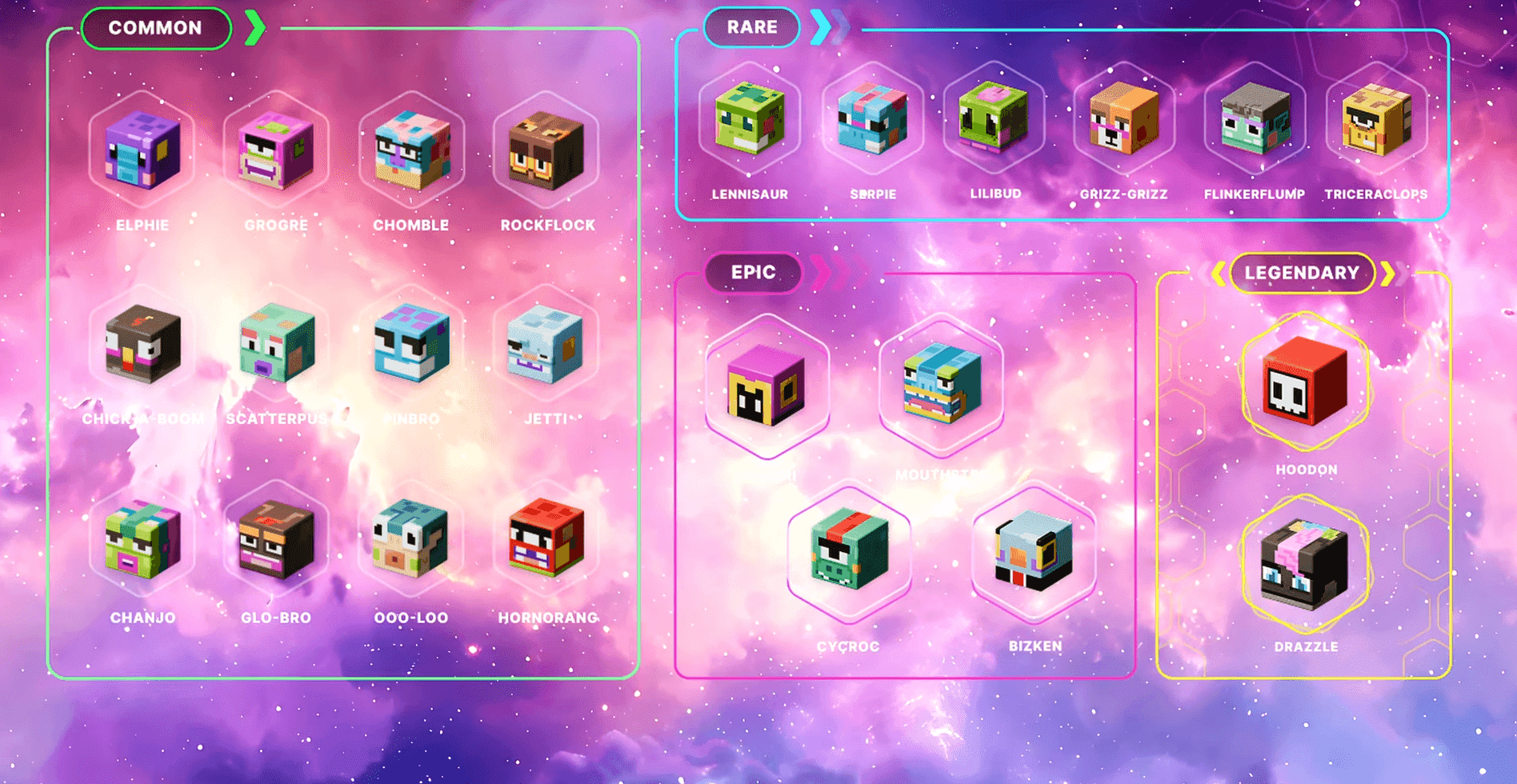
Aerthlings pairs a mobile RPG and collectible game with NFC-enabled physical figures made in collaboration with Moose Toys: buy a collectible, tap it to your phone, and it unlocks and expands your in-game world.
That mechanic is a genuinely different kind of loop than most of the levers covered above.
A digital-only collection system gives players a reason to return to the app.
A collection system tied to a physical object gives them a reason that persists outside the app entirely.
It's on a shelf.
It's at a convention.
It's something you can show another collector.
It's something you can talk about with someone who plays the same game.
That is a very different relationship with a mobile game.
The early traction is notable. Aerthlings has reached roughly 70,000 installs across iOS and Android with a 4.9-star App Store rating. Its companion animated series has also passed 4 million views across 10 episodes on YouTube.
At the game's US launch at PAX East in Boston, it also earned an Apple feature on iOS — a meaningful outcome for an independent studio introducing a new IP into one of the most competitive markets in mobile gaming.
As Aerthlings CEO and co-founder Justin Kifer puts it:
“Mystery boxes are all about the thrill of unboxing, but then the experience is over. Toys-to-life games have this magic moment where physical meets digital and their worlds converge. We spent years asking why nobody had built something that did both, so we built it ourselves.”
Retention isn't just about finding more ways to bring players back. It's about giving them reasons they want to come back.
How does the UA team's work affect retention?
More directly than many UA managers acknowledge. UA doesn't control the entire player experience. But it controls who enters the experience, and what they expect when they get there.
Traffic source quality
Different acquisition sources can produce very different user behaviour.
A user acquired through rewarded traffic or an offerwall may behave very differently from someone acquired through a highly targeted video campaign.
That's why looking at CPI alone can be dangerous.
Segment retention by source. You may just find that your cheapest source is also your weakest source once you look at D7 or D30.
Creative-to-gameplay match
The creative is the player's first experience of your game. If it accurately represents the gameplay, the user arrives with an expectation the game can fulfil.
If it doesn't, you can end up paying for installs from people who were never a good fit.
Track retention by creative angle where possible.
A creative with a slightly higher CPI but substantially better D7 retention may be more useful than the cheapest creative in the account.
Market selection
Retention varies significantly between markets.
Before scaling into a new country, do your homework. Don't assume that because a game works in the US, the same retention curve will automatically transfer to another market.
Look at:
retention
monetization
acquisition cost
uninstall behaviour
player demographics
platform mix
And compare like with like.
Know when the problem isn't UA
This is probably the most important point in the entire article.
If retention is weak across every source, creative and market, changing the campaign probably won't fix it.
If retention is strong from one source and terrible from another, that's a very different problem.
UA teams need to be willing to say:
“This isn't an acquisition problem.”
And product teams need to be willing to say:
“This isn't a traffic problem.”
That's how you actually get somewhere.
Use retention to work out who needs to fix what
Don't just ask: “Is our D7 too low?”
Ask: “Where is the drop happening, and is it happening everywhere?”
Signal | Likely cause | Who should investigate? |
D1 weak across all sources and creatives | Onboarding / first-session experience | Product |
D1 varies significantly by creative | Creative-to-gameplay expectation gap | UA / Creative |
D7 weak across all sources | Core loop / progression | Product |
D7 varies by acquisition channel | Traffic quality / audience fit | UA |
D30 weak regardless of campaign | Content depth / LiveOps / social systems | Product / LiveOps |
Retention changes after an update | Product or technical issue | Product / Engineering |
Retention is healthy but monetization is weak | Monetization design | Product / Monetization |
This is where retention becomes much more useful than a benchmark spreadsheet.
The number tells you that something is wrong.
The segmentation starts to tell you what might be wrong.
Mobile Game Retention Health Checklist
Before significantly increasing paid UA spend, I'd want to know:
D1, D7 and D30 retention baselines are established.
Those baselines are compared against the right genre, platform and market benchmarks.
Retention is segmented by acquisition source and creative.
The onboarding funnel has been reviewed from install to first meaningful gameplay.
Time-to-first-gameplay has actually been measured.
Early difficulty spikes have been identified.
Creative has been checked against the actual gameplay experience.
Push notifications have a clear re-engagement strategy rather than simply being switched on.
Monetization doesn't create unnecessary friction or prevent non-paying players from progressing.
Ad frequency has been tested against both revenue and retention.
There is a realistic LiveOps and content plan for the game's lifecycle.
Technical performance is being monitored alongside player behaviour.
Product, UA and LiveOps teams know who owns the fix when retention drops.
And one final check:
Don't scale spend simply because CPI looks good.
Make sure the users you're buying have a reason to stay.
Conclusion
Retention isn't a product-team metric that marketing waits on.
It sits at the intersection of the game experience, acquisition strategy, creative, monetization and LiveOps.
Getting D1 right means the first experience works.
Getting D7 right means the game has enough going for it to become a habit.
Getting D30 right means there's enough depth, content, social connection or ongoing activity to give players a reason to still be there a month later.
But don't get too hung up on the number itself.
The better question is:
Where are players dropping out, and why?
If D1 is weak across every source, investigate onboarding.
If D1 varies dramatically by creative, investigate the promise made by the ad.
If D7 is weak across every source, investigate the core game.
If D7 varies by channel, investigate traffic quality.
If D30 remains weak regardless of acquisition strategy, look at content, LiveOps and long-term engagement.
The studios that scale UA efficiently treat retention as a shared responsibility across product, marketing and LiveOps.
They don't just look at retention in aggregate.
They look at the cohorts AND the sources AND the creatives AND the markets!
And they use those differences to work out what needs fixing. Because when retention is healthy, UA has something worth scaling.
When it isn't, buying more users rarely fixes the underlying problem.
Looking to improve retention and scale your mobile game more efficiently? Let's talk.
FAQs on Mobile Game Retention
What is mobile game retention?
Retention is the percentage of players who return to a game after their first session, most commonly tracked at Day 1, Day 7, and Day 30. Installs tell you whether a campaign generated interest. Retention tells you whether the game delivered on it.
What's the difference between D1, D7, and D30 retention?
Each measures something different. D1 tells you whether the first session was good enough to bring someone back the next day. D7 tells you whether initial interest turned into a habit. D30 tells you whether the game is still giving players a reason to be there a month later. A game can look healthy on one of these and be failing on another, which is why looking at a single retention number in isolation is misleading.
What are good mobile game retention benchmarks?
According to GameAnalytics' 2025 Mobile Gaming Benchmarks, median Day 1 retention across mobile games is around 22%, with the top 25% of games reaching roughly 31 to 33% on iOS. These figures vary meaningfully by genre, platform, and market, so a studio's own historical cohorts are usually more useful than a generic industry average.
Why does retention matter more than CPI for UA teams?
CPI is visible and easy to compare, but it's a cost metric, not a value metric. Two campaigns can produce identical installs at identical CPI, and one can bring in players who disappear within 48 hours while the other brings in players still active three weeks later. A cheap install that churns fast isn't a good result, it's a cheap way of buying the wrong users.
How does monetization affect retention?
Aggressive monetization, offers at every turn, progress gated behind payment, excessive ad frequency, can generate short-term revenue while increasing long-term churn. The strongest monetization systems make spending feel like an optional acceleration rather than a requirement to keep playing, since a non-paying player who feels blocked or disadvantaged is a player you eventually lose along with the community around them.

Mobile gaming UA specialist since 2011. A female pioneer in the industry, Maria has scaled games across every major platform and genre, from indie puzzle games to massive strategy titles. Known for straight talk and results that actually matter.
Share
Related Articles