If you are evaluating in-game ads as part of your mobile marketing strategy, you are already asking the right questions. Mobile in-game advertising is no longer an experimental line item. It is one of the most scalable, cost-efficient, and audience-rich channels available to app marketers today , and it is still significantly underused relative to the time people actually spend inside mobile games.
In-game advertising on mobile places branded content directly inside the app experience; a branded banner between puzzle levels, a rewarded video before a player's next life, a playable ad running as an interstitial in a casual game. When the format and placement are right, these moments feel like a natural part of the experience rather than a disruption. That is what separates good mobile in-game advertising from bad.
This guide is written for marketers and UA managers who already understand the basics and are now focused on how to structure campaigns, choose the right formats, and measure results effectively.
At Hubapps, we work with mobile gaming publishers and advertisers every day, and in-game advertising is consistently one of the most underutilised channels we see in mobile UA media mixes.
TL;DR
Mobile in-game ads place branded content inside app experiences without breaking gameplay.
With mobile accounting for 55% of total gaming revenue and players logging 444.6 billion hours in 2025 (Adjust), the channel offers reach at a scale most marketers still underestimate.
Mobile offers a wider range of ad formats than most buyers realise, from rewarded video and playable ads to dynamic blended placements, interstitials, and banners. Each serves a different campaign goal and fits different game genres differently.
Genre fit and contextual creative alignment matter most when choosing a format. A format that belongs in the game experience performs; one that jars with it damages both the campaign and the brand.
Global in-game ad spend is projected to reach $11.5 billion by 2027 (Variety). As paid mobile UA costs continue to rise, in-game advertising is becoming a strategically important way to build brand awareness without inflating your CPI.
Measurement should go beyond impressions. Viewability, completion rates, engagement time, and brand lift studies are the tools that give you an accurate picture of what your mobile in-game campaigns are actually delivering.
Why the Mobile In-Game Advertising Opportunity Is Bigger Than Most Buyers Realise
Mobile gaming is not a niche. It is the single largest segment of the global games industry and one of the highest-attention digital channels available to marketers, yet it remains one of the most underspent relative to the time consumers actually give it.
Nearly three billion people play mobile games worldwide, representing around 80% of all gamers globally (Adjust Mobile App Trends report). These are not all hardcore players states the report. The majority are casual users who open a puzzle, simulation, or hypercasual game multiple times a day, in short bursts, across every demographic.
The commuter on the tube.
The parent waiting at school pickup.
The retiree playing word games after dinner.
Mobile gaming reaches all of them, in moments of genuine leisure, with their attention fully on the screen in their hand.
Mobile games are one of the few environments where that person is still genuinely receptive to advertising, provided it is done well.
444.6 Billion Hours
The total time players spent inside mobile games in 2025 , a 1% year-on-year increase , with mobile now accounting for 55% of total gaming industry revenue globally. (Adjust)
The Main Types of In-Game Ads on Mobile
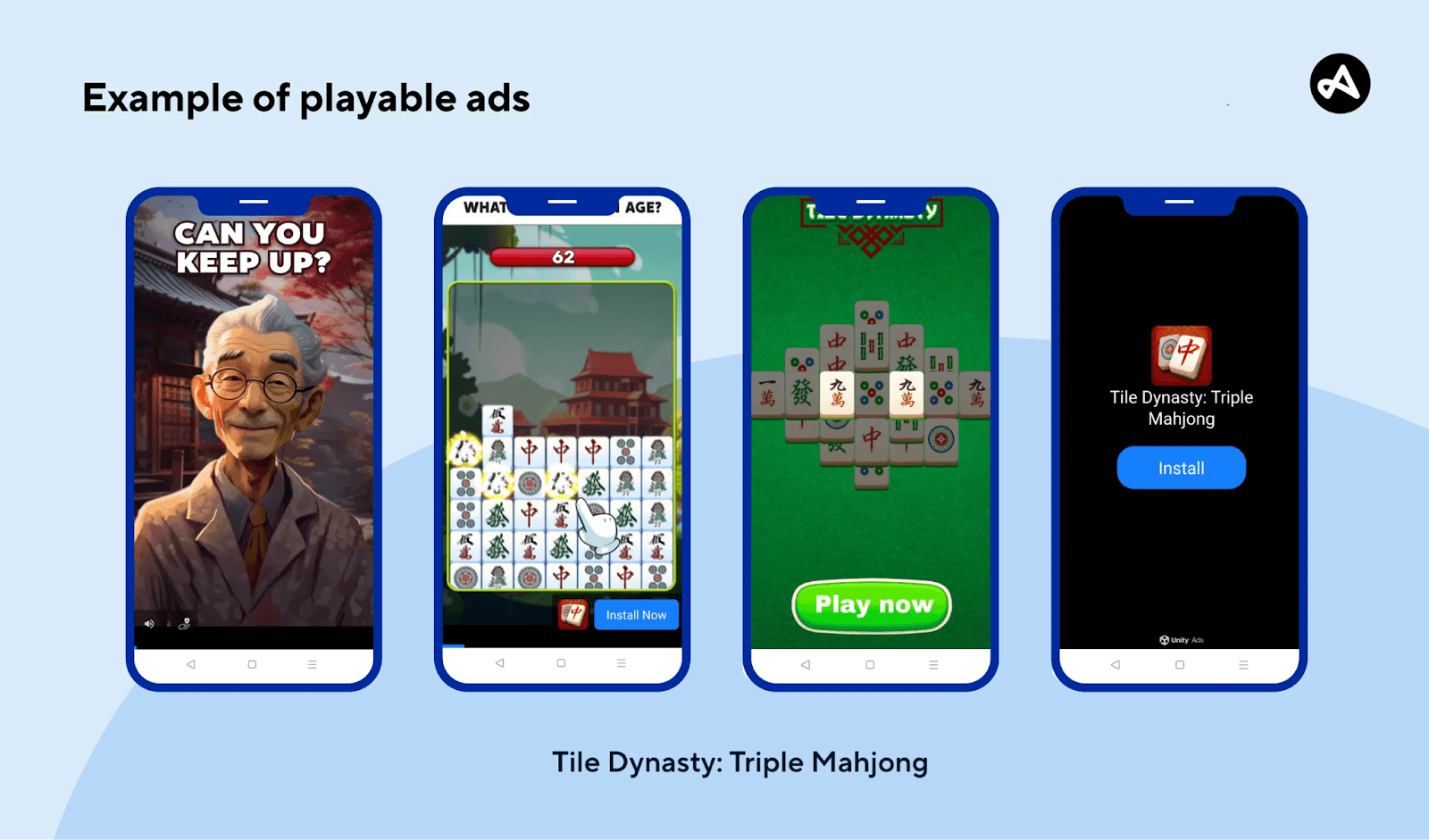
Examples on In-game ads (Adjust)
Mobile in-game advertising covers a significantly wider range of formats than most buyers explore when they first enter the channel. The format you choose will determine not just how your ad looks, but how it performs, how players respond to it, and what kind of campaign goals it can realistically support.
Format | How It Works | Key Strengths | Considerations |
Rewarded Video | Players opt in to watch a full video ad in exchange for an in-game reward , extra lives, in-game currency, power-ups, or continues. | Opt-in format produces exceptional completion rates and positive brand sentiment. Attention is genuine because the player chose to engage. Strong across casual, puzzle, hypercasual, and RPG genres. | Only works in free-to-play titles with an in-game economy and reward structure. Not applicable to premium mobile games or subscription-based apps. |
Playable Ads | Playable ads consist of a short, interactive mini-game lets users experience a simplified version of the advertised app before installing. Delivered as a full-screen interstitial unit. | The strongest intent signal of any mobile format. Users who install after completing a playable are pre-qualified , they have already tried the product. Day-1 retention rates are consistently higher than other formats. | Requires a custom playable build, not repurposed static or video assets. Higher production cost. Best suited to gaming and app advertisers rather than pure brand campaigns. |
Interstitial Ads | Full-screen video or display ads served at natural pause points in the game , between levels, on a game over screen, or during a loading transition. | Full-screen impact with no competing visual elements. High visibility. Widely available across mobile gaming networks and easy to activate programmatically. | Timing is everything. An interstitial mid-action feels like an interruption and generates skip behaviour and negative sentiment. It must land at a genuine natural break. |
Dynamic In-Game Placements | Branded assets consist of banners, billboards, or objects that are served in real time into designated spaces within the mobile game environment. Updated and targeted remotely via programmatic technology. | Contextually integrated and non-interruptive. Supports geo-targeting, demographic targeting, and seasonal creative. Multiple advertisers can rotate through the same placement without any game update required. | Requires specialist supply-side integration. Only works in titles built with dynamic ad placement support. Delivery depends on an active internet connection. |
Banner and Display | Static or animated banner units running persistently at the top or bottom of the game screen throughout gameplay. | Low cost, widely available, and easy to activate with standard creative assets. Useful for sustained brand visibility across high-volume casual and hypercasual inventory. | Lowest engagement of any mobile format. Banner blindness is significant in this environment. Best suited to frequency-based brand awareness at scale rather than performance goals. |
Static In-Game Placements | Branded assets are embedded directly into the game during development, a branded object, environment element, or in-world surface. Fixed and cannot be updated post-launch. | Always present, even without connectivity. Guaranteed impressions for the lifetime of the game. Works well for evergreen brand integrations where longevity is an asset. | Zero flexibility after launch. Creative decisions are permanent. Not appropriate for time-sensitive, seasonal, or campaign-specific messaging. |
Advergames | A mobile game built entirely around a brand or product, developed as a dedicated branded content experience for the App Store or Google Play. | Maximum brand immersion and interaction depth. Players actively engage with the brand for extended sessions. Highly memorable and shareable. | Significant production and distribution investment. Requires the brand to think like a game publisher. Audience reach depends entirely on the advergame's own UA effort. |
For most mobile marketers entering this channel, rewarded video, playable ads, and interstitials are the right starting point.
They are widely available, well understood by mobile gaming publishers, and they generate measurable signals without the production complexity of playable builds or advergames at scale.
Dynamic placements are worth exploring once you have baseline performance data and a clear read on which genres and titles are working for your audience.
How to Choose the Best Mobile In-Game Ad Format for Your Goal?

Fatma Gungor Okutan shares more from a Google perspective.
Format selection needs to follow campaign objective. This sounds obvious but it is one of the areas where mobile in-game campaigns most commonly underperform. The wrong format is often chosen because it is familiar, not because it fits the goal.
For mobile app user acquisition
Playable ads are the most powerful format available. A user who completes a playable and then installs is already engaged, already familiar with the core loop, and far more likely to be retained beyond day one than a user acquired through a static or video unit.
If you are a mobile game advertiser and you are not running playables, this is the highest-leverage creative investment you can make in this channel.
For brand awareness at scale
Rewarded video and dynamic in-game placements both work well for sustained brand exposure. Rewarded video delivers full-screen, full-duration attention across enormous volumes of daily active users in free-to-play titles.
Dynamic placements offer a more ambient, non-interruptive brand presence integrated into the game environment itself. The right choice depends on whether you want high-impact individual exposures or consistent low-friction brand presence over time.
For re-engagement and retargeting
Interstitials served at natural game transitions are well suited to re-engagement messaging, particularly in casual titles where lapsed users can be reached through in-app advertising networks.
The format's full-screen nature makes it effective for direct response creative, and the timing at a natural break reduces the friction that interstitials generate when they are poorly placed.
Genre fit is the variable most buyers underweight
Hypercasual and casual games, including puzzle, word, simulation, idle, and runner titles, are the environments where most mobile in-game advertising budget is most effectively deployed.
Sessions are frequent, audiences are broad, and the free-to-play model means that ad monetisation is a natural part of the player experience rather than an unwelcome interruption.
Mid-core titles like RPGs and strategy games have longer sessions and higher-value players, but require more careful creative integration to avoid breaking immersion. The principle is always the same: the ad needs to fit the context of the game, not just the demographic of the player.
Best Practices for Mobile In-Game Advertising
The principle that governs every well-performing mobile in-game campaign is this: earn the player's attention, do not steal it. Every format and placement decision should be evaluated against that standard.
Match the creative to the tone and aesthetic of the game
A high-energy, fast-cut video creative that performs well on social will feel out of place inside a relaxed puzzle game. Players in casual mobile titles are in a different mindset from users scrolling a feed , they are focused, slightly absorbed, and highly attuned to anything that disrupts the experience. Creative that matches the visual register and pace of the game it appears in consistently outperforms generic digital creative repurposed from other channels.
Use rewarded formats as your default opt-in unit
Whenever the game's monetisation model supports it, rewarded video should be the primary format of choice. The opt-in mechanic is not just a courtesy , it is a performance driver. Players who choose to engage with your ad are a fundamentally different audience from players who have an ad forced on them, and the downstream metrics reflect that difference consistently.
Test on genre before you scale on volume
Running a focused test across two or three genre environments before committing significant budget is the single most effective way to avoid wasted spend in this channel. The performance delta between a well-matched genre placement and a poorly matched one is large enough that getting this right at the test stage pays for itself many times over.
Optimise for completion rate and viewability, not impressions
Volume metrics in mobile in-game advertising can be misleading. A banner impression in a hypercasual game where the player never looks at the bottom of the screen is worth considerably less than a rewarded video completion in a puzzle game where the player is fully present. Completion rate for video formats and viewability for display formats are the metrics that correlate with brand recall and downstream action , prioritise them from the start.
Build brand safety guardrails into your buying criteria
Know which app categories, content ratings, and game genres are appropriate for your brand before you activate, not after. Mobile gaming inventory spans everything from children's apps to mature-rated titles, and network-level defaults are not a substitute for explicit brand safety parameters. Set your inclusion and exclusion lists at the outset and review them as the campaign runs.
How to Measure Mobile in-game Ad Performance
Mobile in-game advertising now has a mature enough measurement framework that buyers should expect to be held to real performance standards, not just delivery metrics.
For video
For video formats, completion rate is the primary signal. A rewarded video that players choose to watch to completion is delivering genuine engagement. For display and dynamic placements, viewability , the percentage of impressions where the placement was actually in view for a meaningful duration , is the baseline quality metric.
Engagement matters
Engagement time matters particularly in mobile gaming because session lengths in many genres are substantial. A branded placement inside a puzzle game session that lasts twenty-five minutes has a fundamentally different value than a display impression on a content page with a two-second average time on site. Understanding the session context of your placements is part of understanding what your buy is actually worth.
Brand life measures real world impact
Brand lift studies remain the most reliable method for measuring real-world impact in this channel. Comparing awareness, recall, and sentiment scores between exposed and unexposed player cohorts gives you a direct read on what the campaign is doing at the brand level , something that click-through rates and install counts alone cannot tell you.
Link post-insteall to your MMP
For performance campaigns, post-install event tracking linked to your MMP (Mobile Measurement Partner) closes the loop between in-game ad exposure and downstream behaviour. This is particularly important for playable ad campaigns where the intent signal at ad engagement can be connected to day-1 retention, session depth, and in-app purchase behaviour.
Challenges Specific to Mobile in-game Advertising
Mobile in-game advertising is a high-quality channel but it comes with operational realities that differ from standard mobile display. Understanding these before you start will save time and budget.
Complexity
Supply path complexity is higher than in standard programmatic. Mobile in-game placements , particularly dynamic and blended formats , are typically delivered via specialist third-party SDK-based technology providers, not through standard display pipes. Not all DSPs have clean, transparent access to this inventory. Before activating, verify that your buying path clearly identifies in-game placements in the bid stream, and that you are not inadvertently buying mis-labelled or indirect supply.
The challenge of creating scale
Creative production requirements scale with format ambition. Banners and standard video units can be activated with existing assets. Playable ads require a purpose-built interactive build. Dynamic in-game placements may require assets sized and formatted to specific SDK requirements. Factor creative production into your timeline and budget from the planning stage, not as an afterthought.
Privacy challenges
Privacy and ATT consent directly affect targeting precision on iOS. As Apple's App Tracking Transparency framework (SKAN) continues to shape what signals are available, mobile in-game campaigns on iOS rely increasingly on contextual signals , genre, game category, creative relevance , rather than user-level behavioural data. This is not a barrier to performance, but it does mean that genre fit and creative quality carry more weight than they do in environments where granular audience targeting is available.
Audience mistmatch
Audience mismatch remains the most common and most preventable failure mode. The wrong game genre for your brand, or creative that is tonally mismatched with the app environment, will generate low completion rates, high skip rates, and in some cases active negative sentiment from players. The research required to map your audience to the right genre and title set is a small investment relative to the media spend it protects.
Bottom Line
At HubApps, we have seen mobile in game advertising deliver results across every stage of the funnel when it is set up with the right intent but in-game advertising only works when
the format fits the goal,
the creative fits the game,
and the measurement goes beyond impressions.
Get those three things right and mobile gaming inventory will consistently outperform most of what sits alongside it in a UA media mix. Get them wrong and you will spend budget generating skip rates and drawing the wrong conclusions about the channel.
Frequently Asked Questions About in-game Ads on Mobile
What are in-game ads on mobile?
Mobile in-game ads are advertisements served within the environment of a mobile game app. They include rewarded video units, playable ads, interstitials, banner placements, and dynamic in-game placements integrated directly into the game world. Unlike traditional mobile display advertising, in-game formats are designed to fit within the flow and context of the gameplay experience rather than interrupting it , which is what drives the higher attention and completion rates that make the channel valuable.
What is the difference between rewarded video and interstitial ads in mobile games?
Rewarded video is an opt-in format: the player chooses to watch a full video ad in exchange for an in-game reward such as extra lives, currency, or items. Interstitials are served at natural transition points in the game , between levels or on a game over screen , and are typically not opt-in. Rewarded video consistently produces higher completion rates and better brand sentiment because the player is choosing to engage. Interstitials deliver higher raw volume and full-screen visibility, but their performance depends heavily on being served at a genuine natural pause in-gameplay rather than forced mid-session.
Are in-game ads effective for mobile app user acquisition?
Yes, particularly playable ads. A user who engages with a playable ad and then installs has already experienced the core loop of the app, which produces meaningfully stronger day-1 retention compared to installs driven by static or video units. Rewarded video and interstitials function more as mid-funnel brand and awareness drivers, building reach among audiences that are difficult to capture cost-efficiently through paid social or search. For UA teams running mobile campaigns, combining playables for acquisition intent with rewarded video for scale is a strong starting framework.
Which mobile game genres work best for in-game advertising?
Hypercasual, casual, puzzle, simulation, and idle games consistently deliver the strongest results for most mobile in-game campaigns. These genres have high daily active user volumes, free-to-play monetisation models where ad exposure is a natural part of the experience, and broad demographic reach. Mid-core genres such as RPG and strategy offer higher-value and more engaged players but require more careful creative integration to avoid breaking immersion. The best genre for your campaign depends on your audience, your creative approach, and your campaign objective.
How do I measure the performance of mobile in-game advertising campaigns?
The right measurement framework depends on your campaign goal. For brand campaigns, viewability, completion rate, and brand lift studies , comparing awareness and recall between exposed and unexposed player cohorts , are the most meaningful metrics. For performance campaigns, post-install event tracking via your MMP connects in-game ad exposure to downstream behaviour including retention, session depth, and revenue. Impression volume alone is not a reliable indicator of campaign quality in this channel , the context and duration of each exposure matter as much as the number.

Mobile gaming UA specialist since 2011. A female pioneer in the industry, Maria has scaled games across every major platform and genre, from indie puzzle games to massive strategy titles. Known for straight talk and results that actually matter.
Share
Related Articles