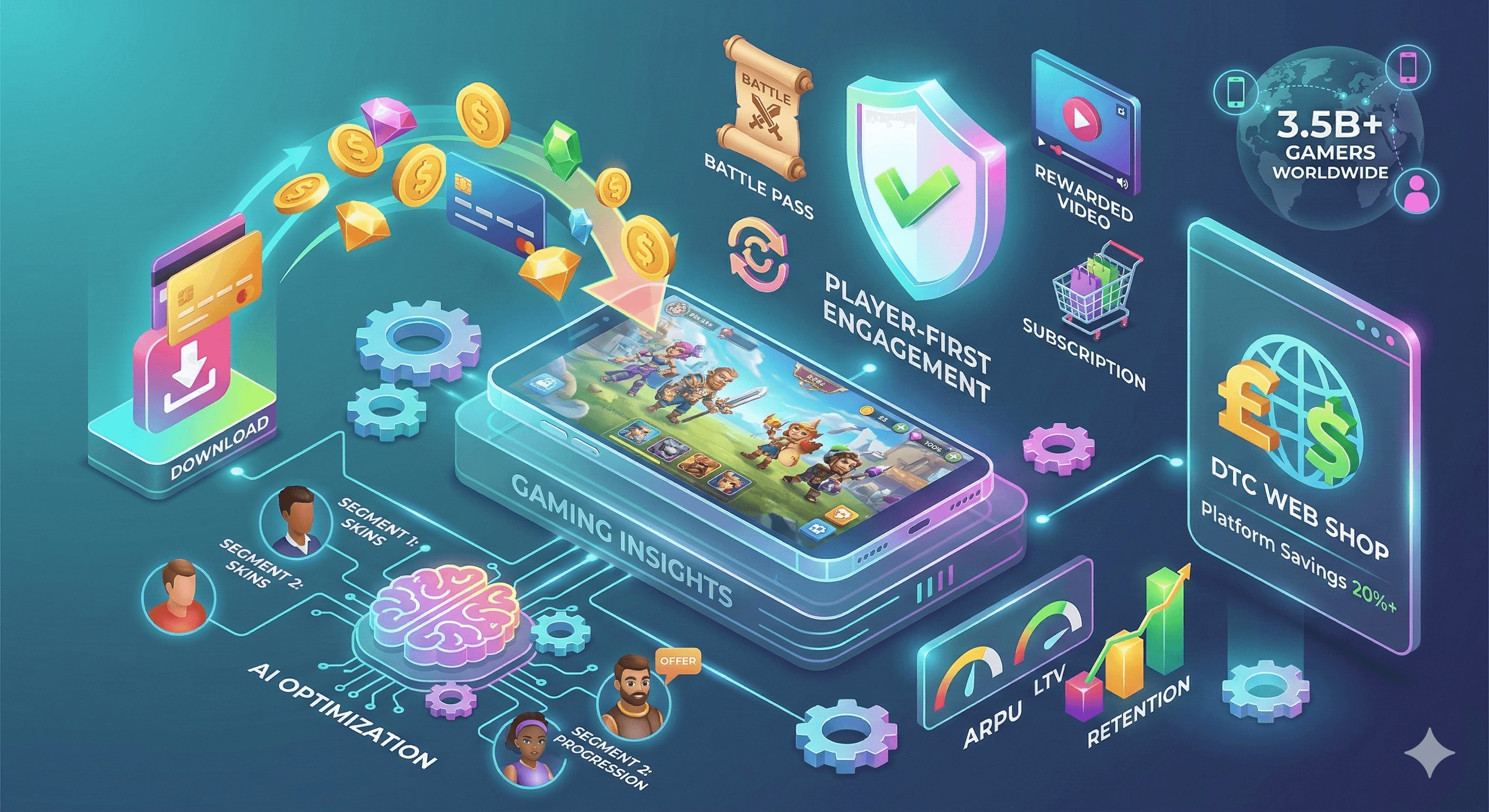
Mobile gaming is the video gaming sector where players spend the least, and the majority of mobile gamers play free-to-play, 71% (Newzoo). So how exactly does mobile game monetization work and what are some potential strategies for studios?
Because monetization does work! Just check out the stats below; in 2025, mobile games generated roughly $82 billion in in-app purchase revenue alone.
This isn’t a market where you can slap a few banner ads on a hyper casual game and expect to retire early. With over 3.5 billion mobile gamers worldwide (Prioridata, 2025), competition for attention and spending is fierce.
The good news?
There are more tools, strategies, and proven models available today than at any point in the industry’s history. The challenge is knowing which ones to use and when.
In this guide, we break down every major monetization model, explore the strategies that are actually driving results right now, and answer the real questions studios and marketers have about mobile game revenue.
Key Takeaways;
What Is Mobile Game Monetization? The best monetization feels like gameplay, not an interruption. Free to play dominates because removing the price barrier lets you monetize players after they're already engaged.
5 Core Monetization Models Most successful games don't pick one model. They combine IAPs, advertising, subscriptions, and premium elements into a hybrid approach that captures revenue from every player segment.
Web Shop Monetization Direct to consumer web shops can save 20%+ in platform commissions. They primarily serve your highest value players, but those are exactly the ones worth giving better deals to.
AI and Monetization AI is making one size fits all obsolete. From personalised ad serving and dynamic store pricing to predictive churn prevention, AI powered monetization is delivering measurably higher CPMs, conversion, and retention.
Strategies That Actually Work Design monetization into the core loop from day one, segment players so each group is monetized appropriately, and invest in live ops to keep them coming back. Retention is the foundation; without it, nothing else scales.
Choosing the Right Strategy There is no universal answer. Follow a test, learn, and adapt cycle: understand your audience, define goals, implement, gather feedback, and iterate relentlessly.
Metrics That Matter Track ARPU, ARPPU, conversion rate, LTV, retention, and revenue per download. Let the data lead every monetization decision, not guesswork.
What Is Mobile Game Monetization?
Mobile game monetization refers to the methods developers use to generate revenue from their games. It encompasses everything from the ads players see between levels to the battle passes they subscribe to and the cosmetic skins they purchase for their favourite characters.
The key distinction that separates successful monetization from the kind that drives players away is integration. The best monetization feels like a natural part of the gameplay experience, not a separate tactic.
✅ When a player happily spends £3.99 on a character skin because it genuinely enhances their enjoyment, that’s monetization done right.
❌ When a full-screen ad interrupts a boss fight, and the player uninstalls the game in frustration, that’s monetization done wrong.
Nearly every successful mobile game today uses a free-to-play model as its foundation. The game itself costs nothing to download, and revenue is generated after the player is already engaged. This approach dominates because it removes the biggest barrier to entry: price. Once players are hooked, they’re far more willing to spend on things that enhance their experience.
Player-first monetization: Balancing engagement and revenue in mobile games | Unite 2025
5 Core Monetization Models for Mobile Games
There are five primary monetization models that virtually every mobile game falls into, or more commonly, a combination of. Understanding each one is essential before you can build a strategy that actually works. The table below provides a quick comparison before we explore each in detail.
Model | Revenue Type | Best For | Example Games |
In App Purchases | Transactional | RPGs, strategy, casual with progression | Candy Crush, Genshin Impact |
In App Advertising | CPM / CPC | Hyper casual, casual, puzzle | Subway Surfers, Wordle |
Premium (Paid) | Upfront | Narrative, indie, puzzle | Minecraft, Monument Valley |
Subscriptions | Recurring | Content rich, service games | Apple Arcade, battle passes |
Hybrid | Mixed | Most mid core and live service games | Pokémon GO, Clash of Clans |
In App Purchases (IAPs)
In app purchases remain the single biggest revenue driver in mobile gaming. They’re the reason free to play games can generate billions of dollars, and they come in several forms.
Consumables are items that get used up and need to be repurchased. Think health potions, extra lives, in game currency, or energy refills. These create ongoing spending because the player always needs more.
Non consumables are permanent purchases. Character skins, new levels, weapon upgrades, or cosmetic items that the player buys once and keeps forever. These appeal to players who want to personalise their experience or show off to others.
Subscriptions within IAPs are recurring purchases like battle passes or VIP memberships. Candy Crush Saga’s Gold Pass is a textbook example. Players pay a weekly or monthly fee for ongoing rewards, and the developer gets predictable, recurring revenue.
The economics of IAPs are worth understanding. Industry data consistently shows that only about 5% of players in a free to play game actually make purchases (Business of Apps, 2025).
But those who do tend to be highly engaged and willing to spend repeatedly. The entire IAP model is built around serving that engaged minority extremely well while keeping the game fun and accessible for everyone else.
In App Advertising (IAA)
For the 95% of players who never make a purchase, advertising is how developers monetize their attention. There are several ad formats, and each one works differently. The table below breaks down how each format compares in practice.
Ad Format | Initiated By | Player Experience | Revenue Per Impression | Best For |
Rewarded Video | User | Positive (opt in) | High | All genres |
Interstitial | System | Neutral to negative | Medium to high | Casual, hyper casual |
Banner | System | Low impact | Low | Casual, utility |
Playable | System | Positive (interactive) | High | Cross promotion |
Offerwall | User | Positive (opt in) | Medium | Mid core, RPG |
Rewarded video ads are the gold standard of mobile game advertising. Players choose to watch a short video ad in exchange for an in game reward like extra lives, bonus currency, or a free spin. Because the player opts in, these ads feel like a fair trade rather than an interruption. They’re also excellent for retention because they give non paying players a way to progress without spending money.
Interstitial ads are full screen ads that appear at natural transition points, typically between levels or after completing a stage. They’re more intrusive than rewarded videos, but when placed thoughtfully at genuine break points in gameplay, they’re generally tolerated by players.
Banner ads are the small, persistent ads that sit at the top or bottom of the screen. They generate less revenue per impression than other formats, but they’re always visible and can add up over millions of sessions.
Playable ads are interactive mini demos of other games. They tend to have high engagement because players are actually doing something rather than passively watching, and they’re increasingly popular for cross promotion between titles.
The critical thing with ad monetization is frequency and placement.
Serve too many ads and you’ll destroy retention. Serve too few and you’re leaving money on the table. The sweet spot varies enormously by genre. Hyper casual game players are accustomed to frequent ads, while strategy game players will tolerate far fewer.
Premium (Paid) Games
The premium model is simple: charge players an upfront fee to download the game, and they get the full experience with no ads and no additional purchases required. Minecraft and Monument Valley are classic examples.
This model has however become increasingly rare in mobile. Free-to-play titles represented 96% of all mobile game downloads in 2025 (Sensor Tower, State of Gaming 2026 Report).
Premium games still have a loyal audience, particularly among players who value a clean, uninterrupted experience and are willing to pay for it. But the ceiling on revenue is much lower because you only earn once per player, and the upfront price tag significantly reduces download numbers.
Subscription Models
Subscriptions offer players ongoing access to premium features, exclusive content, or ad free gameplay in exchange for a recurring fee. Apple Arcade is a platform-level example, while individual games increasingly offer their own subscription tiers.
What makes subscriptions attractive for developers is predictability. Instead of hoping players make one off purchases, you’re building a steady, recurring revenue stream. For players, subscriptions can feel like better value because they’re getting continuous benefits rather than paying for individual items.
Watch out, though: The challenge is delivering enough ongoing value to justify the recurring cost and prevent churn.
Hybrid Monetization Models
In practice, most successful mobile games in 2026 don’t rely on a single monetization model. They use a hybrid approach that combines multiple revenue streams to capture value from different player segments.
One of the World's Top games Pokémon GO is a perfect example.
It generates revenue through in-app purchases for items like Poké Balls and incubators, while also earning from sponsored locations where real-world businesses pay to become in-game points of interest. Clash of Clans uses rewarded ads for players who want free resources while also selling premium currency to those who prefer to skip the wait.
The beauty of hybrid models is flexibility.
Free players generate ad revenue.
Light spenders buy the occasional item.
Dedicated players subscribe or make regular purchases.
And high-value players drive significant revenue through premium IAPs.
By covering all these segments, hybrid models maximise the total revenue potential of your player base.
Web Shop Monetization: The Rising Channel
One of the most significant trends reshaping mobile game monetization in 2026 is the rise of direct to consumer web shops. These are websites outside the game where players can purchase items, currency, and bundles directly from the developer.
The appeal is straightforward: app stores take a 30% commission on every in-app purchase. Web shops typically charge only 5% to 10% (Stash.gg). For a game generating millions in IAP revenue, that difference is enormous.
“Many of the top grossing games are using web shops to increase their game monetization — like Playtika, Huuuge, Scopely, Supercell, Rovio, and more. In fact, web shops account for 25% of Playtika’s total revenue and 30% of Plarium’s.”
— Stash.gg
Beyond the margin improvement, web shops give developers more flexibility.
You can offer
loyalty programmes,
volume-based discounts,
exclusive web only bundles,
and dynamic pricing that simply isn’t possible within the constraints of app store environments.
The trade-off is that web shops require players to leave the game to make a purchase, which means they primarily appeal to your most engaged and motivated spenders. But those are exactly the players you want to give the best deals to.
App Store vs Web Shop Comparison
Factor | App Store / Google Play | Direct to Consumer Web Shop |
Platform commission | 30% (15% for small business) | 5% to 10% |
Pricing flexibility | Limited by store rules | Full control (dynamic pricing, bundles) |
Loyalty programmes | Not supported natively | Fully customisable |
Player friction | Low (in app) | Higher (leaves game) |
Best for | All players | High value, engaged spenders |
How is AI Transforming Mobile Game Monetization?
If there’s one force that’s fundamentally changing how mobile games make money, it’s artificial intelligence. AI is now actively powering the monetization strategies of studios large and small.
Hyper Personalised Advertising
Traditional mobile game ads were one size fits all. Every player saw the same ads at the same frequency. AI has made that approach obsolete. Modern AI systems analyse player behaviour, session patterns, purchase history, and even time of day to serve ads that feel relevant rather than intrusive.
AI powered real time bidding adjusts ad pricing automatically based on how likely a specific player is to engage. It factors in platform, geography, user segment, and engagement likelihood. The result is higher CPMs for developers and a less annoying experience for players, because the ads they see are actually relevant to them.
Deep user segmentation takes this further.
Rather than treating all players the same, AI creates micro-cohorts based on behaviour.
“Cosmetic spenders” see promotions for character skins. “Time savers” get offers for resource boosts. “Competitive achievers” are shown items that give them an edge. Genshin Impact is known for using this kind of targeted approach to surface character skin promotions to players most likely to buy them (GIANTY, 2025).
Dynamic In-Game Stores
AI is turning static in-game shops into adaptive marketplaces.
Instead of every player seeing the same store with the same prices and the same featured items, AI personalises the entire shopping experience based on individual player data.
This means adjusting pricing, bundling items together based on what a specific player is likely to want, timing offers to appear at moments of peak engagement, and recommending products based on past purchases and gameplay behaviour. EA Sports has implemented AI-driven prompts that encourage player pack purchases based on activity patterns
Time-limited offers powered by AI are particularly effective. Research suggests that time-sensitive promotions can be around 8% more effective than standard offers (Clevertap). AI determines the optimal moment to create urgency, such as immediately after a player completes a difficult level or during a retention campaign window.
Predictive Analytics for Retention
Player retention is the foundation on which all monetization is built.
A player who churns after three days generates almost no revenue. A player who stays for six months could generate hundreds of pounds in lifetime value.
AI models analyse session length trends, play frequency, drops in engagement, and difficulty bottlenecks to predict when a player is at risk of leaving.
When the system identifies a churn risk, it can automatically trigger interventions such as
free currency,
personalised rewards,
difficulty adjustments,
or targeted push notifications.
Rovio has used machine learning to adjust Angry Birds difficulty in real time based on player skill and engagement patterns.
Studies have shown that AI-powered adaptive difficulty can increase playtime by up to 40% and boost retention by as much as 30% (DigitalDefynd). Those numbers translate directly into higher lifetime value and more monetization opportunities.
Monetization Strategies That Actually Work in 2026
Design Monetization Into the Core Loop
The single most important principle of mobile game monetization is this: it should never be an afterthought. The games that monetize best are the ones where spending feels like a natural extension of gameplay, not an interruption to it.
This means thinking about monetization from the very first day of game design. Where are the natural points where players might want to spend? What items or upgrades genuinely enhance the experience? How can you create desire without creating frustration? The answers to these questions should shape your game mechanics, progression systems, and economy design from the ground up.
Segment Your Players and Monetize Accordingly
Different players have different monetization behaviours, and treating them all the same leaves money on the table. New users should see fewer ads and more opportunities to fall in love with the game. Highly engaged players should see more rewarded video opportunities and fewer interstitials. High spenders should be directed toward your web shop where they get better deals and you keep more margin.
A/B testing is essential here. Test ad frequency, pricing, placement, and content across different player segments. What works for hyper casual players will not work for strategy game players. The only way to find your sweet spot is through rigorous, data driven testing.
Balance Monetization and Player Experience
This is where so many games get it wrong. Aggressive monetization might boost short term revenue, but it destroys retention and lifetime value. Thousands of Installs with a low CPI looks wonderful but it doesn't mean your game is successful.
Monitor how ads and purchase prompts affect your in-game metrics constantly.
If you see retention dropping after introducing a new ad placement, pull it back. If a pricing change causes purchase conversion to tank, revert it. Your players are telling you through their behaviour what they will and won’t tolerate. Listen to them.
Leverage Live Operations and IP Partnerships
Sensor Tower’s State of Gaming 2026 Report highlights that the studios seeing the most success in a maturing mobile market are those investing heavily in live operations.
Seasonal events,
limited time game modes,
collaboration events with popular IPs and
Regular content updates keep players engaged and spending over the long term.
Monopoly Go achieved the highest in-app purchase revenue among mobile titles in 2025 partly because of its relentless live ops cadence (Sensor Tower, State of Gaming 2026 Report). Roblox maintained nearly 450 million monthly active users through constant community driven content (Sensor Tower). These aren’t flukes. They’re the result of deliberate, sustained investment in keeping games fresh.
How to Choose the Right Monetization Strategy for Your App?
Selecting the right monetization model is one of the most consequential decisions you’ll make as a developer. AppsFlyer outlined a clear framework for making this decision, and it’s worth following closely. (AppsFlyer, 2024).
Understand your target audience.
Define clear goals.
Identify and apply the right monetization models.
Get feedback.
Test, test, test.
Adapt and evolve.
Monetization Metrics Every Studio Should be Tracking
Just a you need early game metrics to predict game success, you also need metrics to track monetization success.
Here are the metrics that matter most for mobile game monetization.
ARPU (Average Revenue Per User) tells you how much revenue you’re generating per player on average. In the US, mobile game ARPU is projected to reach around $60 to $65 by the end of 2026 (Statista, 2025). This is your north star metric for overall monetization effectiveness.
ARPPU (Average Revenue Per Paying User) focuses specifically on players who actually spend money. This tells you how effectively you’re monetizing your converted users and whether your IAP pricing and offerings are working.
Conversion Rate measures the percentage of players who make at least one purchase. The industry average for free to play games sits around 5% (Business of Apps, 2025), but top performing games can push this significantly higher through smart onboarding and first purchase incentives.
LTV (Lifetime Value) is the total revenue a player generates over their entire time with your game. This is arguably the most important metric because it determines how much you can afford to spend on user acquisition while remaining profitable.
Retention Rate tracks how many players come back on day 1, day 7, day 30, and beyond. Strong retention is the prerequisite for strong monetization. Without it, nothing else matters.
Revenue Per Download gives you a high level view of how effectively each install translates into money. Industry averages for games range from about $0.10 to $1.50 per download depending on genre (Ptolemay / Statista, 2025), but this varies enormously based on your monetization model and target audience.
Mobile Gaming Monetization Statistics 2025
In 2025, mobile games generated roughly $82 billion in in-app purchase revenue alone, growing by just 1% year on year while downloads actually declined (Sensor Tower, State of Gaming 2026 Report).
$82B in app purchase revenue (Sensor Tower)
$52.5B App Store gaming revenue (Sensor Tower)
95,000+ mobile game downloads per minute (Sensor Tower)
3.51B mobile gamers worldwide (Prioridata)
96% of downloads are free to play (Sensor Tower)
Understanding the broader market context helps put your own monetization efforts in perspective. The table below consolidates the key data points shaping the industry in 2025 and 2026.
Mobile Gaming Market Snapshot (2025/2026)
Metric | Figure |
Global mobile IAP revenue (2025) | $82 billion (Sensor Tower) |
Total mobile gaming market (2025 est.) | $94 billion (Statista) |
Projected mobile gaming market (2026) | $98 billion (Statista) |
App Store gaming revenue (2025) | $52.5 billion (Sensor Tower) |
Google Play gaming revenue (2025) | $30 billion (Sensor Tower) |
Mobile game downloads per minute (2025) | 95,000+ (Sensor Tower) |
Free to play share of downloads (2025) | 96% (Sensor Tower) |
YoY mobile IAP revenue growth (2025) | 1.4% (Sensor Tower) |
US mobile game ARPU (2025) | ~$60.58 (Statista) |
Global mobile gamers (2025) | 3.51 billion (Prioridata) |
Global mobile gaming revenue reached approximately $82 billion in in app purchases in 2025, with the total market (including advertising) estimated at around $94 billion (Statista, 2025). Projections for 2026 suggest this will grow to roughly $98 billion (Statista).
The App Store generated a record $52.5 billion in gaming revenue in 2025, which exceeded the combined gaming revenue of Google Play ($30 billion) and Steam ($11.7 billion) (Sensor Tower, State of Gaming 2026 Report). However, Google Play dominates downloads with an 81% share versus 15% for the App Store (Sensor Tower).
The US, China, and Japan remain the three largest markets by revenue (Sensor Tower, 2025). But emerging markets including Mexico (+21%), India (+17%), Thailand (+16%), and Saudi Arabia (+14%) are growing rapidly (Sensor Tower).
Final Thoughts
Mobile game monetization in 2026 is not about picking a single model and hoping for the best. It’s about understanding your players, segmenting them thoughtfully, and building revenue streams that serve each segment without compromising the experience that brought players to your game in the first place.
The market is maturing. Downloads are declining. But revenue per user is climbing, AI is making monetization smarter and more personalised, and the studios that invest in retention, live operations, and data driven decision making are the ones pulling ahead.
Whether you’re an indie developer launching your first title or a studio optimising an established portfolio, the fundamentals remain the same: build a game people love, design monetization into the core experience, measure everything, and never stop iterating. That’s what actually works.
Frequently Asked Questions about monetization
How are mobile games monetized?
Mobile games are monetized through five main models: in app purchases (where players buy virtual items, currency, or upgrades), in app advertising (where ads generate revenue from non paying players), premium pricing (where players pay upfront to download the game), subscriptions (where players pay recurring fees for ongoing benefits), and hybrid models that combine several of these approaches.
The vast majority of successful mobile games today use a free to play model as their foundation, meaning the game is free to download and revenue comes from a combination of in app purchases and advertising after the player is already engaged. In 2025, free to play titles accounted for 96% of all mobile game downloads, and this model drives nearly 99% of revenue on Google Play (Sensor Tower, State of Gaming 2026 Report). The specific mix of monetization methods varies significantly by genre. Hyper casual games tend to rely almost entirely on advertising, while RPGs and strategy games generate most of their revenue through in app purchases.
How to Increase Your Mobile Game Monetization?
Consider the following to increase mobile game monetization
Create merchandise and brand hyper
Offer personalised in-game experiences.
Sync up acquisition and monetization.
Drive urgency with limited-time offers.
Cultivate social engagement and community.
Implement seasonal events and rewards - even consider live events
Provide ad free subscriptions for a premium experience - just like YouTube does
Do studios earn money from mobile games?
Yes, mobile games can absolutely generate significant revenue, but how much a studio earns depends heavily on the game’s quality,chosen monetization strategy, target audience, and how well you retain players over time.
The mobile gaming market generated approximately $82 billion in in app purchase revenue in 2025 (Sensor Tower), so there is clearly enormous money in the space. However, the reality is that revenue is heavily concentrated at the top. The biggest games like Honor of Kings (~$1.68B), Last War: Survival (~$1.57B), and Roblox (~$1.5B) each generated over $1 billion in 2025 (AppMagic via MobileGamer.biz). Meanwhile, the vast majority of games earn relatively modest amounts.
For independent developers or small studios, the path to profitability typically involves finding a niche, building a game with strong retention mechanics, implementing smart monetization from day one, and investing in user acquisition once you’ve proven that your game can retain and monetize players effectively. It’s not a get rich quick scenario, but with the right strategy, a well executed mobile game can absolutely become a profitable business.
How much money does a mobile game with 1 million downloads make?
A mobile game with 1 million downloads can generate anywhere from a few thousand pounds per month to over $100,000 per month, depending on how effectively it monetizes those players. The download number alone tells you very little about revenue. What matters is engagement, retention, and conversion.
To put some real numbers to this: the average revenue per download for mobile games ranges from about $0.10 for simple casual games to $1.50 or more for mid core and hardcore titles (Ptolemay / Statista, 2025). At the lower end, 1 million downloads might generate $100,000 in total lifetime revenue. At the higher end, it could mean $1.5 million or more.
If a game has strong engagement and converts even 5% to 10% of its players into paying users who make regular in app purchases or watch rewarded ads consistently, the monthly revenue from 1 million downloads can easily reach $100,000 or above (TekRevol / Apptunix, 2026). Geography matters too. A million downloads from North America and Western Europe will generate significantly more revenue per user than a million downloads from regions with lower average spending.
How much can an app with 1,000 downloads make?
Let’s be honest: 1,000 downloads is a very early stage for a mobile game, and you shouldn’t expect substantial revenue at that scale. But it’s a useful benchmark for understanding your unit economics and whether your monetization model has potential.
With a purely ad supported model, 1,000 downloads might generate anywhere from $0.30 to $5 per day depending on how frequently your players engage and how many ad impressions each session generates. That works out to roughly $9 to $150 per month.
With in app purchases, the math depends entirely on conversion rate. If 5% of your 1,000 users make a purchase and the average transaction is $5, that’s $250 in total, though it may take weeks or months for those purchases to materialise. If you’re charging a subscription at $10 per month and 10% of users subscribe, that’s $1,000 per month, which is optimistic but possible for a genuinely valuable app (Analogue IT Solutions / Medium, 2024).
The real value of 1,000 downloads isn’t the revenue itself. It’s the data. At that scale, you can start measuring retention rates, conversion rates, average session length, and ARPU. These metrics tell you whether your game has the fundamentals to scale profitably. If your day 7 retention is strong and your conversion rate is healthy, then your job is simply to acquire more users. If those numbers are weak, no amount of marketing spend will fix the underlying problem.
What are some of the best ways to monetize a mobile game or app?
There is no single “best” approach to mobile game monetization because the right strategy depends on your genre, audience, and game design. However, these are the methods that consistently prove effective across the industry:
Implement in app purchases that enhance gameplay without creating a pay to win dynamic. Focus on cosmetics, convenience items, and content expansions that feel worth the price.
Use rewarded video ads to monetize non paying players. These are the most player friendly ad format and they boost both revenue and retention by giving free players a way to progress.
Build a hybrid monetization model that combines IAPs, advertising, and optionally subscriptions. This lets you capture value from every player segment rather than relying on just one revenue stream.
Launch a direct to consumer web shop for your highest value players. By moving big spenders off platform, you can save 20% or more in commission fees while offering exclusive deals and loyalty rewards.
Offer battle passes or subscription tiers that provide ongoing value. Recurring revenue models create predictable income and encourage players to stay engaged over weeks and months.
Invest in live operations including seasonal events, limited time modes, and IP collaborations. Consistent content updates are the primary driver of long term retention and spending in a maturing market.
Use AI and data analytics to personalise your monetization. Segment your players, tailor offers to individual behaviour, and optimise ad frequency and placement through rigorous A/B testing.
Design your economy and progression systems with monetization in mind from day one. Retrofitting monetization onto a finished game almost never works as well as building it into the core loop from the start.
Focus on retention above all else. The longer players stay, the more opportunities you have to monetize. Prioritise great onboarding, engaging core gameplay, and features that encourage daily return habits.
Track your key metrics relentlessly. ARPU, LTV, conversion rate, and retention curves should guide every monetization decision you make. Let the data lead, not guesswork.

Mobile gaming UA specialist since 2011. A female pioneer in the industry, Maria has scaled games across every major platform and genre, from indie puzzle games to massive strategy titles. Known for straight talk and results that actually matter.
Share
Related Articles


