How do you market your mobile app when the mobile app economy is larger and more competitive than it has ever been?
According to Sensor Tower, consumers downloaded 149 billion apps across iOS and Google Play in 2025, spent $167 billion on in-app purchases, and used a mobile app for an average of 3.6 hours per day. That works out to 284,000 new app downloads every minute and roughly 13 minutes of app usage per waking hour for the average user.
But scale is not the full story. The story is what the scale is doing to marketing.
Discovery has fragmented, and attribution has fundamentally changed. The average smartphone user now opens apps from a pool of 34 different apps each month, with 10 of those used daily, which means an app's marketing job is no longer just "get the install." It is to win a permanent slot of attention in a small, contested set on someone's home screen.
This guide is for app founders and marketing leads who want to launch and market their app and make sure it sticks!
In this guide we cover
what mobile apps marketing actually is in the current environment,
why the linear funnel model has quietly broken,
the strategies that still work and the ones that don't,
how to measure performance when click-level attribution is gone,
and how to think about attribution itself in a privacy-first market.
KEY TAKEAWAYS
The traditional marketing funnel does not match how users actually discover and re-discover apps nowadays. Loops describe reality better than funnels.
ASO, creative strategy, and lifecycle marketing have become more valuable as paid attribution has become harder to track.
User-level click attribution is largely broken on iOS post-ATT and under pressure on Android with Privacy Sandbox. Data analysis has become essential: media mix modeling, incrementality testing, and in-app analytics.
AI-driven discovery (assistants, AI search, embedded recommendations) is emerging as a real source of installs and is changing how apps need to be positioned, named, and described.
What is mobile app marketing?
Mobile app marketing is the practice of acquiring, retaining, and monetizing users, while leveraging their behavior as a signal to acquire similar audiences. That last part is what separates app marketing from generic digital marketing: the product itself is the funnel, and the data generated within the product feeds every upstream effort.
It is also distinct from mobile games marketing. While games and subscription apps share infrastructure (the same app stores and MMP tools) and have similar economics, their user acquisition strategies differ significantly. Both verticals monetize through subscriptions, ads, and in-app purchases. However, to keep users engaged, games rely heavily on frequent content updates and acquiring users through specific gaming networks.
In contrast, consumer apps lean more on social channels for acquisition, and use CRM and email marketing as core pillars of their retention strategy. Learning these different strategies can help teams think outside the box by cross-pollinating knowledge between the two.
The difference between apps and mobile games
In 2025, the line between "app" and "game" started to blur economically. Additionally, for the first time since 2022, there were no games in the Billion Dollar Earnings club.
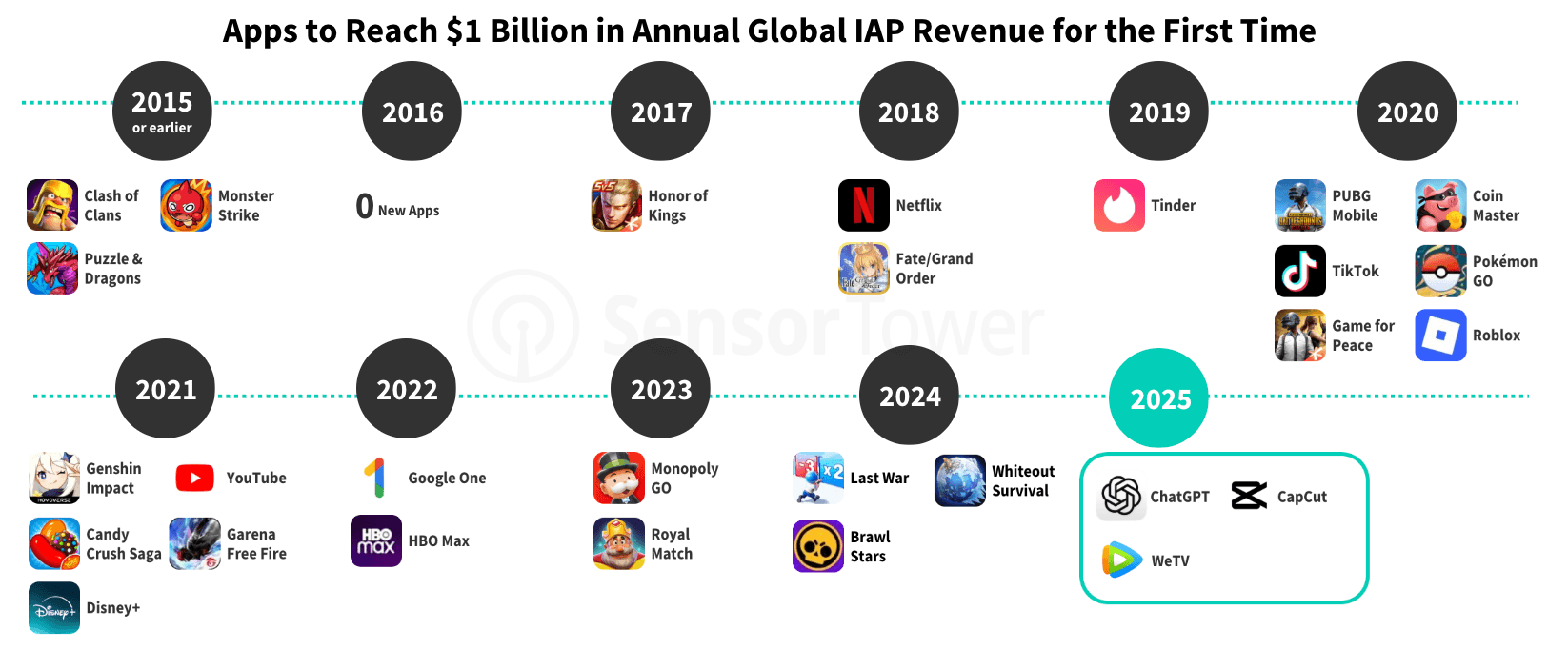
Sensor Tower reported that consumers spent more on subscription apps than on games in 2025 for the first time, with non-game IAP revenue reaching roughly $85 billion, up 21% year over year. Generative AI apps led that growth, but the gains were broad: nearly every app category posted positive IAP revenue growth in 2025.
The implication for marketers is straightforward. subscription app monetization is now a serious budget line, and the strategies you bring to it need to match the maturity of the market.
Why the funnel approach to apps marketing doesn't work anymore
The marketing funnel (awareness, consideration, install, retention, monetization) was useful when the customer journey was roughly linear and roughly measurable. In 2026 it is neither.
Consider how a user actually finds a subscription app today. They might see a TikTok creator demo it. They might ask ChatGPT for a recommendation. They might search the App Store with a keyword. They might see a friend's screenshot in a group chat. They might encounter a paid ad. They might come back to it three weeks later through a re-engagement push. None of these steps have to happen in any particular order. Several of them often happen simultaneously, and some of them are invisible to the marketing team.
The funnel model tells you to optimize each stage in sequence: pay for awareness, then nurture consideration, then close with a direct response ad, then retain. The real market does not work that way.
Three forces are responsible for the break.
1. Discovery is parallel, not sequential
With 34 apps used per month per user and 10 unique apps used daily (Sensor Tower), users move between contexts constantly. They do not progress through your funnel. They graze across many funnels at once.
2.The middle of the funnel is largely unmeasurable on iOS
Following Apple's ATT rollout, 'consideration' became almost impossible to track at the user level. While Android still offers better visibility through the GAID and Play Referrer, the overall industry trend is moving toward a 'black box' model where we can see the Top (reach) and the Bottom (installs), but the journey in between is increasingly fragmented
PS Be sure to check out our article on SKAN for more.
3. Retention drives acquisition
App Store and Google Play ranking algorithms reward sustained DAU and engagement. Users who stay generate organic referrals, word of mouth, and reviews. Users who churn quietly drag your store ranking down and make every paid install more expensive. In a funnel model, retention is the last step.
In reality it is the first one, because retention determines how affordable acquisition is.
A more useful mental model is a loop. Every user is simultaneously a converter and a signal. They install, they engage, they monetize, and they feed the next install through ranking, reviews, referrals, and the data that improves your targeting. Marketing's job is to make the loop spin faster, not to push users down a one-way path.
Essential strategies for Apps Marketing in 2026

Fall in Love with These App Marketing Strategies
Strategy follows the model. If you accept that app marketing is loop-shaped rather than funnel-shaped, the priorities reorder. Here are the six strategies that matter most in 2026.
1. App Store Optimization as a permanent product surface
ASO is not a launch tactic; it is a permanent surface that compounds. Your title, subtitle, keywords, screenshots, preview video, ratings, and reviews together determine whether you convert the organic traffic you are already getting.
Most apps under-invest here because the work is unglamorous and the wins are gradual. Apps that take ASO seriously consistently see meaningfully higher install conversion rates than peers in their category, which mathematically reduces every paid CPI you will ever pay.
Audit your store listing every quarter; test screenshots and watch what changes when iOS or Google Play updates their algorithm.
2. Creative as the primary lever
Creativity is what differentiates a winning campaign from a losing one.
In an era where ad network algorithms have commoditized targeting and bidding, creative is the last remaining lever for true differentiation. It is no longer about the technical format—be it native, video, or static—but about the creative’s ability to act as the primary targeting mechanism. A well-crafted creative does the heavy lifting that data used to do: it speaks directly to the user’s pain points, filters out low-quality traffic, and captures attention in a crowded feed. High-performing creatives succeed not because they are "native," but because they offer a clear value proposition and a compelling reason to act. In fact, a high-clarity static image often outperforms a complex native video if it communicates the product's benefit more effectively, proving that creative strategy, not just format, is the real driver of Alpha.
Build a creative pipeline, not a campaign.
3. Owned channels and lifecycle marketing
Push notifications, email, in-app messages, and SMS are the channels you actually control. They are also where most of your retention work happens. A well-segmented onboarding sequence can lift early retention substantially.
A re-engagement campaign for dormant users can recover a non-trivial share of churned users at near-zero acquisition cost. These wins do not require a budget but they require attention.
4. User Acquisition (UA) as an integrated discipline
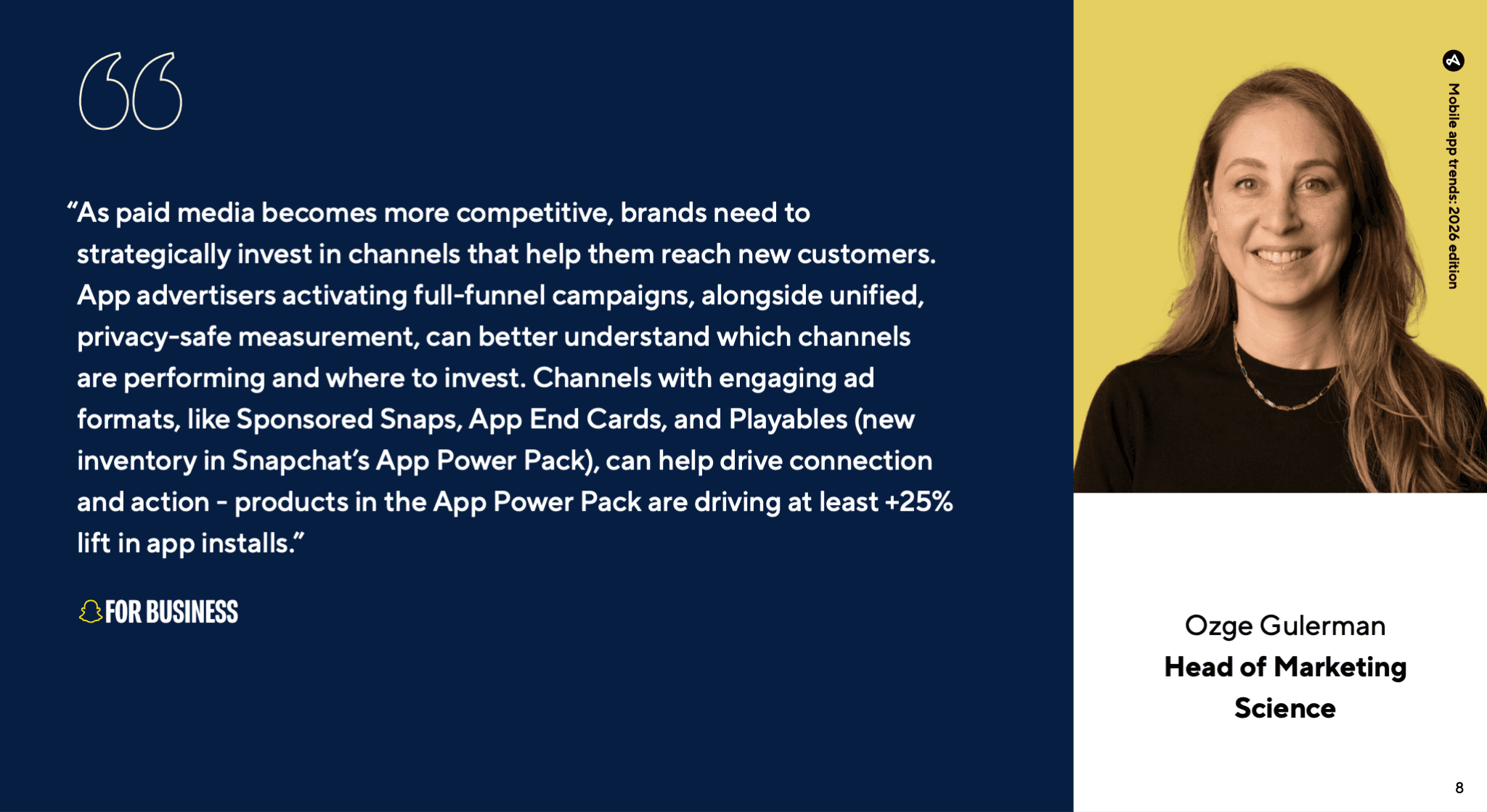
Paid UA remains the primary engine for mobile growth, but its execution has shifted from simple manual bidding to algorithmic optimization. Success is no longer about managing separate channel silos, but about feeding high-quality signals into a unified machine-learning ecosystem. Today’s UA stack is built on automated campaigns—such as Google’s App Campaigns (AC) and Meta’s Advantage+—where the algorithm handles the funnel, and the UA team focuses on creative diversification and signal integrity.
Instead of traditional brand campaigns, top-tier advertisers leverage Apple Search Ads for high-intent capture and diversified social channels (TikTok, Meta) to drive scale. In a privacy-first environment where user-level retargeting has been largely deprecated, the focus has moved toward holistic incrementality. Advertisers who treat their spend as a single, fluid ecosystem—measuring the blended impact of high-intent search and broad-reach social—are the ones capable of scaling efficiently without over-relying on a single network.
UA is one of the hardest disciplines in apps marketing to run well, and it is also the one most apps under-resource. Building a creative pipeline, an attribution stack, and a payback model in-house requires a team that most apps at the early scaling stage do not yet have.
5. AI-driven discovery
This is new in 2026 and most apps are not ready for it.
Users now ask ChatGPT, Perplexity, Gemini, and other AI assistants for app recommendations. Whether your app shows up depends on how it is described in third-party content the AI was trained on or retrieved from.
That means proper App Store Optimization (ASO), PR, listings on review sites, your own blog, and your store description all influence AI visibility.
Treat your app's positioning the way you would have treated SEO content five years ago: deliberate, descriptive, and consistent.
6. Influencer and creator partnerships
Influencer marketing is a must-have for apps looking to scale.
For most consumer subscription apps, creator-led discovery on TikTok, Instagram, YouTube Shorts, and increasingly LinkedIn for B2B apps, has become a primary acquisition channel.
The mechanic is simple: a creator with an audience trust demos your app to followers who are already in the right context for your category. The wins are in targeting precision and trust transfer, not in volume.
A niche fitness creator with 50,000 engaged followers will produce more retained users for a workout app than a generalist creator with 1 million followers will for the same spend.
Three things make creator partnerships work at scale:
a clear creative brief that gives the creator latitude rather than dictating script,
a defined attribution method (promo codes, custom landing pages, or post-promo geo lift studies),
and a portfolio approach, where you partner with 20 to 50 creators per quarter rather than betting on one or two large ones.
The apps that struggle with creator marketing usually do so because they treat each partnership as a campaign rather than a continuous program.
7. Brand as a moat
The longer privacy restrictions continue, the more valuable direct intent becomes. A user who searches for your app by name in the App Store costs effectively nothing to acquire.
A user who has heard of you, even faintly, converts at meaningfully higher rates from paid media. Brand is no longer a soft metric. It is the cheapest form of lower-funnel performance you can buy.
The Mobile Apps Marketing Checklist (By Phase)
The work below maps the strategies above onto the four phases every app goes through, from pre-launch through ongoing retention. Use it as a starting point and adapt to your category, monetization model, and team size.
Pre-launch
This is the foundation phase. Most of the leverage in app marketing is created here, before the first install happens.
Define your ICP (ideal customer profile): demographics, jobs-to-be-done, and the specific moment they need your app
Competitive landscape audit: top 10 apps in your category, their positioning, pricing, ASO setup, and review themes
Positioning and messaging foundation, anchored by a clear one-sentence value proposition
Brand basics: name, icon, color system, voice
Pre-launch landing page or waitlist with email capture
ASO foundation work: keyword research, listing copy drafts, screenshot concepts, preview video script
Press kit and target media list (publications, newsletters, podcasts in your category)
Closed beta or TestFlight cohort to surface bugs and early product feedback
Analytics and measurement stack setup: MMP, in-app event taxonomy, server-side data warehouse, MMM data foundation
Privacy and legal: ATT prompt copy, consent flows, store policy compliance, GDPR/CCPA readiness
Launch phase
This is the four to six weeks around going live. The goal is a clean launch with reliable signal coming back.
Final ASO listing live: keywords locked, screenshots A/B tested where possible
Coordinated PR push: press release, journalist outreach, podcast and newsletter pitches
Influencer and creator partnerships activated, ideally with a phased posting schedule
Paid media warm-up at modest budget to seed targeting and gather baseline data, not to scale
App Store and Google Play featuring submissions
Community activation: existing audience, founder networks, relevant subreddits and Discord servers
Aggressive monitoring of crash rates, app store reviews, and onboarding drop-off in the first 72 hours
Day-one onboarding tightening based on early user behavior
Day 1, Day 7, and Day 30 retention tracking on the launch cohort
Post-launch (the first 90 days)
This is where you find marketing-product fit: which channels and creatives actually produce users who stay and monetize.
Paid UA scaling: start narrow, expand only where ROAS and retention hold
Creative testing pipeline with a target volume of new ad concepts per week
Continuous ASO iteration: screenshot tests, keyword refinement, listing copy updates
Owned channel infrastructure built out: push notifications, email, in-app messaging, SMS where relevant
Cohort analysis by acquisition source: which channels retain best at Day 30?
First incrementality test, typically a geo holdout on the largest paid channel
Content and SEO program if your category supports it
Performance reporting cadence established: weekly tactical, monthly strategic
Initial AI-discovery audit: how is your app described when users ask ChatGPT, Perplexity, or Gemini for category recommendations?
Retention (ongoing)
This is the loop. The work here determines how affordable acquisition becomes over time.
Lifecycle campaigns: onboarding sequences, milestone celebrations, feature education, win-back flows
Segmentation-driven push notification strategy, with frequency caps and content relevance
Dormant user re-engagement: identify churn patterns and intervene before users uninstall
Review and rating management: prompt happy users at the right moments, respond to negative reviews
Quarterly ASO audits to catch algorithm changes and competitor moves
Referral and word-of-mouth programs where the product supports it
Subscription retention work if relevant: dunning, billing recovery, churn prediction, paywall optimization
LTV cohort analysis and continuous LTV model refinement
Incrementality testing on a rolling basis, not as a one-time exercise
AI-discovery surface monitoring: track how your app's positioning is represented across AI assistants and review sites, and update your owned content where needed
How to measure mobile app marketing?
Most apps measure too many metrics and act on too few. The cure is to organize measurement around economic decisions, not around dashboards.
At the campaign level, the metrics that matter are CPI (cost per install), CPA (cost per acquisition for a defined event such as a registration, purchase, or subscription start), and ROAS over a defined window (D7, D30, or D90 depending on retention and monetization speed). Below that, the metrics that determine whether the business actually works are LTV, payback period, and retention curves by cohort.
Sensor Tower's 2025 data shows IAP revenue growing 10.6% year over year while download volume grew only 0.8%. The implication is that per-user economics are now where the gains live, not in install volume. That changes how you should weigh your measurement. ROAS and LTV beat CPI in importance for almost every app category in 2026.
Two practices separate the apps that measure well from the apps that measure poorly
The first is cohort analysis
Looking at retention, revenue, and engagement by acquisition cohort tells you which channels, creative, and audiences are actually building the business and which are filling a vanity metric. A campaign with low CPI and bad Day 30 retention is not a good campaign. It is an expensive one with a delay.
The second is incrementality testing
Most reported conversions in any paid channel are some mix of incremental and non-incremental (users who would have converted anyway). Geo holdout tests, ghost ads, and scaled budget experiments are the standard ways to separate the two. The output, true incremental ROAS, is the only number that should drive budget allocation decisions for top-of-funnel channels.
If you take one thing from this section, take this: stop optimizing CPI in isolation.
Optimize the loop economics. The questions worth answering are how much it costs to acquire a user who actually monetizes and stays, and which channels and creatives produce those users.
How has attribution changed for Apps Marketing?
Attribution is the area where the gap between what marketers learned and what is actually true is widest.
Before 2021, mobile attribution was primarily deterministic. The IDFA on iOS and the GAID on Android allowed mobile measurement partners (MMPs) to tie an ad impression to an install with high accuracy at the user level. Click-level attribution was the default and the data was clean enough to optimize granular bid strategies.
That world is gone.
On iOS, Apple's App Tracking Transparency framework requires explicit user consent for cross-app tracking, and most users decline. The replacement is SKAdNetwork, now part of AdAttributionKit, which provides aggregated, delayed, and partially obscured attribution data. You can still measure paid performance on iOS, but you cannot do it at the user level and you cannot do it in real time.
On Android, Google's Privacy Sandbox is rolling out the same direction at a slower pace. The GAID is still available but its long-term role is uncertain, and Privacy Sandbox APIs (Attribution Reporting, Topics, Protected Audience) are designed to provide measurement without user-level tracking.
What this means in practice is that no single tool will give you a complete picture of paid performance. The modern measurement stack is a triangulation.
Media mix modeling (MMM) gives you a directional read on which channels and tactics are driving the business at a portfolio level. It works without any user-level tracking and is well suited to understanding brand and upper-funnel investments.
In-app analytics (Amplitude, Mixpanel, your own data warehouse) gives you ground truth on what users do once they are in your product. This is where retention, monetization, and feature engagement are actually measured.
Incrementality testing gives you causal evidence about whether your paid spend is driving incremental installs and revenue or just intercepting organic demand.
MMP attribution still has a role, but treat it as one input among several rather than as the source of truth. The apps that will have an advantage in 2026 are the ones that have already built this triangulated stack, because the apps still optimizing on MMP last-click attribution alone are flying blind whether they realize it or not.
Conclusion
The mobile app market in 2026 is bigger, more profitable per user, and harder to navigate than it has ever been. The fundamentals that built winning apps a decade ago (cheap installs, click-level optimization, linear funnel models) are no longer the fundamentals.
The new fundamentals are different. Loops, not funnels. Creative quality, not channel arbitrage. Owned channels and lifecycle work, not just paid acquisition. Brand as performance, not as decoration. Measurement as a triangulated discipline, not a dashboard.
App founders and marketing leads who internalize this will spend less per user, retain more of them, and build something that compounds. The ones who keep running last year's playbook will find paid media getting more expensive every quarter while their organic loops fail to fill the gap.
The opportunity is real. Sensor Tower's data shows IAP revenue growing more than 10% per year on a base of $167 billion. Engagement is climbing. Per-user value is climbing. There is more money on the table than there has ever been. The question is whether your marketing is built to capture it.
If you are rethinking your app marketing strategy for 2026 and want help working through it, that is what Hubapps.team exists for.
Frequently Asked Questions
1. How much should an app spend on marketing?
The right question is not "how much should I spend" but "at what spend level does my LTV/CAC ratio start to break." Find that ceiling, then spend up to it. If you do not yet know your LTV with confidence, prioritize building that measurement before scaling spend.
2. What's the difference between mobile apps marketing and mobile games marketing?
The infrastructure is shared (same stores, similar economics, same MMPs) but the channels, creative norms and retention strategies are different.
3. Is ASO still worth investing in?
Yes, more than ever. App Store search remains one of the largest sources of organic installs for most apps, and conversion rate on the store listing affects every paid CPI you pay. As paid attribution has become harder, ASO has become disproportionately valuable because it is the one channel where you fully control the surface area. Quarterly ASO audits, screenshot testing, keyword research aligned with how users actually search, and active review management all compound over time.
4. How is AI changing app discovery?
In two ways. First, users are increasingly asking AI assistants (ChatGPT, Perplexity, Gemini, others) for app recommendations, which means your visibility now depends partly on how your app is described across third-party content that AI systems retrieve or were trained on. Second, the apps competing for attention now include AI-native products that did not exist eighteen months ago, which has compressed acquisition costs in some categories and expanded them in others. Practically, this means PR, review site placements, your own content, and your store description copy all influence AI-driven discovery. Treat your app's external positioning the way SEO content was treated five years ago: deliberate, descriptive, and consistent across surfaces.

Mobile gaming UA specialist since 2011. A female pioneer in the industry, Maria has scaled games across every major platform and genre, from indie puzzle games to massive strategy titles. Known for straight talk and results that actually matter.
Share
Related Articles