
If you run paid user acquisition campaigns for iOS games, SKAdNetwork is the rulebook your attribution data lives inside. It controls what you know, how quickly you know it, and how much detail you get about the players your campaigns bring in. Yet despite its central role in mobile game marketing, it remains one of the most misunderstood frameworks in the industry.
Today, SKAN accounts for over 35 percent of all iOS attribution, making it the leading attribution method on the platform. Apple Search Ads, which operates under similar privacy constraints, accounts for a further 20 percent. Between them, privacy-first attribution now represents the majority of how iOS campaign performance is measured. For mobile game marketers, where iOS users in markets like North America represent more than half of all smartphone users and consistently outspend Android users, understanding SKAN is not optional. It is the measurement foundation everything else sits on.
This guide breaks down everything mobile game marketers need to understand about SKAdNetwork, from its origins and mechanics to the practical strategies that make it work for gaming apps in 2026 and beyond.
What is SKAdNetwork?
SKAdNetwork (StoreKit Ad Network, abbreviated as SKAN) is Apple's privacy-preserving attribution framework for iOS app install campaigns. It allows advertisers to measure whether their ads led to app installs and in-app activity, without any individual user data being shared in the process.

Source: AppsFlyer
Before SKAN, mobile attribution relied on the IDFA (Identifier for Advertisers), a device-level ID that allowed marketers to tie a specific user to a specific ad click, install, and every subsequent in-app action. That level of granularity was enormously powerful for campaign optimization, but it also meant that extensive behavioural data on individual users flowed freely among Apple, ad networks, and advertisers.
SKAN changes this entirely.
Instead of attributing at the user level, it operates at the campaign level, using aggregated and anonymised data. What you receive is a postback, a signal from Apple confirming that an install occurred and providing a limited set of campaign-level information. You never learn who the user is. You only learn, within certain parameters, that someone installed your game after seeing your ad.
For mobile game marketers specifically, this shift matters because gaming is one of the most performance-sensitive verticals in mobile.
Games live and die by their ability to acquire users at
a profitable cost,
and model lifetime value.
SKAN affects all three of those areas in meaningful ways.
Today, SKAN accounts for over 35 percent of all iOS attribution, making it the leading attribution method on the platform. Apple Search Ads, which operates under similar privacy constraints, accounts for a further 20 percent.
Between them, privacy-first attribution now represents the majority of how iOS campaign performance is measured. For mobile game marketers, where iOS users in markets like the US represent more than half of all smartphone users and consistently outspend Android users, understanding SKAN is not optional. It is the measurement foundation on which everything else sits.
Why Did Apple Deploy SKAdNetwork? Understanding Apple's Privacy-First Attribution
The simple version: users did not want to be tracked, regulators started paying attention, and Apple decided to get ahead of both.
For most of the 2010s, the IDFA flowed freely through the mobile advertising ecosystem. Users had theoretically opted in by agreeing to terms of service, but in practice very few people understood what that meant or what data was being collected. Behavioural profiles were being built across apps and sessions, sold between parties, and used to target ads in ways that many users found intrusive once they became aware of them.
The warning signs were visible well before ATT. Apple's Limited Ad Tracking (LAT) toggle, which allowed users to block IDFA access voluntarily, saw steadily rising adoption through 2019 and 2020. Globally, the EU's GDPR had already set a new standard for data consent, and California's CCPA followed. Tim Cook was describing privacy as "a fundamental human right" in public speeches. The direction of travel was clear.
In April 2021, Apple acted. iOS 14.5 introduced App Tracking Transparency, which required every app to explicitly ask users for permission before accessing their IDFA. The results were immediate.
According to Adjust, the global ATT opt-in rate as of Q2 2025 sits at around 35 percent, meaning roughly two-thirds of iOS users cannot be tracked at the device level at all.
For gaming apps specifically, AppsFlyer data puts the opt-in rate at 51 percent, which sounds more encouraging until you remember that half of your potential players are still invisible to traditional attribution methods.
SKAdNetwork was Apple's answer to the question of what advertisers should use instead. It provides deterministic, campaign-level attribution that functions regardless of whether the user has consented to ATT.
Even for users who decline the tracking prompt, SKAN can still attribute their install to the correct ad network. This makes SKAN the only attribution method in iOS with a complete view across all campaigns and all users, whether consented or not.
The result is a framework that is genuinely useful for its stated purpose (measuring campaign performance without compromising individual privacy) but which imposes real constraints on the ways marketers are used to working.
What is the Difference Between SKAdNetwork 3 and SKAdNetwork 4?
SKAdNetwork 3 and SKAdNetwork 4 represent two meaningfully different approaches to mobile attribution, and understanding the gap between them is essential for any gaming team that takes iOS measurement seriously.
The most important differences between SKAN 3 and SKAN 4
Feature | SKAN 3 | SKAN 4 |
|---|---|---|
Number of postbacks | 1 | Up to 3 |
Measurement window | 24 hours (resettable) | Days 0 to 2, 3 to 7, 8 to 35 |
Conversion value types | Fine only (0 to 63) | Fine (postback 1) and coarse (postbacks 2 and 3) |
Campaign volume tiers | Privacy threshold only | Four crowd anonymity tiers (0 to 3) |
Early window closing | Not available | LockWindow feature |
Web-to-app attribution | Not available | Available via Safari |
SKAdNetwork 3: The Single Postback Era
Under SKAN 3, advertisers received one postback per attributed install. That postback was based on a 24-hour activity window starting from the moment the user first opened the game. If the user performed an in-app action within that 24-hour window (completing the tutorial, making a purchase, reaching a milestone), the app could update a conversion value, a number between 0 and 63, to encode information about that user's behaviour.
Every time the app updated the conversion value, the 24-hour timer reset. The timer would continue resetting with each update until no update occurred for 24 hours, at which point the window closed and the postback was prepared. Apple would then send it to the ad network after a randomised delay to prevent timing-based identification of individual users.
This meant that a user who engaged heavily with your game in the first few days could extend the window substantially, while a casual user who played once and never returned would close the window after 24 hours with no conversion value at all.
The result was that SKAN 3 was heavily biased toward short-term engagement signals, gave no visibility beyond the initial window, and sent all data in a single pulse that was hard to interpret for games with longer monetisation cycles.
SKAdNetwork 4: Three Windows, Coarse Values, and More Control
SKAN 4, released in October 2022 alongside iOS 16.1, addressed several of these limitations while simultaneously adding new complexity.
The most significant change is the introduction of three separate postbacks, each covering a distinct measurement window. The first window spans days 0 to 2 post-install. The second window spans days 3 to 7. The third window spans days 8 to 35. This is a dramatic expansion of the measurement horizon for gaming apps, where meaningful monetisation events often occur days or weeks after install.
Each postback contains a conversion value, but the type of conversion value differs. The first postback can contain a fine-grained value, the same 0 to 63 integer scale used in SKAN 3, but only when Apple's crowd anonymity threshold is met. The second and third postbacks return only coarse-grained conversion values, which use three levels: low, medium, or high. Coarse values are less precise, but they are far better than the null values that previously made smaller campaigns essentially invisible.
SKAN 4 also introduced the concept of postback data tiers, numbered 0 through 3, which Apple assigns based on campaign volume. Higher tiers unlock more granular data. Tier 0 campaigns receive only a first postback with minimal data. Tier 3 campaigns receive all three postbacks with the most complete conversion data and a four-digit source identifier that allows for more granular campaign-level analysis. This creates an incentive to consolidate spend and scale volume on individual campaigns, which has real strategic implications for gaming teams managing large numbers of small ad sets.
Another meaningful addition in SKAN 4 is the lockWindow feature. This allows developers to manually close a conversion window before it expires naturally. For a gaming app, this is valuable when you have already captured the signal you need. If a user completes a purchase on day 1, you may not need to wait until day 2 for the first window to close. Locking the window early starts the postback timer sooner, meaning you receive data faster without waiting for the full window to expire.
Finally, SKAN 4 introduced web-to-app attribution via Safari, allowing advertisers to measure installs driven by mobile web ads, not just in-app ads. This is limited to Safari and has specific technical requirements, but it opens a meaningful new acquisition channel for studios exploring web-based user acquisition funnels.
SKAN 5.0: Expected Release in 2026
In 2025 most iOS campaigns were SKAN-first. And 2026 is expected to be the same with its promised release of SKAN 5.
Faster postbacks
Built-in incrementality testing.
And privacy safe retargeting.
Exciting times for marketers!
How Does SKAdNetwork Work?
SKAdNetwork involves five participants: Apple and the App Store, the ad network (the company serving the ad), the publisher app (where the ad is shown), the advertised app (your game), and optionally a Mobile Measurement Partner (MMP) acting as a centralised hub.
Here is how the full flow works in practice.
Registration
Before any campaign can be measured, the ad network must register with Apple's SKAdNetwork programme and receive a unique ad network ID. Ad networks sign each ad impression or click with a cryptographic signature using this ID. This signature is how Apple verifies that the attribution postback is legitimate and has not been tampered with.
Ad display
A user is shown an ad for your game inside a publisher app, for example, a banner or video ad inside another mobile game. The publisher app notifies SKAdNetwork that the ad was displayed. For a view-through attribution, the ad must be shown for at least three seconds.
Install and first launch
The user taps the ad, the App Store opens natively inside the publisher app via StoreKit, and the user downloads your game. When the user opens your game for the first time, SKAN recognises the ad signature and begins the attribution process. The timer for the first conversion window starts at this moment.
Conversion value updates
As the user plays your game, your app can update the conversion value based on in-app events you have defined. Tutorial completion, first purchase, a specific level milestone, reaching a revenue threshold: each of these can be mapped to a conversion value that tells your ad network something meaningful about user quality. In SKAN 4, this happens across up to three separate windows.
Postback delivery
Once a conversion window closes (either naturally or through lockWindow), Apple prepares a postback and sends it to the winning ad network after a randomised delay. The delay exists specifically to prevent advertisers from inferring the install time of individual users. Apple also sends a copy of the postback to an endpoint defined by the developer in the app's info.plist file, meaning you receive the same raw data the ad network receives.
MMP aggregation
Most gaming studios route their SKAN postbacks through an MMP such as Adjust, AppsFlyer, or Singular. The MMP collects postbacks from all ad networks and from your own endpoint, decodes the conversion values according to your mapping schema, applies statistical modelling to account for null values and crowd anonymity, and surfaces unified campaign-level reporting. The MMP is not required for SKAN to function, but it becomes practically necessary at any meaningful scale.
One critical concept to understand is crowd anonymity. If your campaign drives a very small number of installs, Apple withholds granular data from the postback to protect individual users from being identified. At low volumes, conversion values may be returned as null. As volume grows and users blend into a sufficiently large crowd, the tier rises, and more data becomes available. This creates a real challenge for gaming studios running many small creative tests or launching in new markets, where campaign volumes are initially low.
SKAdNetwork Benefits for Publishers and Advertisers
Despite its complexity, SKAN offers genuine advantages that are worth understanding clearly.
Benefit | What it means in practice |
|---|---|
Universal coverage | Attributes installs regardless of ATT consent status, giving you a complete view across all users |
Deterministic attribution | Cryptographic signing by registered ad networks makes the attribution chain verifiable and tamper-resistant |
No MMP dependency | Raw postback copies arrive at your own endpoint, so smaller teams can operate without a third-party measurement partner |
Fraud resistance | Signed ads prevent click injection and SDK spoofing attacks that were common in pre-SKAN attribution models |
Cross-network comparability | Every ad network uses the same framework, so campaign data from Meta, Google, AppLovin, and TikTok can be evaluated on equal terms |
Universal coverage
SKAN is the only iOS attribution method that works regardless of ATT status. For users who have declined the tracking prompt (typically the majority), SKAN is the only window you have into the performance of your campaigns. No other method gives you a consistent, deterministic view across both consented and non-consented users.
Deterministic attribution
SKAN postbacks are cryptographically signed by ad networks and verified by Apple. This is not probabilistic matching or fingerprinting. When a postback arrives, Apple has confirmed the attribution chain. This is significantly more reliable than the fingerprinting methods some networks have used as a workaround in the post-IDFA era.
No MMP dependency
While MMPs are valuable for aggregation and analysis, SKAN functions without one. The postback copy you receive at your info.plist endpoint is the same raw data the ad network receives. Smaller studios or teams building custom measurement stacks can work directly with SKAN without routing through a third party.
Fraud resistance
Because each ad must be cryptographically signed by a registered ad network, it is significantly harder to generate fraudulent install attributions in the SKAN ecosystem than in traditional attribution models where click injection and SDK spoofing were common attack vectors.
Cross-network comparability
Because every ad network uses the same SKAN framework, campaign data across Meta, Google, AppLovin, TikTok, and any other SKAN-registered network is directly comparable using the same methodology. This eliminates the distortions that arise when each network uses its own reporting logic.
For publishers, SKAN provides confirmation that their inventory is being credited for the conversions it drives, within the privacy framework Apple has set. For advertisers, it provides the best available signal for iOS campaign performance in a privacy-first world.
What Are the Challenges of SKAN for Advertisers?
The benefits of SKAN come with real operational costs, and being clear-eyed about those costs is the first step to managing them effectively.
Here are the challenges of SKAN
Challenge | Why it matters |
|---|---|
No user-level data | Campaign quality must be inferred from aggregated postback signals rather than individual user behaviour |
Delayed postbacks | Data from a single install cohort can take up to five or six weeks to arrive in full, slowing creative iteration |
Crowd anonymity thresholds | Low-volume campaigns return null or coarse data, making ROAS calculations unreliable without statistical modelling |
No creative-level attribution | Postbacks attribute at the campaign level only, so cross-network creative performance cannot be compared using SKAN data |
Schema maintenance burden | Conversion value mappings drift out of alignment as the game evolves, requiring regular review to stay accurate |
S2S engineering dependency | Server-side purchase events require specific client-side implementation work to feed into the conversion value pipeline |
Postbacks cannot be linked across windows | Postbacks 1, 2, and 3 arrive independently with no shared identifier, preventing cohesive per-install journey analysis |
Uneven SKAN 4 adoption | Some ad networks aggregate or strip postback data before forwarding it, creating inconsistencies across the network mix |
No user-level data, ever
This is the foundational constraint that everything else flows from. You cannot see which specific users came from which campaigns, you cannot build multi-touch attribution models that rely on a unique identifier, and you cannot directly observe the post-install journey of any individual player. Everything you know about campaign quality is inferred from aggregated postback signals. For gaming teams accustomed to optimising at the user level, this is a significant mental and operational shift.
Delayed data
Postbacks do not arrive in real time. Even with lockWindow, your first postback arrives a minimum of 24 to 48 hours after the first conversion window closes, and postbacks 2 and 3 carry additional randomised delays that can push final data from a single install cohort out to five or six weeks. Running a creative test and waiting weeks for definitive performance data creates real tension with the pace at which game marketing teams typically need to iterate.
Crowd anonymity thresholds penalise small campaigns
Any campaign that does not drive sufficient install volume to meet Apple's privacy threshold returns minimal data. Null postbacks are not just uninformative, they actively distort your ROAS calculations if you do not account for them. For smaller studios, new market launches, or creative testing scenarios where budgets are intentionally constrained, SKAN frequently provides very little usable signal.
Creative-level data is absent
SKAN postbacks do not tell you which specific ad creative drove an install. You receive attribution at the campaign level but not at the ad level. For gaming teams where creative testing is a primary lever for performance improvement, this is a meaningful gap. Ad networks provide their own creative reporting dashboards, but that data is siloed within each platform and cannot be unified and compared across networks using SKAN's methodology.
The conversion value schema requires ongoing maintenance
Your conversion value mapping is not a set-and-forget configuration. As your game evolves, as pricing experiments are run, as new content is added that changes the behavioural profile of high-value players, the events and revenue ranges encoded in your schema can drift out of alignment with reality. A schema designed at launch may no longer reflect what actually predicts LTV six months later, and stale mapping produces misleading optimisation signals that networks act on incorrectly.
Server-to-server events require specific engineering work
Because SKAN conversion values are updated client-side (triggered by events that occur when the app is open), purchase verification and other server-side events require a specific implementation to feed back into the conversion value pipeline. This is a recurring source of missed signals for gaming apps that manage IAP receipt validation on the server, and it demands ongoing collaboration between the UA team and the engineering team to keep working correctly.
Postbacks from different windows cannot be linked to the same install
In SKAN 4, there is no way to deterministically connect postback 1, postback 2, and postback 3 for a single user. Each postback arrives independently. This makes building a coherent picture of user progression across the 35-day measurement horizon significantly harder than it appears on paper. Most teams work around this by building cohort-level estimates rather than tracking individual install journeys, but the limitation places a ceiling on the analytical sophistication that SKAN data can support.
SKAN 4 adoption remains uneven across ad networks
Despite being available since October 2022, SKAN 4 is still not fully supported by every ad network in equal measure. Some networks forward raw postbacks with all three windows intact. Others aggregate data before passing it downstream, reducing its usefulness. Teams running campaigns across a broad network mix will encounter inconsistencies in postback quality and timing that require careful handling at the MMP or data warehouse layer.
How to Measure SKAN?
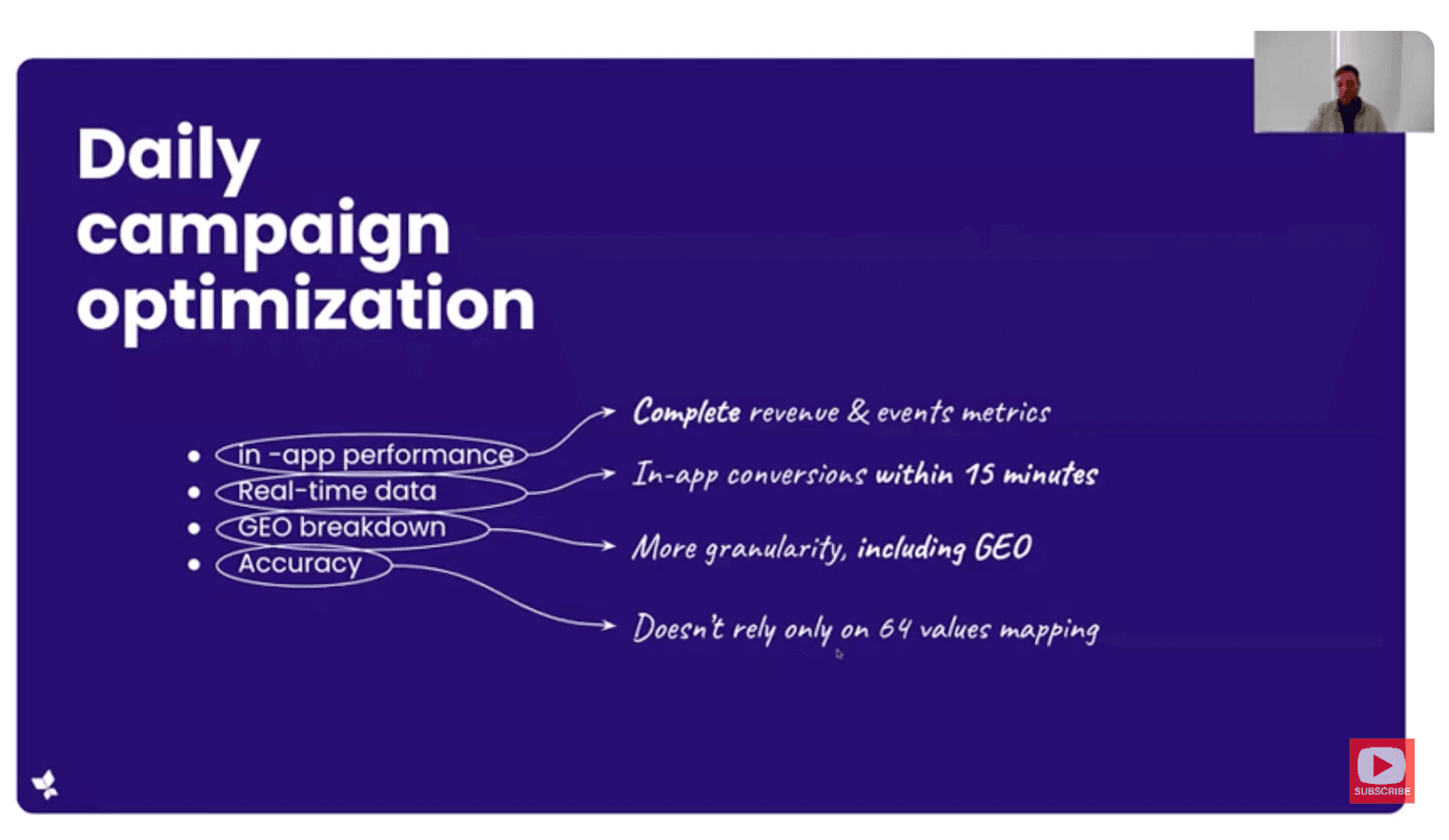
How to Measure on SKAN with AppsFlyer's Single Source of Truth (SSOT)
How Can Mobile Games Make the Most of SKAdNetwork?
Getting real value from SKAN in a gaming context requires deliberate strategy across conversion value design, campaign structure, and data interpretation.
The stakes are real: AppsFlyer data shows that around 50 percent of apps increased their iOS advertising spend between Q1 2023 and Q1 2024, with year-on-year growth of 28 percent. The industry has clearly decided that iOS is worth investing in under SKAN constraints. The question is how to make that investment count.
Design your conversion value schema around the metrics that predict LTV
The 64 fine-grained conversion values you have in window 1 are a finite resource. Assigning them randomly or following generic templates will produce data that is hard to act on.
For mobile games, the most predictive early signals tend to be tutorial completion, the first in-app purchase (and at what price point), session count, and specific milestone completions that your retention modelling has identified as correlated with long-term value. A purchase of 0.99 cents on day 1 is a fundamentally different signal from completing five levels. Both should be represented distinctly in your schema.
A practical schema for window 1 might reserve the lower range of values (0 to 9) for non-engaged installs, the mid-range (10 to 44) for progressive engagement milestones, and the upper range (45 to 63) for varying revenue tiers. The key is that each value bracket should map to a user segment with meaningfully different expected LTV, so that your ad networks can use the conversion signal to optimise toward your most valuable players.
Map coarse values in windows 2 and 3 deliberately
Because postbacks 2 and 3 only return low, medium, or high, you need to define what each of those three levels means for your game across the days 3 to 7 and days 8 to 35 windows.
For a mobile game, a reasonable approach is to map these against retention milestones (day 7 and day 30 retention) or cumulative revenue tiers.
Low might indicate a user who played briefly and stopped spending.
Medium might indicate a retained casual player.
High might indicate a regular session player or a paying user.
These coarse signals still feed back into campaign optimisation at the network level and are far more useful than null.
Use lockWindow strategically to accelerate data feedback loops
The standard conversion windows in SKAN 4 mean that even your first postback arrives 3 to 4 days after install. In a live game with constant creative testing, that delay is significant. For users who perform a high-value action early, such as a day 0 purchase or completing a specific tutorial step you have pre-identified as a strong LTV predictor, consider locking the window immediately.
You sacrifice some additional data from the rest of the window, but you get the postback sooner and can feed optimisation signals back to your ad networks faster. This is a meaningful advantage for gaming campaigns that need rapid creative iteration.
Consolidate campaigns to reach higher crowd anonymity tiers
Because SKAN 4's data quality scales with install volume, running fifty small campaigns at low budgets will keep most of them in tier 0 or tier 1, where postback data is sparse. Consolidating toward a smaller number of well-funded campaigns raises the crowd anonymity tier and unlocks the fine-grained conversion values and additional postbacks that make SKAN genuinely useful for optimisation.
This is a strategic trade-off but one that consistently produces better measurement outcomes.
Account for null values in your ROAS models
A portion of your postbacks will always return null conversion values, particularly from smaller campaigns or in markets where you have low install volumes. Ignoring these installs distorts your ROAS calculations significantly.
The best practice is to use your non-null postbacks to estimate an average revenue per install for each campaign, then apply that multiplier to the null postback count to produce an estimated total. This produces a more realistic view of actual revenue performance than simply treating null installs as zero-value users.
Use Android data to validate and inform iOS creative strategy
Android still allows for deterministic user-level measurement in many markets, and it remains the most reliable environment for rapid creative testing, A/B experiments, and LTV modelling.
Many gaming studios now run their creative tests on Android first, use the results to inform iOS campaign structure, and rely on SKAN as a directional validation layer rather than a granular optimisation input.
Partner with your engineering team on S2S event implementation
SKAN measures events based on client-side triggers, meaning the conversion value can only be updated when the app is open.
For gaming apps that rely on server-to-server event tracking (particularly for verifying purchases or measuring social features), specific implementation work is needed to ensure those server-side events can still trigger conversion value updates via the app client. If this is not set up correctly, you will miss attribution signals for some of your most important monetisation events.
AdAttributionKit: What Game Marketers Need to Know for 2026 and Beyond
Apple introduced AdAttributionKit (AAK) at WWDC 2024, and it received significant additional updates at WWDC 2025. It is not a replacement for SKAN in any immediate sense. Instead, it is best understood as Apple's next evolution of the same privacy-first attribution philosophy, with a broader scope and several features that address genuine gaps in the SKAN framework.
Re-engagement attribution is the most significant addition for gaming marketers
SKAN has never supported retargeting measurement. If a lapsed player returns to your game after seeing a re-engagement ad, SKAN cannot attribute that event. AAK introduces the ability to track conversions from ads shown to users who already have the app installed. For games with large existing player bases where lapsed user reactivation is a meaningful revenue driver, this is a genuinely important development.
Alternative marketplace support means AAK extends attribution capabilities
This extends beyond the App Store to third-party app stores, which became possible in the EU following Apple's compliance with the Digital Markets Act. Gaming studios distributing through alternative storefronts in Europe can use AAK to measure those campaigns within the same framework.
Developer mode simplifies testing.
One of the most frustrating aspects of working with SKAN in production has been the inability to test attribution setups without waiting for real-world data and randomised timers. AAK includes a developer mode that accelerates the process, making it faster to validate that your conversion value mapping and postback infrastructure are working correctly before committing to a full campaign launch.
Fraud prevention improvements
This includes requirements that ads must be displayed in the foreground and limits on programmatic timers that were previously used to end impressions prematurely and inflate attribution credit.
The practical reality for most gaming teams in 2025 is that SKAN 4 remains the dominant operational framework, because the majority of ad networks have not yet fully adopted AAK.
Apple has confirmed that SKAN and AAK will operate in parallel, and existing SKAN-registered ad networks will not need to redo their integrations to start working with AAK. Adoption will be gradual, much as the transition from SKAN 3 to SKAN 4 proved slower than expected.
Gaming teams should monitor AAK adoption among their key network partners and begin building familiarity with the framework now, particularly around its re-engagement capabilities, which have no equivalent in the current SKAN system.
Closing Note for Mobile Marketers
This guide was written for mobile game marketers and user acquisition teams navigating iOS attribution in 2026. The SKAN framework continues to evolve, and staying current with MMP documentation from partners such as Adjust, AppsFlyer, and Singular is the best way to ensure your implementation reflects the latest changes.
FAQs on SKAdNetwork
How does SKAdNetwork work?
SKAdNetwork works by having ad networks cryptographically sign each ad they serve. When a user installs and opens an app after seeing that ad, the iOS framework recognises the signature, starts a conversion tracking timer, and measures in-app events that the developer has mapped to conversion values. After the measurement window closes, Apple sends an aggregated postback to the ad network and a copy to the developer's own endpoint. No individual user data is included. The attribution is based on the signed ad interaction and confirmed by Apple, making it deterministic at the campaign level without compromising user privacy.
What is the difference between AdAttributionKit and SKAdNetwork?
AdAttributionKit and SKAdNetwork are frameworks that enable ad attribution and user engagement measurement for conversions. AdAttributionKit works with both the App Store and alternative app marketplaces, while SKAdNetwork works specifically with the App Store.
What is the SKAdNetwork API on my iPhone?
The SKAdNetwork API is a component of Apple's StoreKit framework that runs at the operating system level on your iPhone. It operates silently in the background whenever you install an app through the App Store after interacting with an ad. You do not interact with it directly as a user. It does not track your identity, your name, or your device ID. Its sole function is to confirm to the ad network that an install occurred and, within privacy limits, provide an aggregated signal about your early in-app behaviour. The API is what allows app developers to receive attribution data without any individual user being identifiable in the process.
Is SKAN reliable for app attribution?
SKAN is reliable for campaign-level attribution in a privacy-constrained environment, but it comes with meaningful limitations that marketers need to account for. Its deterministic attribution method (cryptographic signing by registered ad networks) means the data it does provide is highly trustworthy. However, the randomised postback timers, crowd anonymity thresholds that withhold data for low-volume campaigns, the absence of user-level data, and the inability to connect postbacks from different windows to the same individual user all require careful statistical modelling to compensate. SKAN is not a replacement for the IDFA era's granular measurement. It is a different type of measurement that rewards well-designed conversion value schemas, consolidated campaign structures, and disciplined modelling of null values.
How does an ad network work within the SKAdNetwork ecosystem?
An ad network operates as a broker between advertisers and publishers. Within the SKAN ecosystem specifically, ad networks must register with Apple to receive a unique ad network ID, and they are responsible for cryptographically signing every ad impression or click their platform serves. When a user who saw one of their signed ads installs the advertised app, Apple sends the attribution postback to the ad network rather than directly to the advertiser. The ad network then either uses the conversion signal to optimise its own campaign delivery algorithms or forwards it to the advertiser's MMP for unified reporting. The ad network's ability to receive and act on these postbacks is what powers the feedback loop that allows platforms like Google, Meta, and AppLovin to optimise their iOS app install campaigns.
What is a conversion value in SKAdNetwork?
A conversion value is the numerical signal that an app sends to Apple to communicate information about a user's post-install behaviour, without revealing who that user is. In SKAN 4, there are two types. Fine-grained conversion values are integers from 0 to 63, each of which can be mapped by the developer to represent a specific in-app event or revenue tier. They are available in the first postback when the campaign meets Apple's crowd anonymity threshold. Coarse-grained conversion values are the three-level equivalent (low, medium, or high) used in the second and third postbacks, and also available as a fallback in the first postback for lower-volume campaigns. For mobile games, conversion values are typically used to represent tutorial stages, revenue milestones, session counts, or combinations of engagement signals that correlate with long-term player value.
What is crowd anonymity in SKAN 4?
Crowd anonymity is Apple's mechanism for ensuring that postback data cannot be used to identify individual users. Apple assigns each install to one of four postback data tiers (0 through 3) based on the volume of installs a campaign generates and the uniqueness of the user within that crowd. At tier 0, almost no data is returned beyond the basic attribution. At tier 3, the full set of postbacks, fine-grained conversion values, and a four-digit source identifier are all available. The threshold values Apple uses to determine tier assignment are not publicly disclosed and can vary by geography and time period. The practical implication for gaming marketers is that larger, consolidated campaigns consistently receive richer data, reinforcing the argument for focusing budget on fewer, higher-volume campaigns rather than spreading across many small ones.

Mobile gaming UA specialist since 2011. A female pioneer in the industry, Maria has scaled games across every major platform and genre, from indie puzzle games to massive strategy titles. Known for straight talk and results that actually matter.
Share
Related Articles


