Mobile gaming success often comes down to one question.
Can you scale user acquisition fast enough once you find a game that works?
If you look at the top studios in the market, the difference between a game that plateaus and one that becomes a global hit is often not just product quality. It is the ability to scale user acquisition at the right moment.
User acquisition has always been the engine of mobile growth. Studios invest heavily in acquiring players through advertising and performance marketing campaigns. For successful titles, UA budgets can represent a large portion of total revenue reinvestment into growth.
But scaling UA requires capital, and historically that capital came with tradeoffs. Developers had to raise venture capital, sign publishing deals, or slow down their growth because they simply did not have the cash to increase their marketing budgets.
Over the last few years, a new option has emerged: UA funding.
UA funding is a specialized form of growth capital designed specifically to scale user acquisition campaigns. Instead of giving up equity or control, studios can access capital that is tied directly to the performance of their marketing spend.
In this article, I want to explain what UA funding actually is, how it works, and when it makes sense for mobile studios.
Key Takeaways
UA funding provides capital specifically to scale user acquisition campaigns
It allows studios to grow without giving up equity or control of their company
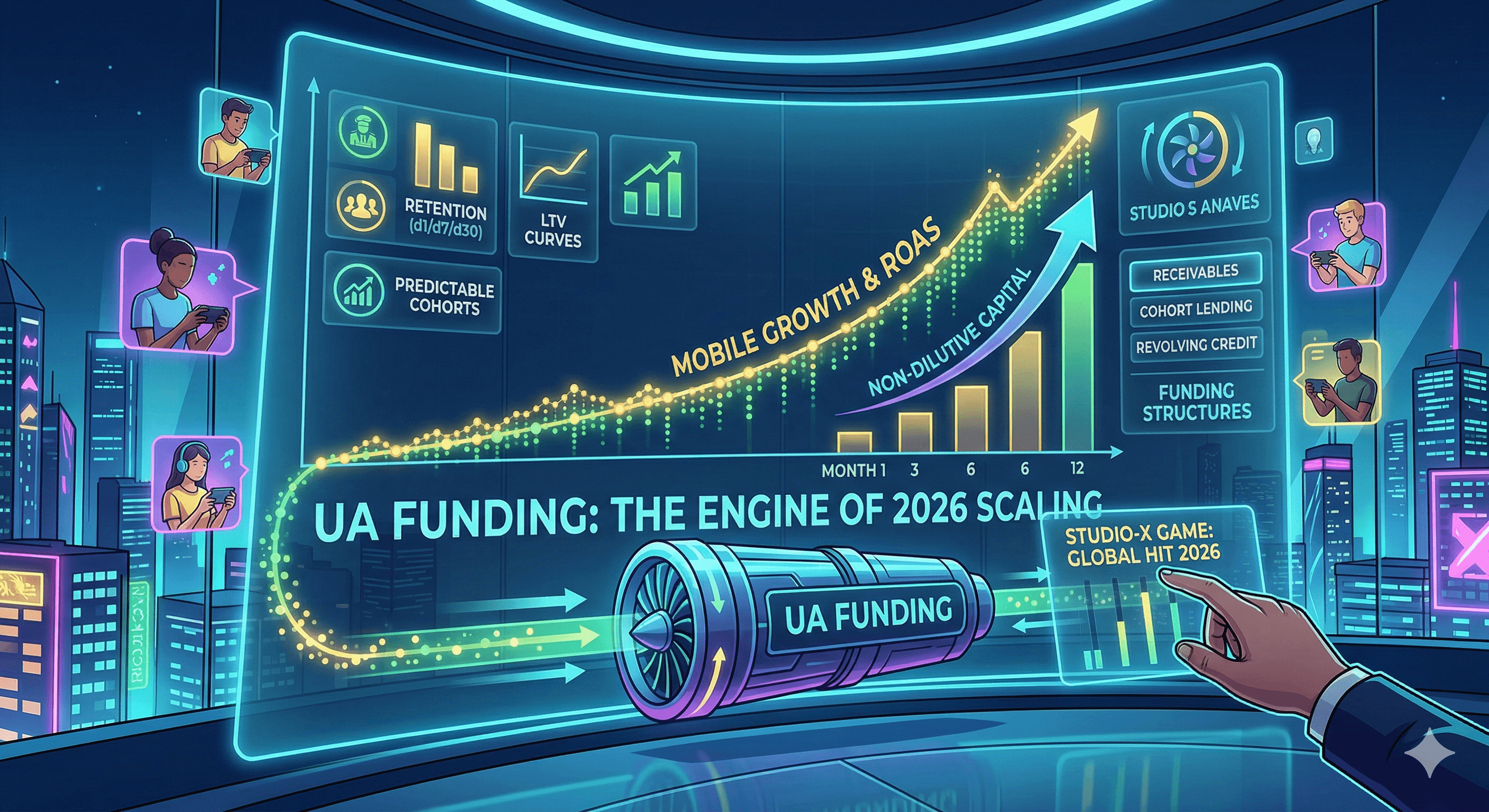
Different funding structures exist, including receivables financing, cohort lending, and revolving credit facilities
UA funding typically works best once a game has proven KPIs and predictable cohort performance
The best partners combine capital with operational expertise and data insights
UA Funding: The Founder's Dilemma
For many founders, scaling a successful game creates a difficult choice. They can raise more equity and give away part of their company, or they can slow growth because marketing budgets are constrained by cash flow.
UA funding changes that equation. It allows studios to scale proven games and grow their portfolio without giving up ownership of the business.
What Is UA Funding?
User acquisition funding is essentially capital that studios can use to pay for marketing campaigns that bring players into their games.
User acquisition itself refers to the process of attracting new players through advertising, app store discovery, and other marketing channels.
In mobile gaming, UA is often the main driver of scale. If the economics work, meaning your lifetime value exceeds your cost to acquire a user, then increasing UA spend should grow the business.
“The challenge is timing.”

UA Funding Explained with Janette D'Alessio: How Mobile Games Scale User Acquisition
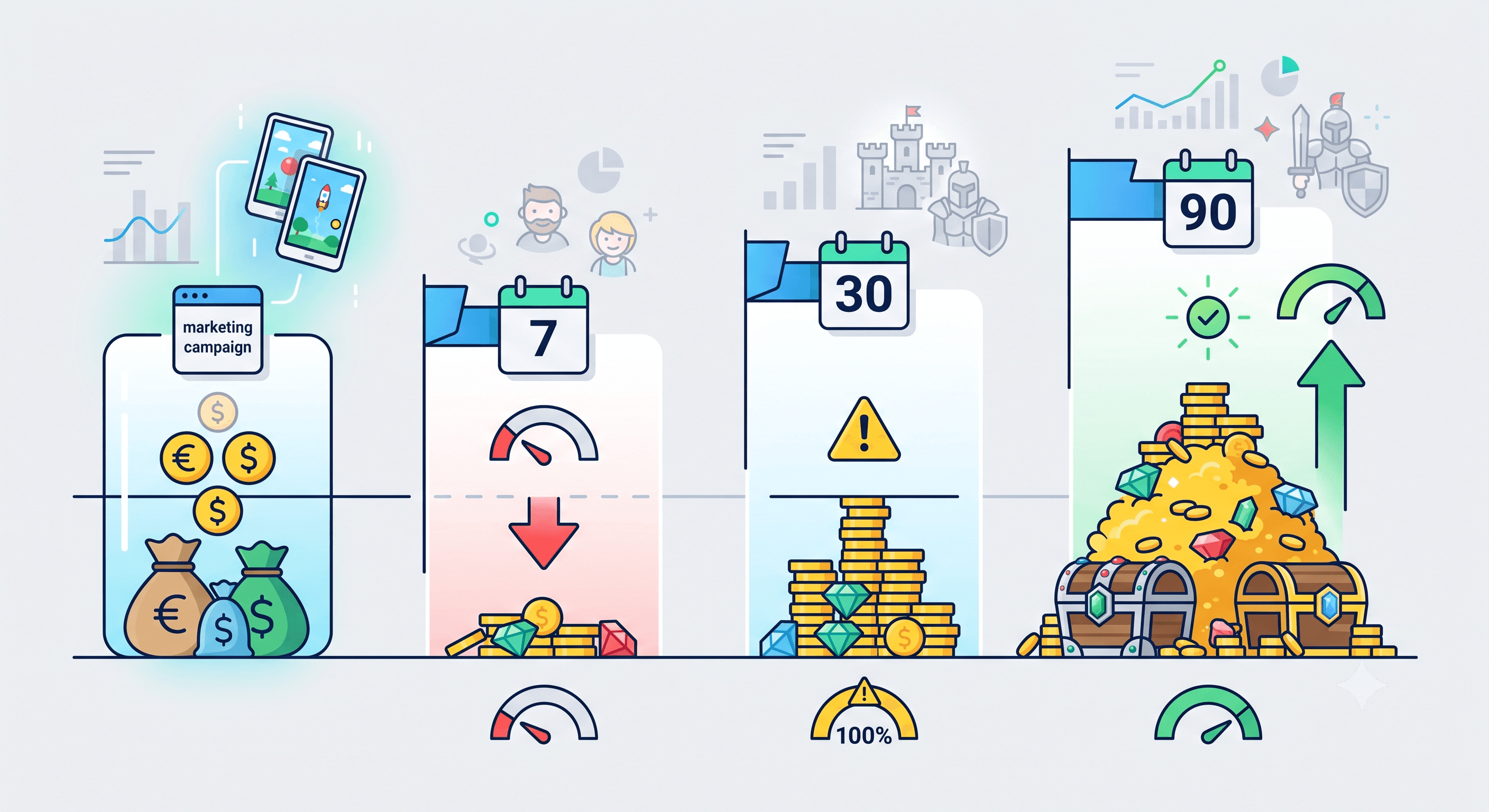
Studios often pay for advertising upfront while the revenue from those players arrives gradually over time. UA funding solves this gap by providing the capital needed to run campaigns today while the cohorts monetize over the coming months.
Instead of slowing down growth due to cash flow constraints, studios can continue scaling profitable campaigns.
Another key aspect is that UA funding is usually non-dilutive. That means developers keep ownership of their company and IP while still accessing growth capital.
Why UA Funding Is Becoming More Popular
The mobile games industry has changed significantly over the last few years.
Raising venture capital has become more difficult. Publishing deals are harder to sign and often require studios to give up control over product decisions or monetization strategies.
At the same time, many experienced teams are building strong games that simply need capital to scale their marketing.
UA funding fills that gap.
Instead of replacing publishers or investors entirely, it provides another tool in the growth toolkit. When used correctly, it allows studios to increase their UA budgets, grow revenue, and increase the overall value of the company.
It also aligns incentives in a different way.
Most UA funding models tie repayment to the performance of the cohorts acquired with the funded campaigns. If those cohorts perform well, the lender gets repaid with a predefined return. If they underperform, the lender shares part of the downside risk.
This makes the structure far more aligned with the realities of mobile gaming economics.
The Three Main Types of UA Funding
While the category is often discussed as a single thing, there are actually several approaches to UA financing.
1. Receivables Financing
This model advances revenue that studios are already earning from platforms like Apple or Google.
Because app stores typically pay on a delay, financing companies can provide access to that cash earlier.
This works well for studios with fast payback cycles and predictable revenue flows. However, it can limit growth if you want to spend more on UA than your current revenue supports.
2. Cohort-Based Financing
Cohort financing has become one of the most widely known models.
In this structure, a funding partner pays for a portion of your UA spend. They then recoup their investment from the revenue generated by the cohorts acquired through those campaigns.
Once the financing partner recovers their investment plus an agreed return, the remaining revenue belongs entirely to the developer.
This structure works well when your cohort performance is predictable and payback periods are relatively clear.
3. Revolving Credit Facilities
A newer model focuses on providing a revolving credit facility that studios can draw from as they scale their UA campaigns.
Instead of funding individual cohorts, developers receive a credit line that can be deployed, repaid, and redeployed as campaigns generate revenue.
This structure is designed to align with how games actually scale over time. When studios push UA harder, payback curves may extend. Flexible financing structures can accommodate that growth without penalizing the developer.
When Should Studios Consider UA Funding?
UA funding is not designed for games in the earliest stages. Equity is often best used for uncertain bets such as building new games or entering new markets, while UA funding is better suited for scaling proven growth engines.
Most funding partners want to see proof that a game’s unit economics work.
That usually means the game has already launched and is spending on user acquisition at some level. Studios should have clear performance metrics such as retention, LTV curves, and ROAS performance.
In practical terms, the best timing is often after soft launch when a game is already scaling toward global release.
Once you know your marketing spend generates profitable cohorts, additional capital becomes a powerful growth lever.
Without it, studios often grow slower than they could.
With it, they can double down on the channels and creatives that are already working.
Key Performance Indicators That Matter
Studios should have visibility into metrics such as retention, lifetime value, and return on ad spend before pursuing financing.
Understanding the game success metrics that drive mobile growth can help developers determine whether their game is ready to scale.
Evaluating Whether Your Game Is Ready to Scale
Before pursuing UA funding, studios should ensure their game has solid market potential and sustainable unit economics.
If you are still evaluating your game’s long term viability, it is worth assessing whether your mobile game is truly ready to scale.
Once a game has predictable performance and profitable UA campaigns, additional capital can significantly accelerate growth.
UA Funding Only Works With Strong Monetization
User acquisition only makes sense when the underlying business model supports it.
If player lifetime value is too low, increasing marketing spend will simply increase losses.
That is why developers need to understand how their revenue systems work before scaling UA.
A strong understanding of mobile game monetization models is essential to ensure that player revenue exceeds acquisition costs.
Studios that optimize monetization alongside UA often see the best results when scaling their games.
Why Partnerships Matter in UA Funding
One of the biggest misconceptions about UA funding is that it is simply a loan.
In reality, the best partnerships combine capital with expertise.
Access to capital is only part of the equation.
The mobile gaming ecosystem moves quickly, and UA strategies change constantly as platforms evolve, privacy rules shift, and creative trends emerge.
Successfully scaling UA requires continuous experimentation with targeting strategies, creative testing, and channel optimization. Studios that want to improve performance should also focus on optimizing their UA campaigns to maximize return on ad spend.
This is where experienced UA teams can provide significant value.
At Plan A Games, for example, we work closely with UA specialists like HubApps to help studios analyze campaigns, refine strategies, and identify opportunities to scale further.
Having experienced UA operators reviewing data, testing ideas, and advising teams can be just as valuable as the capital itself.
When funding and expertise work together, studios can make better decisions and scale faster.
The Future of UA Funding
UA financing is still a relatively new category, but it is evolving quickly.
More capital providers are entering the market, and studios have more options than ever before.
This competition is good for developers. It means more flexible structures, better terms, and funding partners that understand how mobile games actually grow.
What excites me most is that it gives studios more independence.
Developers can retain ownership of their games, control their roadmap, and still access the capital needed to compete at scale.
In a market where marketing budgets often determine visibility and growth, that is a powerful shift.
FAQs About UA Funding for Mobile Games
What is UA funding in mobile gaming?
UA funding is capital provided to game studios specifically to finance user acquisition campaigns. Instead of using internal cash, developers can borrow funds to run marketing campaigns and repay the financing from the revenue generated by those users.
How is UA funding different from venture capital or publishing deals?
UA funding is typically non dilutive. This means studios do not give up equity or ownership of their company. Instead, the funding is tied to campaign performance and repaid from the revenue generated by those campaigns.
What metrics do funding partners look at before approving UA funding?
Most providers look at core performance metrics such as retention, lifetime value, ROAS curves, and the consistency of user acquisition campaigns. These metrics help determine whether scaling UA is likely to generate profitable growth.
Janette is Head of Business Development @ Plan A Games | With +8 year experience in gaming, she drives Game Growth and Partnerships with a unique UA funding model. She's also a regular presenter in the industry at mobile gaming events.
Share
Related Articles