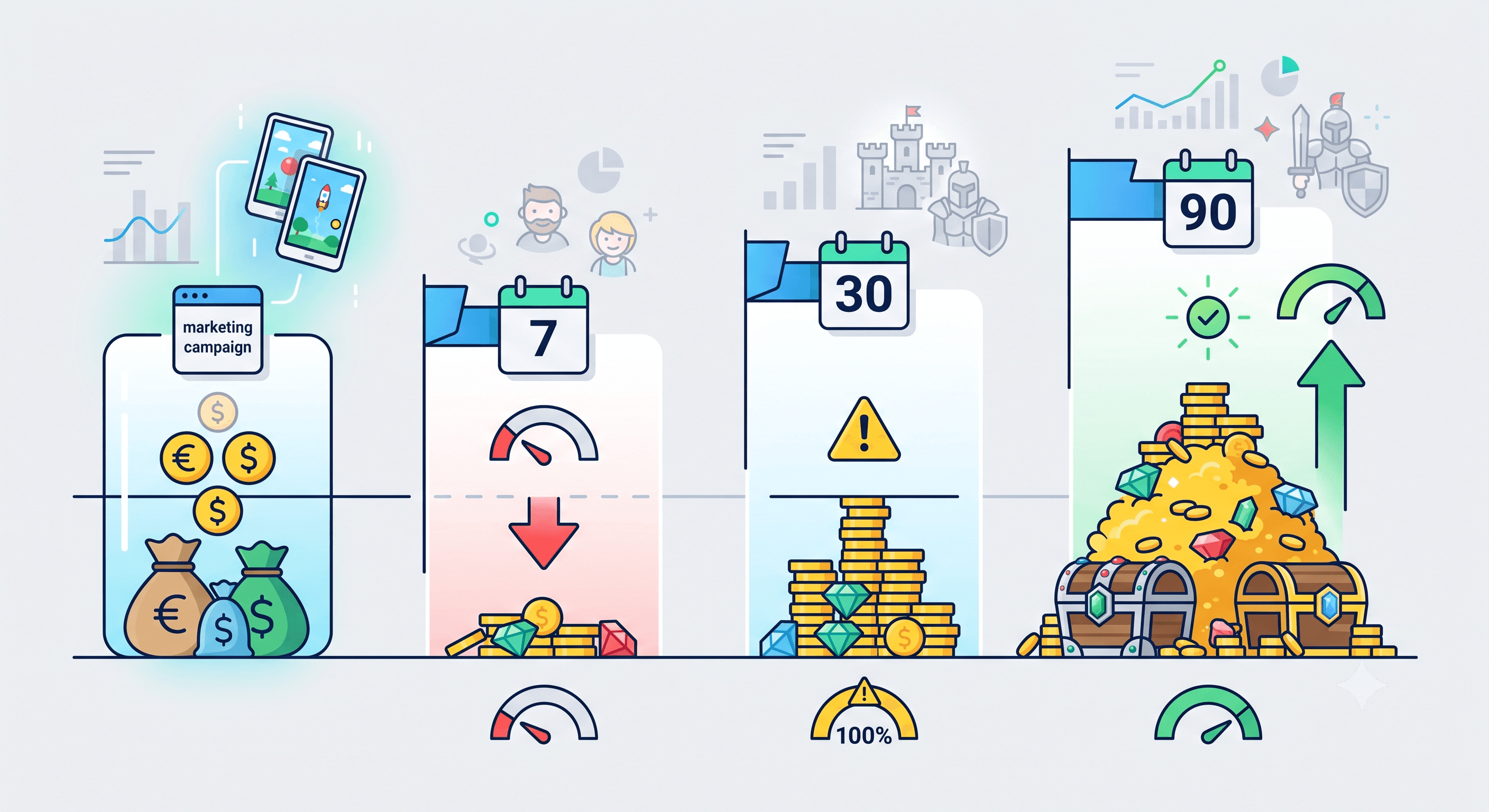
Most teams running mobile user acquisition campaigns are spending confidently but not scaling efficiently. The campaigns are live, the budgets are committed, and the installs are coming in. But players are churning fast, CPIs keep creeping up, and nobody can quite explain why the numbers look healthy on paper but feel disappointing in practice.
That gap between activity and performance is exactly why we built Hubapps. And it is the gap that smart UA optimization is designed to close.
This article is not a beginner's primer on what user acquisition is. If you are running mobile campaigns, you already know the basics. What we want to give you here is the strategic framework we use with our clients to move from spending on installs to building a genuine, scalable acquisition engine.
TL;DR: Key Takeaways
UA optimization is a system, not a one-time fix. It means continuously refining creatives, targeting, channels, and budget across every campaign.
Mobile UA is harder than ever. Global downloads grew just 1% in 2023, CPIs are rising, and privacy changes have broken legacy measurement playbooks.
Define your target user before you spend. Build campaigns around LTV-positive user profiles, not just demographic guesses.
Creatives are your biggest lever. Test new concepts every one to two weeks, across formats and hooks, and only scale on statistically meaningful data.
Diversify channels deliberately. Anchor roughly 70% of budget on proven platforms and use 30% to test new inventory.
Let precision targeting feed AI scaling. Use granular segments to generate signal, then hand the best performers to machine learning tools.
Budget allocation is a live variable. Review it weekly and shift spend toward campaigns with low CPI and strong post-install retention.
ASO amplifies every paid dollar. A well-optimized, localized store listing converts more of the traffic your campaigns drive.
Track the metrics that matter. CPI and installs are only half the picture. D7 retention, LTV, and ROAS tell you whether you are acquiring users worth keeping.
What Does It Mean to Optimize a Mobile User Acquisition Campaign?
Optimization is not a single action; it’s a system. It means continuously refining every layer of your campaign so that the right users see the right message on the right channel at the lowest possible cost.
The essential levers in mobile UA are:
Creative: What you show people and how it makes them feel
Targeting: Who sees your ad and in what context
Channel mix: Where your budget is deployed and how diversified it is
Budget allocation: How dynamically you move spend toward what is working
Post-install experience: Whether the users you acquire actually stay
That last point matters more than most teams give it credit for because an install is not a win.
A retained user and monetizing the game is. If your optimization strategy stops at the download, you are optimizing the wrong thing and won't realize LTV.
Why Mobile UA Is Harder Than It Used to Be?
Before we get into solutions, it is worth being honest about the environment. Mobile user acquisition has become structurally more difficult across almost every dimension.
The market is saturated
Over 12,000 games are launched annually, and that is before you factor in non-gaming apps competing for the same screen time and ad inventory.
Downloads are stagnating
Global app downloads grew by just one percent in 2023, according to data from data.ai's State of Mobile 2024. When the total pool of new users stops growing, the competition for each one intensifies.
CPIs are climbing
According to Adjust's Gaming App Insights Report 2026, global gaming CPI rose 30% year-on-year in 2025, reaching an average of $0.56, with the US climbing to $1.68 per install. Every dollar wasted on a low-quality install is a dollar that cannot be redeployed toward a high-value user.
The same report found that the global paid-to-organic ratio for gaming apps jumped 61% between 2024 and 2025, signalling that organic discovery alone can no longer be relied on to drive meaningful install volume.
Privacy changes have broken legacy playbooks
ATT enforcement, SKAN updates, and shifting attribution windows have made it genuinely harder to measure what is working. Teams that relied on deterministic attribution to guide their decisions are now flying with less visibility than before.
The teams winning in this environment are not the ones with the biggest budgets. They are the ones with the tightest systems.
6 Ways to Optimize Your Mobile User Acquisition Campaigns
1. Define Your Target User Before You Spend a Single Dollar
This sounds obvious. It rarely happens in practice.
Before any campaign goes live, you need a clear picture of what a high-value user looks like for your specific app or game. Not just demographics, but behavioral indicators: what does Day 7 retention look like for users who eventually monetize? Which acquisition sources correlate with lower churn? What device types and geographies index well for LTV?
When you build your campaigns around a user profile grounded in cohort data, you can set bids and budget thresholds that reflect what a user is genuinely worth to you, not just what it costs to acquire them. Tying your bidding strategy to predicted LTV rather than CPI alone is one of the most impactful shifts you can make.
Start with smaller, targeted campaigns that validate your assumptions. Segment by demographics, device, and geography early. The signal you gather in those first two weeks will inform every optimization decision that follows.
2. Master Creative Testing, and Do It Faster Than You Think
Creatives are the single biggest performance lever available to you. We say that without hesitation, having managed campaigns across dozens of mobile products. The difference between a creative that converts and one that does not can be the difference between a profitable campaign and a hemorrhaging one.
Most UA teams test too slowly and too narrowly. Running two variants for a month and picking a winner is not creative optimization. It is coin-flipping with extra steps.
What actually works is introducing new creative variables every one to two weeks: different hooks, different formats (playable ads, UGC-style video, gameplay footage, character-led narratives), different calls to action, different opening frames. You run multiple phases: concept exploration first, then refinement of the strongest performers, then format variations, then scaling by audience segment.
You need sufficient data before making decisions. Hundreds of installs per creative, not dozens. Premature scaling based on thin data is one of the most common and most expensive mistakes in mobile UA.
Watch your fatigue signals closely. When frequency rises and CTR starts dropping, that creative is done. Refresh it before performance collapses, not after.
3. Diversify Your UA Channels Strategically
Concentration risk is real in mobile advertising. If the majority of your install volume runs through a single platform and that platform changes its algorithm, updates its privacy policies, or simply becomes more expensive, your entire acquisition program is exposed.
Diversification is the answer, but it has to be deliberate. Spreading budget thinly across ten channels because it feels safer is not a strategy. It just means you never build enough signal in any single channel to optimize effectively.
The approach we recommend is to establish a core that performs well, then use a portion of your budget (roughly 30 percent) to test adjacent channels. Your core will likely include Meta Advantage+, Google App Campaigns, and TikTok Smart Performance Campaigns. These platforms use machine learning to find high-intent users at scale and they have the install volume to generate meaningful optimization signals quickly.
Beyond the core, consider rewarded and engagement-based networks for audiences already in an active gaming or app usage mindset. Connected TV is increasingly useful as a top-of-funnel awareness driver. For publishers with multiple titles, cross-promotion is an underutilized and highly efficient acquisition channel because you are reaching users who have already demonstrated they engage with your category.
Channel Type | Best For | Budget Priority |
Meta Advantage+ | Broad reach, lookalike scaling | Core (high) |
Google App Campaigns | Intent-driven installs | Core (high) |
TikTok Smart Performance | Younger demographics, creative-led growth | Core (medium) |
Rewarded networks | High-intent gaming audiences | Secondary |
Connected TV | Top-of-funnel awareness | Secondary |
Cross-promotion | Multi-title publishers, low CPI installs | Supplementary |
Emerging channels | Testing new audiences and formats | Testing (30%) |
4. Use Granular Targeting, Then Let AI Scale What Works
The best UA teams we have worked with use a two-phase approach to targeting.
The first phase is precision: you define tight audience parameters and run campaigns long enough to identify which segments are responding.
The second phase is scale: you hand the best-performing segments to AI-powered tools and let machine learning do what it does best.
In phase one, you are validating. You want to understand which combinations of age, gender, geography, device type, and app usage pattern correlate with installs from users who retain and monetize. Spend at least two weeks in this phase before drawing conclusions.
In phase two, you feed that signal into platform-native tools: Google's App Campaigns, Meta's Advantage+ audience targeting, TikTok's smart bidding. These systems will find lookalike audiences at a scale no human team can match manually.
One important caveat: resist the urge to over-restrict your targeting. Overly narrow parameters can reduce your campaign's distribution priority and starve the algorithm of the volume it needs to learn. Precision and scale need to coexist.
5. Treat Budget Allocation as a Live Variable
We have reviewed a lot of campaigns where the budget was set at launch and essentially left alone for weeks. That is leaving money on the table.
We suggest reviewing budget allocations at least weekly.
The goal is to continuously shift spend toward campaigns delivering the best combination of low CPI and strong post-install retention metrics. A campaign that acquires users cheaply but loses them in the first three days is not actually performing well.
Kill underperformers early. Do not wait for the monthly report to make the call. And when you identify a campaign that is delivering quality users at an efficient cost, be willing to scale it aggressively before the window closes.
Geographic expansion is also a legitimate budget efficiency strategy. Tier 2 and Tier 3 markets frequently offer lower CPIs, less competitive auction environments, and strong retention from users who are less saturated with mobile advertising. Testing new geos on a defined budget before committing to a full expansion is a disciplined way to grow reach without overcommitting.
6. Do Not Neglect ASO. It Is UA's Silent Partner
Your paid campaigns drive traffic to your store listing. If that listing does not convert, you are paying for clicks that will never become installs.
App Store Optimization directly amplifies the return on every dollar you spend on paid UA. A well-optimized listing with a strong icon, compelling screenshots, a localized description, and a high average rating will convert more of your paid traffic than a listing that has been ignored since launch.
The most commonly overlooked ASO lever is localization. It is not just translation. It is cultural adaptation: using imagery, keywords, and design sensibilities that resonate with specific markets. Apps that invest in thorough localization can see significantly more organic downloads in non-English markets compared to those with only basic translations.
A/B test your store listing assets just as rigorously as you test your ad creatives. Icon variations, screenshot order, and preview video content all have a measurable impact on conversion rate. Treat your listing as a performance asset, not a static page.
The Metrics Your UA Team Should Be Tracking
Optimization without measurement is guesswork. Although you can check out more in our article on mobile analytics, these are the metrics that matter for mobile user acquisition campaigns:
CPI (Cost Per Install): Your baseline efficiency metric
IPM (Installs Per Mille): How well your creative converts impressions to installs
CTR (Click-Through Rate): Measures creative relevance and audience alignment
D1 / D7 / D30 Retention: The real signal on whether you are acquiring quality users
LTV (Lifetime Value): The north star for all bidding and budget decisions
ROAS (Return on Ad Spend): Measures the revenue return on your investment
Creative fatigue signals: Frequency trend combined with CTR decline
If you are only watching CPI and install volume, you are seeing about half the picture. The post-install metrics are where the real story lives.
Why an Embedded UA Team Outperforms a Generalist Agency
Most agencies run your campaigns. They set them up, report on them monthly, and make recommendations that may or may not get actioned before the next check-in.
That is not what mobile apps and games need in this environment.
An embedded UA team operates inside your workflow. They are not waiting for a briefing document. They are in your data, in your creative review process, and in your weekly performance calls. When a campaign starts underperforming, they do not flag it at the end of the month. They are already on it.
At Hubapps, we built our model specifically because we kept seeing the same problem: talented internal teams who understood their product deeply but were stretched too thin to run UA at the depth and speed the market demands. We fill that gap as specialists who integrate into your team, not sit above it.
The difference shows up in speed of iteration, depth of platform knowledge, and the ability to move budget and creative in response to real-time signal rather than scheduled reporting cycles.
Final Thoughts: Optimization Is a System, Not a Switch
There is no single tactic that fixes mobile user acquisition. The apps and games that consistently scale are the ones that have built optimization into their operating rhythm. They are testing creatives continuously, reviewing budget allocation weekly, watching post-install metrics daily, and treating every data point as an input to a better decision.
That takes bandwidth, platform expertise, and genuine focus on performance. If your team has all of that in-house, excellent. If there is a gap, that is exactly what we are here to close.
If you want to talk through what an embedded UA partnership with Hubapps looks like, get in touch.
Frequently Asked Questions on Mobile UA Optimization
What is a mobile user acquisition campaign?
A mobile user acquisition campaign is a paid marketing effort designed to drive new users to download and engage with your mobile app or game. It typically runs across platforms like Meta, Google, and TikTok, and is measured by metrics such as cost per install, retention rate, and lifetime value rather than impressions or clicks alone.
What is a good cost per install for a mobile app?
It depends heavily on your category, platform, and geography. Feel free to touch base with us to find out your benchmarks.
How often should I refresh my ad creatives?
We recommend introducing new creative concepts every one to two weeks. The most common mistake UA teams make is testing too infrequently and for too long. Watch for fatigue signals: when your frequency is rising and your CTR is falling, that creative needs to be refreshed immediately, not at the end of the month.
How do I know which UA channels to prioritize?
Start by identifying where your highest-LTV users are coming from, not just where your installs are coming from. Run your core budget through platforms with proven scale like Meta, Google, and TikTok, and reserve roughly 30 percent for testing emerging or supplementary channels. The table in section three of this article gives a practical breakdown of channel types and their best use cases.

Mobile gaming UA specialist since 2011. A female pioneer in the industry, Maria has scaled games across every major platform and genre, from indie puzzle games to massive strategy titles. Known for straight talk and results that actually matter.
Share
Related Articles