Key Takeaways
|
A few years ago, the analytics conversation in mobile gaming was relatively straightforward. You
tracked installs,
monitored your cost per install,
watched your day-one retention,
and optimized your ad creative.
If those numbers were decent, you scaled. If they were not, you paused and tested something new.
That model is broken now. Not because the metrics themselves are wrong, but because the environment around them has shifted so dramatically that studios relying on those four numbers alone are flying with a faulty instrument panel.
Mobile gaming generated approximately $103 billion* in annual revenues in 2025, making it the largest segment of the global gaming market at 55% of total industry revenue (Newzoo / maf.ad).
That is an enormous market.
But it is also a ruthlessly concentrated one.
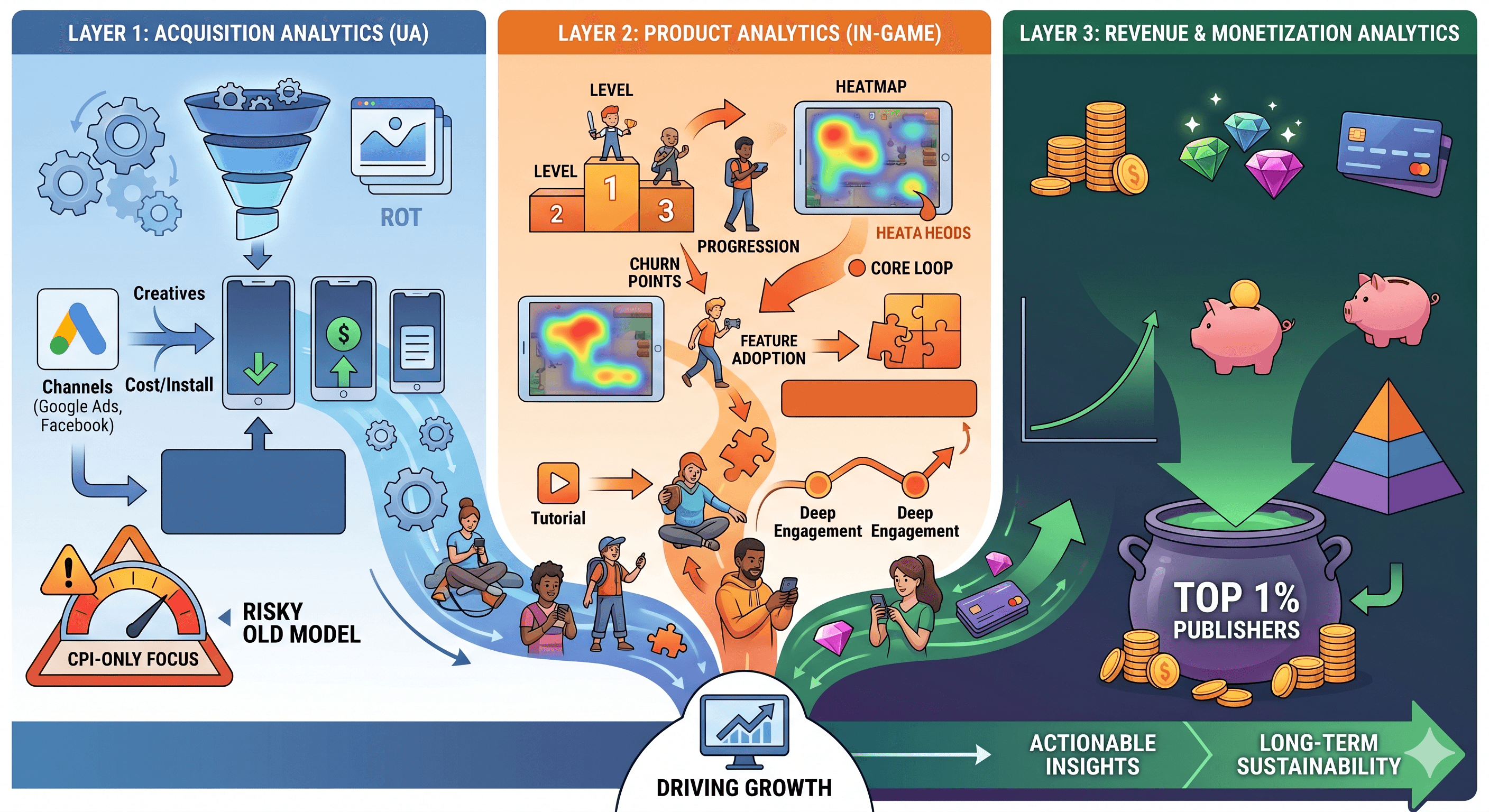
In 2025, 92.5% of all in-app purchase revenue was generated by titles from the top 1% of publishers (manataz.com). The studios winning at scale are building analytics infrastructure that connects acquisition to retention to monetization in a way that most mid-size studios are not.
Let's get into it
What is Mobile Game Analytics?
The phrase 'mobile game analytics' is used to describe everything from a Firebase dashboard to a custom data warehouse feeding a real-time LiveOps decision engine. For the purposes of making strategic decisions, it helps to think about analytics in three distinct layers.
Layer 1: Acquisition Analytics
This covers everything that happens before a player touches your game.
Which channels are bringing users in?
What is the effective cost per install by source?
Which creatives are converting,
and at what funnel stage are prospects dropping out?
This layer is dominated by your Mobile Measurement Partner (MMP) and your paid UA data.
Layer 2: Product Analytics
This is the in-game layer.
How are players progressing through your levels or content?
Where are they churning?
Which features are driving session frequency?
What does the monetisation funnel look like from first open to first purchase?
This is where tools like GameAnalytics, Amplitude, Firebase, or a custom event tracking setup live.
Layer 3: Revenue and Monetisation Analytics
This is the financial layer that most studios underinvest in.
What is the actual lifetime value of a cohort by acquisition source, by geography, by device, and by genre sub-segment?
How are your in-app purchase conversion rates trending?
What is your ARPPU and how does it segment across your payer base?
This layer is where acquisition analytics and product analytics have to converge, and where the most consequential decisions are made.
The Metrics That Matter Most
Below is a working reference for the core KPIs every CMO in mobile gaming should be able to discuss without notes. Benchmarks are illustrative and vary meaningfully by genre, platform, and region.
Metric | What it Means | What It Measures | Why It Matters | Benchmark to Aim For |
Day 1 Retention | - | % returning the day after install | Quality of onboarding and first impression | ~29% average (AppsFlyer) |
Day 7 Retention | - | % still playing one week in | Whether the core loop is compelling | ~8-10% average |
Day 30 Retention | - | % active one month later | Long-term product-market fit | 3-5% is competitive |
LTV | Lifetime Revenue | Total revenue per acquired user | Sets the ceiling on viable CPI | Depends on genre and model |
ROAS | Return on Ad Spend | Revenue generated per ad dollar spent | Efficiency of paid UA at channel level | Target 100%+ at D90-D180 |
ARPDAU | Average Revenue Per Daily Active User | Revenue per daily active user | Monetisation health day-to-day | Varies widely by genre |
ARPPU | Average Revenue Per Paying User | Revenue per paying user | Depth of spend among payers | Tracks whales vs broad base |
CPI | Cost per Install | Cost to acquire one install | UA economics and channel efficiency | iOS mid-core avg $3.80 in 2025 |
On the retention side, the numbers are sobering.
According to data from AppsFlyer via Segwise, the average Day 1 retention rate across mobile games sits at approximately 29%, Day 7 at around 8.7%, and Day 30 at around 3.2%. A GameAnalytics benchmark study of over 10,000 games noted median Day 7 retention of 4.2% and Day 28 retention of 0.85% (Game Industry Library).
The gap between median and top-quartile performers is crazy; top-quartile games operate in a different retention tier entirely.
Retention matters! If your Day 30 retention does not justify the cost of acquiring a user at those rates, no amount of creative testing or bid optimisation will save your payback period.
Building an Analytics Stack That Actually Works
One of the most common mistakes studios make is treating analytics as a tooling problem. They add platforms, add events, add dashboards, and then discover they have more data than they can act on and less insight than they need.
The question is not what tools you are running. It is whether your stack can answer the three questions that drive growth decisions.
Question 1: Where is my LTV coming from?
Every dollar of ad spend needs to map to a downstream LTV estimate by source. Without this, you are optimizing for CPI, which is a cost metric, not a value metric. Your MMP and your product analytics need to be joined at the hip.
If you are spending significant budget on UA campaign optimisation and cannot produce a D30 ROAS figure by channel, that gap needs to be closed before you scale.
Question 2: Where are players dropping out and why?
Funnel and cohort analysis inside your product layer should be able to identify the exact sessions, features, or content gates where retention breaks down.
The 'why' is harder and requires combining quantitative data with qualitative signals, including review monitoring, support ticket analysis, and where possible, player surveys. Analytics tells you something is happening.
Understanding why requires a human layer on top.
Question 3: Who are my most valuable players, and what do they have in common?
Segmenting your payer base is not optional at any meaningful scale. The relationship between ARPU and ARPPU is rarely linear. A small cohort of high spenders often subsidizes your entire revenue base. Knowing what acquisition source, creative type, geography, or device tier those players came from is the foundation of profitable scaling.
What Are the Biggest Mistakes in Mobile Game Analytics
Having worked with mobile gaming studios across a range of genres and scales, these are the patterns that cost studios the most money.
Optimizing for installs instead of downstream value
The most expensive mistake in mobile UA is scaling a campaign because it delivers cheap installs, without knowing whether those users retain or monetize. A $0.80 CPI campaign that produces users with a Day 30 retention of 0.5% is not cheap. It is a drain on your budget.
The fix is to hold every campaign to a ROAS or LTV-per-install standard, not simply a CPI standard.
Treating Day 1 retention as the only onboarding signal
Studios that focus exclusively on Day 1 retention miss the more important question of what happens between Day 1 and Day 7. A game can have a serviceable Day 1 rate and still hemorrhage players in the first week because the core loop does not deliver on the promise of the tutorial.
Tracking session frequency and feature adoption in the first three days is a more actionable leading indicator of Day 7 and Day 30 outcomes.
Running analytics in silos
When UA, product, and monetization analytics are owned by different teams using different tools with no shared definitions, you get conflicting numbers, missed correlations, and slow decisions. The classic symptom is a studio that knows its CPI by channel and knows its Day 30 retention by cohort, but cannot connect the two to produce a meaningful ROAS figure.
Ignoring the privacy signal degradation
The combination of Apple's App Tracking Transparency, evolving GDPR enforcement, and Google's Privacy Sandbox has fundamentally changed what data is available and how reliable it is. Studios that have not adapted their measurement models to account for signal loss are working from optimistic numbers.
Probabilistic modeling, aggregated reporting from SKAdNetwork, and a heavier reliance on first-party cohort data are not optional. They are the new baseline.
Collecting data that never drives a decision
Many studios instrument hundreds of events into their analytics platform, generate weekly dashboards, and then continue making the same decisions they would have made without the data.
Analytics is only valuable when it changes behavior.
If your team cannot point to a specific decision made differently because of a specific data signal last month, your analytics program has a culture problem, not a data problem.
This is particularly relevant when thinking about in-game advertising, where ad placement and frequency decisions that feel instinctive often turn out to have a measurable and significant impact on retention when properly A/B tested.
Benchmarking against the wrong peers
Global averages for retention and monetization metrics are useful context, but they can be deeply misleading if your game is a mid-core strategy title and you are measuring yourself against the casual games average.
Genre, platform mix, geography, and monetization model all produce very different benchmark ranges. Apply the relevant peer group or you will draw the wrong conclusions.
What about Analytics for Soft Launch?
The sections above treat analytics as an ongoing operational discipline, which it is. But there is a phase that sits before all of it where measurement decisions get made or missed that are very difficult to unpick later: soft launch.
Soft launch is not a marketing exercise. It is a data collection exercise. The goal is to answer these questions with enough statistical confidence that you can justify scaling:
Does the core loop retain players beyond Day 7?
Does the monetization model produce an LTV that makes UA economics viable?
And is the product stable enough to handle the traffic a scaled campaign will bring?
And ultimately, is the game worth it?
The answers to those questions are also what UA funding partners evaluate before committing capital to a studio.
A well-structured soft launch produces a data package, retention curves by cohort, early LTV estimates by channel, payer conversion rates, and ARPPU, that allows an external partner to stress-test your unit economics before underwriting the spend.
We'll delve more into soft launch analytics and data in another article. For now, it's about understanding that the metrics you use depend on the stage of your game.
What Tools Power Each Analytics Layer?
Layer | Common Tools | What They Handle |
Acquisition Analytics | Adjust, AppsFlyer | Attribution, campaign-level cost data, fraud detection, cohort tracking by source |
Product Analytics | Firebase/GA4, GameAnalytics, Amplitude | In-game event tracking, funnels, retention curves, segmentation |
Revenue & Monetisation | BigQuery, Snowflake, plus a BI layer like Looker or a purpose-built AI analyst | Warehousing that joins acquisition, product, and revenue data so LTV-by-source and blended ROAS become answerable in one place |
Mobile Gaming Metrics: Where to Focus First?
If you are a CMO or studio leader trying to raise the analytical maturity of your team, the instinct is often to reach for a new platform and to try and account for as much data as possible. Resist that. Most studios have more data than they use well.
Start by mapping the metrics that matter and ultimately those that illustrate long-term sustainability of the game.
The studios consistently outperforming in mobile gaming right are running tighter feedback loops between what the data says and what the team does next. That discipline is learnable, and it is the highest-leverage investment a studio can make before scaling user acquisition or pushing into new markets.
*Statistics and market data referenced in this article are drawn from publicly available industry reports including Newzoo, Sensor Tower, AppsFlyer, Mordor Intelligence, GameAnalytics, and manataz.com. All figures should be treated as directional benchmarks. Specific metrics will vary by genre, geography, platform, and studio context.
FAQs on Gaming Metrics:
What is the difference between acquisition analytics, product analytics, and revenue analytics in mobile gaming?
Acquisition analytics covers everything before a player installs your game: which channels, creatives, and campaigns are delivering users and at what cost.
Product analytics covers in-game behavior: where players progress, where they churn, and which features drive session frequency.
Revenue analytics connects the two by mapping lifetime value back to its source.
Most studios are reasonably capable at one of these layers. The ones scaling profitably have all three talking to each other.
What retention rates should a mobile game be targeting?
Industry data from AppsFlyer puts the average Day 1 retention across mobile games at approximately 29%, Day 7 at around 8.7%, and Day 30 at around 3.2%.
Top-quartile games perform meaningfully above these averages.
The more important point is that these benchmarks vary significantly by genre, platform, and geography, so applying the right peer group matters as much as knowing the numbers. A mid-core strategy game should not be measuring itself against the casual games' average.
Why is optimizing for cost per install (CPI) a mistake?
CPI is a cost metric, not a value metric. A campaign delivering installs at $0.80 can still be destroying budget if those users churn before generating any revenue.
Every acquisition decision should be held to a ROAS or LTV-per-install standard instead. Without connecting your MMP data to downstream retention and monetization, you are scaling the wrong campaigns and will not know it until the damage is done.

Mobile gaming UA specialist since 2011. A female pioneer in the industry, Maria has scaled games across every major platform and genre, from indie puzzle games to massive strategy titles. Known for straight talk and results that actually matter.
Share
Related Articles


