If you’ve opened any mobile game in the last few years, you’ve seen them: chaotic “pull-the-pin” puzzles, disaster scenarios that make no sense, dramatic choice screens that never appear in the actual game, and playable ads that feel like they belong to an entirely different genre.
They’re everywhere — roasted in memes, celebrated in marketing circles, scorned by players, dissected by analysts.
Welcome to the wild, ridiculous, strangely effective world of fake mobile game ads.
And in 2026, they’re at a fascinating turning point. The strategy still works, but the terrain has changed: platforms are stricter, players are smarter, and UA teams can’t rely on cheap CPI forever. Some studios are doubling down, others are pulling back, and the smartest ones are evolving their entire creative-to-product pipeline.
This guide breaks down what fake ads really are, why they worked so well, why they’re wobbling now, and what forward-thinking studios should actually do about them.
Let’s dive in.
What EXACTLY is a fake ad?
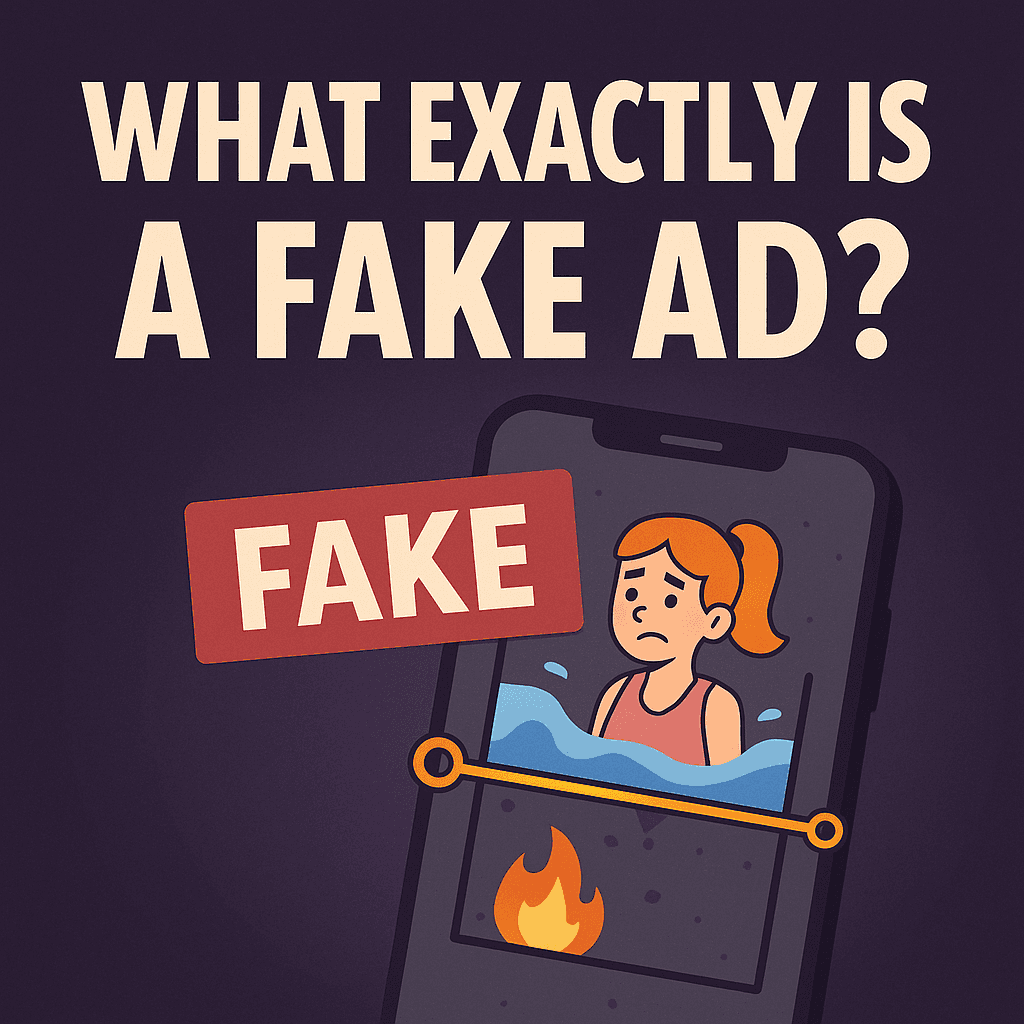
A fake ad is an ad creative that presents something as part of the game — a mechanic, scenario, feature, or emotional payoff — that the player will not realistically encounter when they install and play the game.
A fake ad is not an exaggeration; it doesn't feature creative framing.
It's fundamentally a material mismatch.
That covers a spectrum:
Fully fabricated playables built to convert but not representative of the core loop.
Fail / frustration ads (the classic “that player keeps pulling the wrong pin!”) showing situations or mini-games that either don’t exist or are buried so deep they’re effectively never encountered.
Dramatic scenes / decision screens that imply story or mechanics the app lacks.
Let’s clear this up once and for all.
Think:
A game shows intense puzzle-solving… but the actual app is match-3.
A playable demo showcases a mini-game that doesn’t exist.
A cinematic suggests branching moral choices… that the game doesn’t offer.
A fail ad shows a puzzle that exists only at level 175 — far past where 90% of players churn.
This mismatch is what turns a creative from “stylized” into “fake.”
But here’s the nuance: fake ads exist on a spectrum.
Some are mild stretches. Some are outright fiction. And most studios don’t set out to deceive — they test everything and scale whatever hits CPI targets. If the fake one wins… well, guess which gets the spend?
Why do fake ads work for gaming? (the ugly truth)
Love them or hate them, fake ads exploded because they worked too well.
Fake ads are a performance play: they often produce higher CTR and lower CPI during creative testing. In UA teams’ dashboards, the numbers are stark — a weird fail ad can beat a truthful gameplay reel 2–4x in early tests. That’s why they keep getting budget.
Their superpower isn’t mystery — it’s psychology.
Fake creatives work because they exploit reliable human responses:
The curiosity gap — ads stop just before a payoff. Humans click to resolve the question.
Frustration bait / “I can do better” hooks. Watching an on-screen player fail a trivial task triggers reactance — users want to prove they’re smarter.
Pattern interruption — odd art, poor animation, or surreal logic breaks the scroll reflex.
Immediate stakes — dropping a user into danger or drama cheats the brain into caring fast.
You don’t have to mislead to use these levers. The principle: hook fast, deliver honestly. Use curiosity and urgency — but show something the player actually gets in the first run.
The problem with Fake Ads
Short-term: Fake ads → low CPI, high volume, fast scale.
Long-term: Fake ads → lower retention, worse LTV, more churn.
Most UA dashboards only highlight the short term. Low CPI looks sexy. Big install numbers look sexy. Growth charts go up and to the right.
But numbers hide the follow-through. High-volume installs from fake creatives can lead to higher churn and a range of negative consequences.
When you zoom out, a pattern emerges:
Day-1 and Day-7 retention are significantly lower
LTV is weaker
You pay more later to replace churned users
App store reviews take a hit
Trust degrades (especially in saturated genres)
Fake ads are like speedrunning a game using glitches: you might finish faster, but the risk of breaking the run is real.
Recent industry reports show playable formats and honest creatives are rising because long-term ROAS beats the cheap install bubble when you factor in retention.
Rules & enforcement — what’s new in 2026?
Regulators and platforms have already acted and continue to tighten policy.
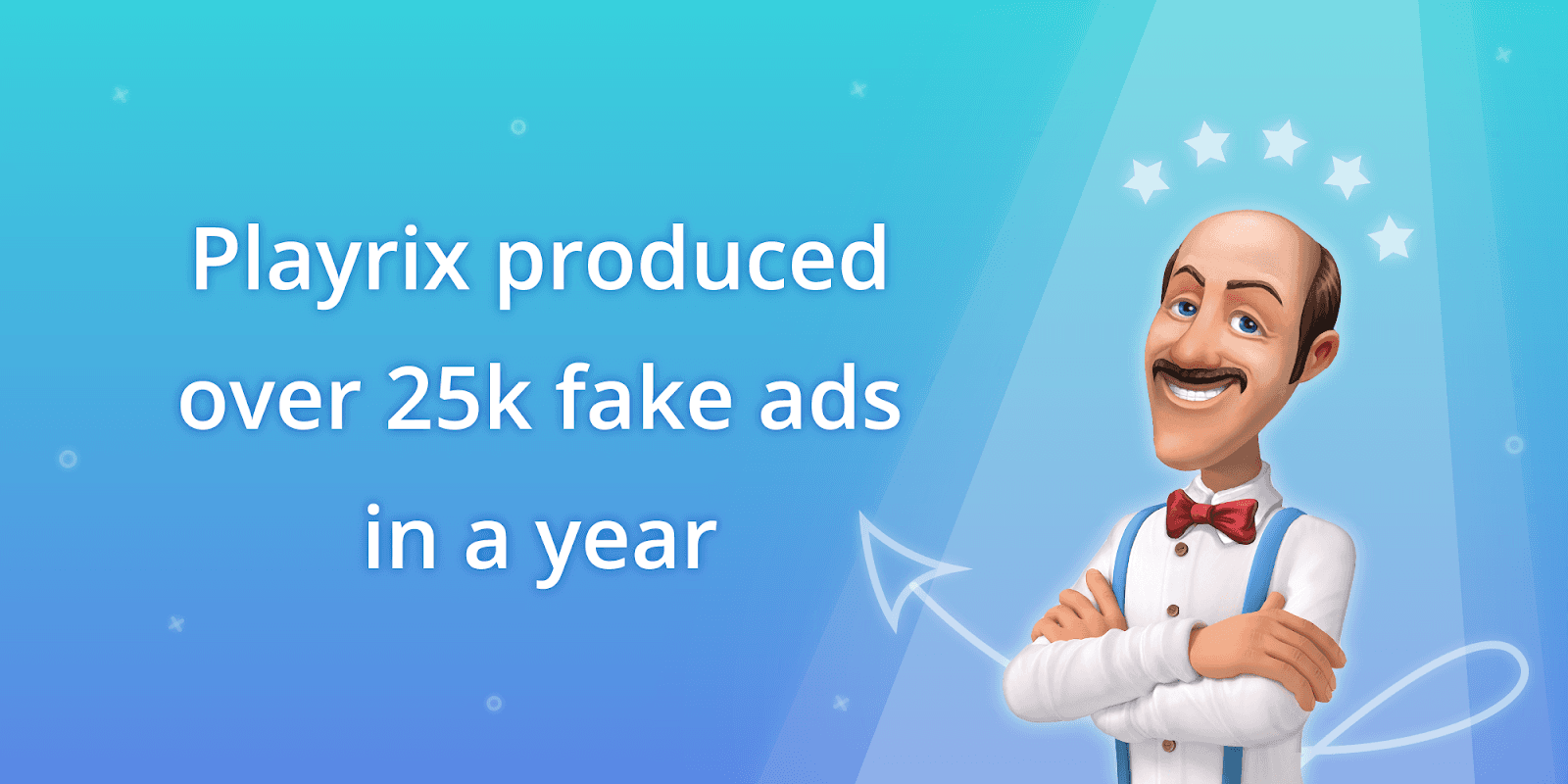
In 2020, Playrix was banned from using misleading creative that misrepresented gameplay. And a bunch followed suit.
Google Play and major ad networks have updated deceptive-ads / misrepresentation policies (e.g., removing UI-impersonation, limiting misleading button designs), and they increasingly police creatives that simulate interfaces or impersonate features. Expect stricter enforcement and ad rejections if you push the lie too far.
Take NOTE:
Put simply, you can still be edgy, but outright fabrications that would “materially mislead” a reasonable user are riskier than before. Add a compliance gate to your scale decisions: if a creative would cause regulatory complaints in markets like the UK or EU, either adjust it or don’t scale it there.
For studios building governance, Hubapps recommends a compliance log and creative audit before global scale — part of the full-suite UA approach.
The smart playbook for fake ads in 2026 — how to win without burning your brand?
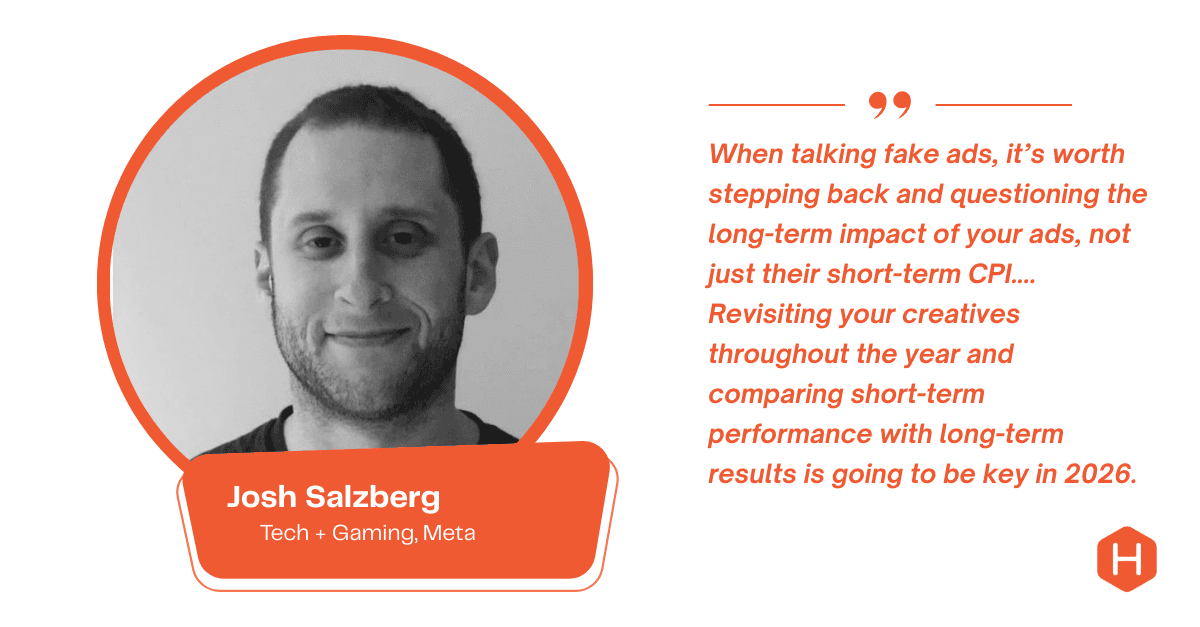
“Considering we've been seeing fake ads, in some form, for so many years, UA teams and creative departments generate them more as a reflex rather than as a thought-out strategy.
Creative planning often starts by looking at what competitors are running. But when everyone uses the same tools and copies the same patterns, it creates an endless feedback loop of similar ads fueling more similar ads. This article does a great job of asking the most critical question in that cycle: why is this actually working — and at what cost?
If creative planning is part of your day-to-day, it’s worth stepping back and questioning the long-term impact of your ads, not just their short-term CPI. As we move into a new year, UA and creative teams should do what good businesses always do: look back, review how the year started versus where it ended, and learn from it.
Revisiting your creatives throughout the year and comparing short-term performance with long-term results is essential. That reflection is what should shape creative strategy going into 2026 — not reflex, not imitation, but informed decisions based on real outcomes.”
Josh Salzberg, Tech + Gaming @Meta
The rules for fake ads have changed in 2026
Players are wise to the trick.
They’ve been burned, memed it to death, and now scroll past more aggressively.
Platforms are cracking down.
Google Play, ad networks, and certain regulators have tightened definitions around:
Misrepresentation
Impersonation of UIs
Missing or inaccessible features
Over-promising gameplay
This doesn’t kill fake ads outright, but it raises the risk.
In 2026, treat fake ads like hypotheses, not strategies.
Experiment fast, but don’t scale blind. Use fake creatives to discover hooks, but require a retention test before scaling beyond a defined spend threshold.
Ship parity or pivot product. If a fake creative consistently wins, plan a minimal viable version of that mechanic (mini-game, bonus mode) into the next sprint. That reduces churn and aligns product with expectations.
Hybrid creatives (truthful hook + curiosity). Start with a cinematic hook, then show the real loop in the last 1–2 seconds or an end card that says “Play this exact mini-challenge in-game.” That keeps curiosity while fixing expectations.
Invest in playables and UGC. Playables that feel like the real game convert and retain better. User-generated ads (influencer-style) often outperform fake creatives in retention because they set realistic expectations.
Add an onboarding reward tied to the ad hook. If your ad shows a “pull-the-pin” challenge, give installs a small token or tutorial that lets them access a similar bite-sized challenge immediately. Small delight → lower uninstall.
Compliance & creative audit. Add a short checklist: does this creative show features available in the first session? Does it impersonate UI? Would an ASA-like regulator flag it? If yes, revise.
Operational checklist (quick, do this now)
Run a creative-to-product gap matrix for every top-performing creative.
If a fake ad wins, A/B test an honest variant that shares the same hook but shows real gameplay.
Add a “mini-game parity” ticket into the product backlog for the top 1–2 fake creatives that scale.
Instrument Day-0 funnels and measure conversion → D1 → D7 for users from fake vs honest creatives.
Keep a legal/regulatory log per market — some countries/markets (like the UK) are already more aggressive.
Our final verdict on fake ads
In 2026, fake ads won’t vanish. But the era of “pure fiction” is fading.
The winning path is:
authentic playables
story-driven UGC
hybrid creatives
product alignment
honest but dramatic hooks
better onboarding
smarter governance
When studios use fake ads purely for cheap installs, they get cheap results. But when they use them as R&D for what players want, then integrate those findings into gameplay and retention — that’s where the real growth happens.
The future belongs to studios who:
respect their players,
align creative with product,
understand long-term ROAS, and
build trust alongside performance.
Our final advice
Use fake ads as experiments.
Use hybrid ads to scale.
Use your product team to close the expectation gap.
Use playables and UGC to keep things real.
If you'd like a solid UA strategy in 2026, let's talk.

Mobile gaming UA specialist since 2011. A female pioneer in the industry, Maria has scaled games across every major platform and genre, from indie puzzle games to massive strategy titles. Known for straight talk and results that actually matter.
Share
Related Articles


