
Are female and male gaming audiences fundamentally different?
Without intending to strengthen or widen gender stereotypes, the bottom line is yes, but perhaps not in ways you might have imagined.
The gaming audience today isn’t some outdated stereotype of teens in basements. It’s diverse, engaged, and evolving — and female gamers are not just present, they’re powerful. For marketers who are serious about growth, understanding how women and men play differently is not optional — it’s strategic.
Before we 'launch’ into the article, we'd like to say that this is not a blanket statement, nor do we intend to reinforce stereotypes. This is just about understanding differences and tailoring UA approaches where necessary.
The Modern Gamer: Nearly Equal in Number
Contrary to old assumptions, the global gamer base is almost evenly split by gender. Recent research shows women make up about 45–48% of all gamers worldwide. In some regions and platforms, the balance is even tighter, with surveys reporting 48% women vs. 51% men (NewZoo) — nearly parity.
This means that in total reach, female gamers are not a niche — they are a core audience.
In the US, 64% of women said they regularly play games on smartphones, compared to 58% of men.
Of course, stats will have shifted potentially but the top three genres for women in 2024 were
casual (39% of U.S. female respondents said they played this genre in general),
followed by strategy (34%)
and action (31%).
For U.S. men the top three were action (48%), action-adventure (45%) and shooters (38%).
How do Women and Men Game Differently?
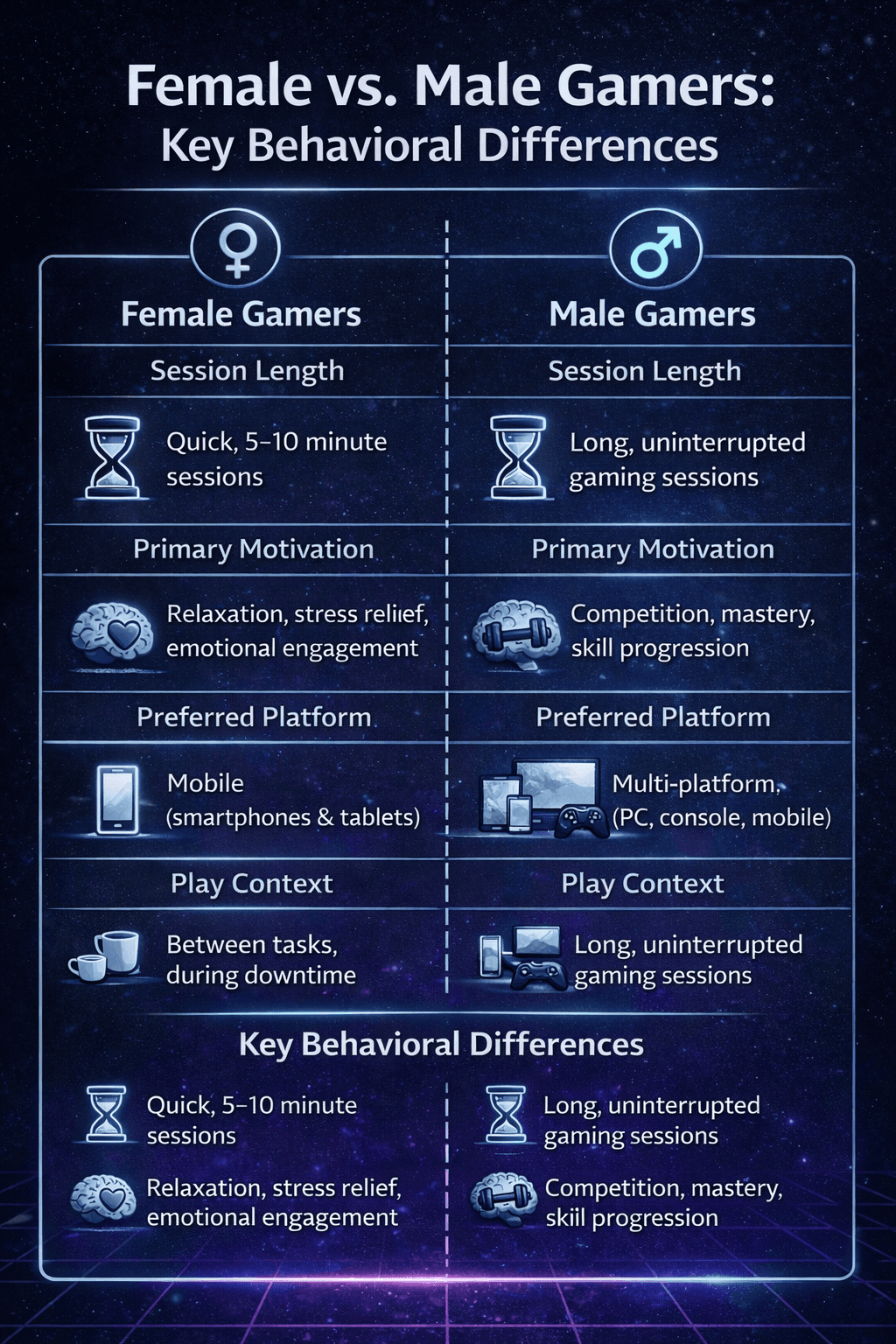
Female vs. Male Gamers — Key Behavioral Differences
Dimension | Female Gamers | Male Gamers |
Primary motivation | Stress relief, relaxation, emotional engagement | Competition, mastery, progression |
Session length | Short sessions (often 3–10 minutes) between tasks | Longer, uninterrupted sessions |
Play context | Multitasking: work breaks, caregiving, daily routines | Dedicated play time |
Preferred platforms | Mobile-first; high mobile-only usage | Multi-platform (mobile + PC + console) |
Genre tendencies | Puzzle, casual, narrative, social, simulation | Action, shooter, strategy, competitive |
Engagement triggers | Calming feedback, ASMR-like effects, positive reinforcement | Challenge loops, ranking systems, skill progression |
Community interaction | Smaller, safer, more private social spaces | Open, competitive, public communities |
Self-identification | Less likely to call themselves “gamers” | More likely to adopt gamer identity |
Spending behavior | Value-driven purchases (cosmetics, story, social features) | Performance-driven purchases (power, progression) |
Ad creative response | Emotion-led, lifestyle-based, relatable scenarios | Skill-based, competitive, outcome-focused |
This isn’t about reinforcing stereotypes — it’s about designing acquisition, creative, and retention systems that match real behavior.
If your UA creatives assume:
long sessions,
competitive motivation,
or hardcore identity cues,
You’re structurally under-serving a huge portion of your audience — especially women who play frequently, but differently.
Short sessions don’t mean low value. They mean different value mechanics.
1. Motivation & Play Style
One of the biggest differences isn’t just what games people play — it’s why they play.
Female gamers are significantly more likely to game for:
Relaxation and stress relief
Short, flexible sessions
Social or narrative engagement
Data suggests up to 63% of women game primarily to de-stress (ZipDo), and their average weekly play time is often spread across shorter bursts rather than marathon sessions.
In contrast, male gamers are more likely to engage in longer, extended sessions — often tied to competitive play, mastery goals, or looping mechanics that reward time investment.
2. Platform Preferences
Platform choice matters greatly in how marketers design campaigns and retention strategies.
Women show a strong preference for mobile gaming. Nearly half of female players are mobile-only, compared to a much lower share among male gamers. Newzoo
Games that support on-the-go play — quick puzzles, narratives, social sims — tend to see a higher female engagement rate.
Men are relatively more active across multi-platform ecosystems — mobile + PC + console — especially in core and competitive segments.
For marketers, this means mobile optimization and cross-platform touchpoints are critical for reaching women effectively.
3. Genre & Engagement Patterns
There are also systematic differences in genre interest:
Female gamers often gravitate toward:
Puzzle and casual titles
Narrative and story-rich games
Multiplayer social experiences
Male gamers often gravitate toward:
Competitive shooters
Esports titles
Strategy and action games
But these are tendencies, of course, not absolutes. Women also play RPGs, Sims-style games, strategy titles, and even competitive multiplayer when the environment feels inclusive and supportive.
The takeaway? Assume diversity within each group, but tailor experiences based on broader behavioral patterns.
What should studios consider when marketing to female gamers?
Identity & Perception: “Gamer” as a Label
This is a critical but often overlooked insight:
Even though nearly half of gamers are women, women are significantly less likely to self-identify as “gamers” compared to men — only around 36% of women describe themselves that way. Newzoo
That matters for how marketing language resonates. Messages centered around identity (“Are you a gamer?”) may unintentionally alienate a large portion of women who are active players but don’t adopt the gamer label.
Instead, messaging grounded in behavior and emotion (“Play to relax”, “Mobile fun between tasks”) will land more authentically.
Social & Community Dynamics
Women often engage differently with communities:
They may prefer private social groups over open competitive spaces.
They report greater sensitivity to community tone and are more likely to disengage from toxic chat environments.
Many avoid broadcasting their gaming identity publicly due to negative experiences.
This means marketers should think beyond the traditional “competitive” gamer community and invest in safe, upbeat social ecosystems (for example, dedicated women’s spaces, story-focused communities, or co-play experiences).
Spending Power & Commercial Behavior
While some older narratives suggest women spend less on gaming, more recent data paints a different picture:
Women influence and contribute to game spending meaningfully across platforms.
They are more likely to make purchases linked to community, customization, and social engagement.
Mobile and in-game content purchases show high female participation rates — often tied to enjoyment and personal expression.
This highlights a key opportunity: monetization strategies should align with motivations, not just session length. Bundles, narrative expansions, and social features can outperform standard competitive monetization models.
Esports & Competitive Play: A Gap, Not a Wall
Women are underrepresented in top-tier esports, but the gap is narrowing. Female esports viewership and participation are growing — and women’s teams and leagues now attract substantial female audiences.
The barrier is less interest and more access and culture. Toxic competitive environments and a lack of visible role models keep some women from fully entering traditional esports. For marketers, this means:
Sponsorship and support of women-centric tournaments and teams can drive brand loyalty.
Representation matters — visibly celebrating female pros and community leaders pays dividends.
What Marketers Must Do to Appeal to Female Gamers?
To engage both female and male gamers effectively:
1. Segment by behavior, not just gender
Play style, session length, platform, and motivation matter more than binary gender categories.
2. Tailor messaging to real play contexts
Women often play to relax, while men are more likely to play to compete. Align narrative and emotional hooks accordingly.
3. Design for inclusivity in community and culture
Safe spaces, positive language, and visible representation help reduce barriers for all players — especially women.
4. Build monetization into meaningful experiences
Cosmetics, story DLCs, social features, and short-session friendly monetization can outperform hard-core time-investment benchmarks.
5. Don’t force the “gamer identity” tag
Speak to how they play, not what they call themselves.
6. Consider Session Length, Attention, and Why Context Matters
One of the most overlooked differences between male and female gamers is not genre or spend — it’s attention context.
In broad terms, male gamers tend to play longer, uninterrupted sessions. They are more likely to sit down with the intention of playing and remain focused on a single activity for extended periods of time.
Female gamers, on the other hand, tend to play in short, intentional bursts. For many women, gaming is a form of stress relief, not a primary activity. Sessions often last around five minutes and happen between tasks — during work breaks, after chores, while caring for children, or in moments of downtime throughout the day.
This context explains why certain creative formats, mechanics and sensory elements consistently perform better.
How to structure game mechanics and sensory elements for female audiences?
Utilize;
Calming feedback loops
Satisfying micro-interactions
ASMR-style audio and visual cues
Low-pressure progression systems
High-stress mechanics, time pressure, or aggressive fail states can break the experience for players who are looking to decompress, not compete.
This does not mean women don’t enjoy challenge — but challenge must be optional, forgiving, and resumable. Games that respect interrupted attention tend to see stronger retention among female players.
For marketers, this distinction is critical. If your creatives, onboarding, or early gameplay assume long, uninterrupted sessions, you are misaligned with how a large segment of your audience actually plays.
Conclusion
Women are no longer on the periphery of gaming — they are central to how games are played, shared, and monetized. Understanding why, when, and how women play unlocks smarter segmentation, better community design, and more impactful marketing.
Real growth in gaming doesn’t come from one size fits all campaigns. It comes from meeting players where they actually are — in their motivations, devices, and experiences.

Mobile gaming UA specialist since 2011. A female pioneer in the industry, Maria has scaled games across every major platform and genre, from indie puzzle games to massive strategy titles. Known for straight talk and results that actually matter.
Share
Related Articles


