
As a studio looking to launch a game, there are a few options when putting your User Acquisition (UA) team together.
Most mobile game studios treat this as a binary choice: hire a mobile games agency or build a team in-house. But there's a third model that sits between the two, and for a lot of studios at a lot of different stages.
What Are the Key Takeaways?
There is no universally right model. In-house, agency, and embedded consultancy all have legitimate use cases.
The model should fit the gap, not the other way around. A studio with no UA function has different needs to one with a junior team that needs senior oversight, or a strong team that's at capacity.
Traditional agencies work best at scale, not at the beginning. Their model is built for volume across many clients. If your game isn't a priority account, you'll feel it in the attention your campaigns get and the seniority of the people working on them.
Embedded consultancies fill the space. Senior expertise, working inside your team, without the cost or commitment of a full-time hire. Flexible enough to sit alongside an existing team or own the function entirely depending on what you need.
Having an in-house team doesn't mean you don't need external support. Capacity gaps, new markets, new genres, specific specialisms your team doesn't cover: these are all situations where an external partner working alongside your internal team makes more sense than trying to stretch what you already have.
What Are the Three Ways Studios Handle UA?
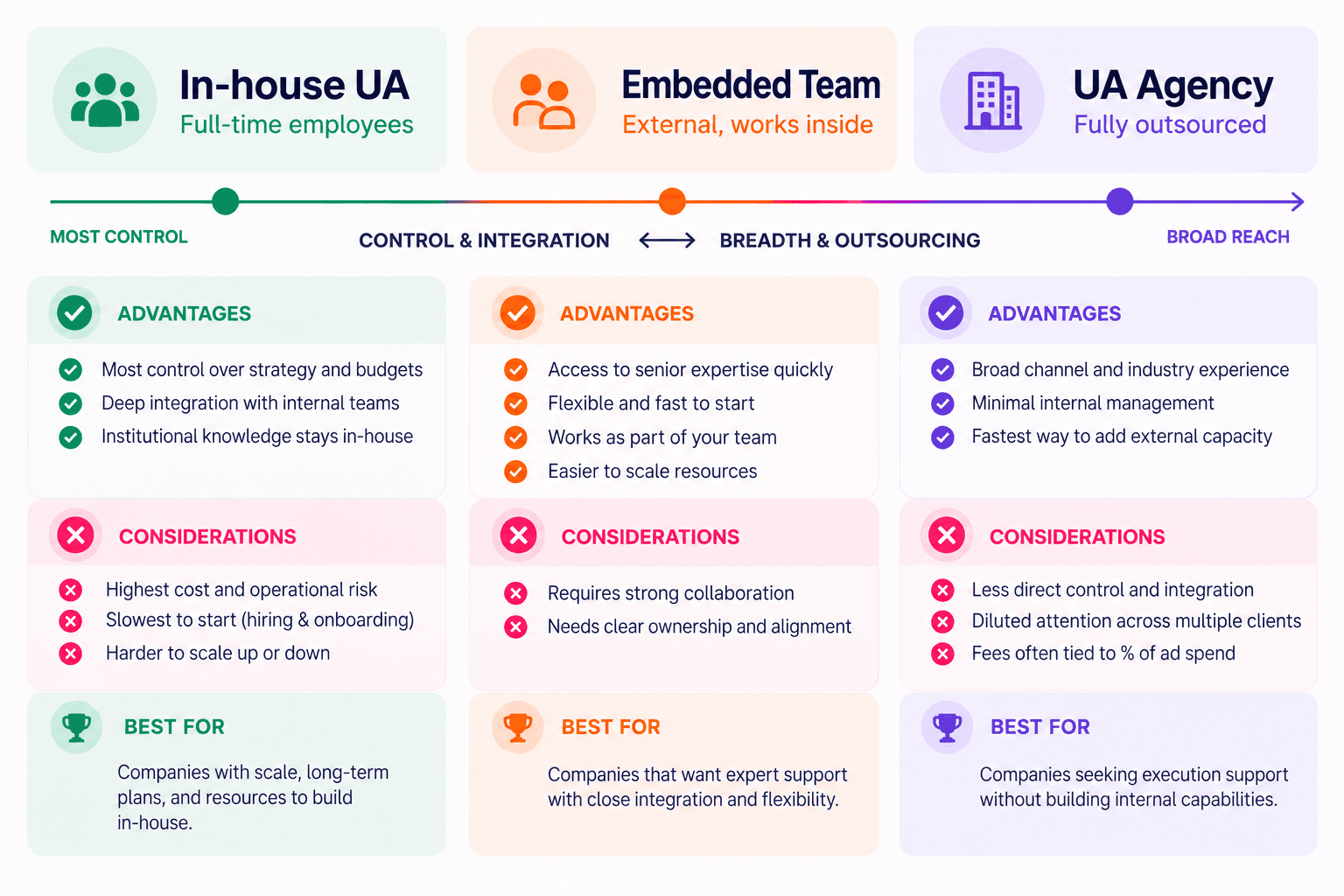
Before comparing them, it's worth being clear about what each model actually is, because the lines between them get blurred a lot.
What is In-house UA?
Hiring in-house means you hire one or more UA managers as full-time employees. They work exclusively on your games, they sit inside your team, and over time they build deep knowledge of your product and your players.
However a senior UA hire is expensive, can take months to recruit, and needs time to ramp up.
Advantages of in-house UA
Maximum control over strategy, budgets, and priorities
Deep integration with product, marketing, and analytics teams
Strong institutional knowledge retained within the company
Considerations of in-house UA
Highest hiring and employment costs
Longer time-to-value due to recruiting and onboarding
Greater operational risk if key team members leave
What is a traditional UA agency?
Hiring a UA Agency means you get access to a team without the overhead of hiring, and a good agency brings broad experience from working across many accounts, genres, and markets.
This really depends on the agency but often when hiring a big traditional UA agency, the attention on your account can wane. Your game can be one of many on their roster, and as such you don't always get the best attention.
Advantages of a traditional UA Agency?
Access to broad channel experience across multiple clients
Minimal internal management requirements
Fastest way to add external capacity
Considerations of a traditional UA Agency?
Less direct control and integration
Team attention may be split across multiple accounts
Fee structures are often tied to advertising spend
What is an Embedded UA consultancy in Gaming?
An embedded specialist or specialist UA consultancy works inside your team, in your tools, your Slack, your processes, attending your standups, sharing data with your product team in real time.
This means no recruitment risk, no long ramp-up, and the flexibility to scale the engagement up or down as your needs change. This is the model that we at Hubapps use.
Advantages of an embedded UA consultancy?
Access to senior-level expertise from day one
Faster and more flexible than hiring full-time staff
Closely integrated with internal teams and workflows
Easier to scale resources up or down as needs change
Considerations of an embedded UA consultancy?
Requires strong collaboration and communication
Success depends on clear ownership and alignment
How does a UA Agency, an Embedded Team, and an In-House UA Team Actually Compare?
Factor | In-House UA | UA Agency | Embedded Consultancy |
Who manages your account | Your own employee, fully dedicated | Junior account manager handling multiple clients | Senior specialist dedicated to your game |
Mobile gaming expertise | Depends entirely on who you hire | Depends - is per agency specific | Specialists with deep mobile games experience |
Team integration | Full integration by definition | External vendor, managed at arm's length | Works inside your Slack, sprints, and standups |
Cost model | Salary, benefits, recruitment costs | Typically a retainer | Hourly or package fee |
Reporting transparency | Full access, your own dashboards | Agency dashboard, often hard to export | Your MMP, your data, full access |
Risk | High if the hire doesn't work out | Low commitment, lower performance ceiling | Low commitment, high performance ceiling |
What Are the Downsides of Hiring in-house vs agency?
None of these models is inherently the right answer. Each one has real failure modes that studios don't always see coming.
The obvious constraint is cost.
UA Cost Comparison: In-House vs Agency vs Embedded Consultancy
Factor | In-House UA Team | Traditional UA Agency | Embedded UA Consultancy |
Pricing model | Fixed salary + benefits | Retainer, % of ad spend, or both | Hourly, project-based, or monthly package |
Upfront costs | Recruitment and onboarding | Setup or onboarding fees may apply | Usually limited onboarding costs |
Ongoing costs | Fixed employment costs | Recurring fees, potentially increasing with spend | Based on agreed scope and capacity |
Creative production | Internal resources or additional hires | May cost extra | Depends on scope |
Commitment | Long-term employment | Contract-dependent | Typically flexible |
Cost when scaling | Additional hires may be needed | Fees may rise with ad spend | More specialist hours or capacity |
Cost when activity slows | Salary remains fixed | Minimum fees may still apply | Scope can often be reduced |
Best financial fit | Studios with consistent, long-term UA needs | Studios needing outsourced campaign management | Studios needing flexible senior expertise |
Cost is obviously a consideration when deciding how to manage user acquisition. But comparing a full-time salary with an agency retainer or consultancy fee doesn't tell you the whole story.
What matters is what you're actually paying for, how much expertise you're getting, and whether that model makes sense for the stage your game is at.
The Cost of Hiring In-House
Hiring a senior UA manager means committing to a salary, benefits, recruitment costs, and potentially several months of onboarding.
The upside? You have someone dedicated entirely to your games, building knowledge of your product and working directly with your team.
The downside is that you're paying for that expertise full-time, whether you're scaling campaigns aggressively or running a limited soft launch.
And one person rarely covers everything. A great UA manager might know Meta inside out but have limited experience with AppLovin, ASO, or creative production. You may still need external specialists.
The Cost of Hiring a UA Agency
Most traditional UA agencies work on a monthly retainer, a percentage of ad spend, or a combination of both.
This gives you access to a broader team without the costs of recruiting and employing someone directly.
However, it's worth understanding exactly what's included in that fee. Does creative production cost extra? Who actually manages your account? How frequently are campaigns reviewed? Is there a minimum spend or contract commitment?
A percentage-of-spend model can also become expensive as your campaigns scale, even if the amount of work required doesn't increase proportionally.
The Cost of an Embedded UA Consultancy
An embedded consultancy typically charges for specialist time, whether that's an hourly rate, a fixed project fee, or an agreed monthly package.
At Hubapps, we work directly inside your team, giving you access to senior UA expertise without requiring a permanent hire.
You might need someone to manage your entire UA function during soft launch, support an existing team for a few days a week, or help with a specific challenge like attribution or scaling a new network.
The advantage is flexibility. You're paying for the expertise and capacity you need rather than committing to a full-time employee.
Of course, this model also requires your team to invest time in collaboration and knowledge sharing.
What is the cost difference between hiring an agency vs hiring an embedded UA Team? Vs in-house?

How Can Each UA Model Can Fall Short?
Cost isn't the only consideration. Each model has its limitations, and understanding them before committing can save your studio a lot of frustration.
Where Traditional UA Agencies Can Fall Short

Navigating mobile game marketing: Agency partnerships demystified 🎮
The structural problem with most agencies is that their business model and your interests don't fully align. They need to be profitable across a large client roster, which means account managers carry too many clients to give any one game the attention it needs.
The percentage-of-spend fee model used with some agencies compounds this. If an agency charges a percentage of your media budget, they have a financial incentive to spend more, not necessarily to spend smarter. And when their staff rotate, which happens regularly, your new account manager starts from scratch on understanding your game while you keep paying the same retainer.
Where embedded consultancies break down
The embedded model works best when there's genuine collaboration.
Your external specialist needs access to your data, communication channels, and internal teams. They need to understand what's happening with the game, not just what's happening in the ad accounts.
If your studio wants to hand everything over to an external provider and receive a monthly report without much involvement, an embedded consultancy may not be the best fit.
The model also depends on clear responsibilities. When external specialists work closely with internal teams, everyone needs to know who's making the final decisions.
Where In-House UA Teams Can Fall Short
Having someone dedicated to your game sounds ideal. And in many cases, it is.
But even experienced UA managers have limitations.
Someone who's brilliant at scaling campaigns on Meta might have little experience with rewarded networks. Someone who's spent years working on hypercasual games might struggle when moving into a completely different genre.
Then there's capacity.
Launching a second game, expanding into new markets, or managing a major live-ops event can quickly overwhelm a small internal team.
And if your senior UA manager leaves, they take years of experience and valuable knowledge of your campaigns with them.
That's why having an in-house team doesn't necessarily mean you won't benefit from external expertise.
What Gap Are You Actually Trying to Fill?
The right model depends less on a general preference and more on the specific situation your studio is in right now. These are the most common ones we see at Hubapps.
You have no UA function yet
You've built a game and you need someone to own UA from scratch. Setting up tracking, choosing channels, running the first campaigns, reading the early data correctly. We would suggest an in-house hire, agency or an embedded team in this instance.
You have a junior team that needs senior oversight
You have someone in-house running campaigns, but they don't have the experience to make the bigger strategic calls. Which channels to prioritise, how to read early retention signals correctly, when to push budget and when to pull back.
Bringing in a senior embedded specialist alongside a junior in-house person is one of the most effective setups we work in. The junior team member learns, the campaigns benefit from senior judgment, and you're not paying a full senior salary.
Your team is strong but at capacity
Your UA function works well, but you're launching a new game, entering a new market, or running something that your existing team can't absorb without something else slipping.
This is a common situation and one where neither a full-time hire nor a traditional agency is a clean fit. A full-time hire takes too long and commits too much. An agency adds coordination overhead you don't need. An embedded specialist can plug in alongside your existing team for the duration of what you need covered.
You're launching something outside your existing expertise or soft launching
Your team knows hypercasual but you're launching a midcore title.
Or you've always run on Android but this game needs an iOS soft launch.
Ot you're soft launching a new game.
Or you're entering a market you've never operated in before.
Expertise gaps like these are exactly what an embedded consultancy is built for. You get someone who has done this specific thing before, working inside your team, without having to permanently hire for a specialism you may only need for one product cycle.
You need a specific service covered
Sometimes the gap isn't about UA overall, it's about one part of it.
Specific UA best practices
ASO that your UA team doesn't have time for.
Creative strategy that isn't connected enough to campaign performance.
Analytics that nobody is acting on.
An embedded consultancy can cover a specific function, work alongside whatever team you already have, and integrate into your existing workflow rather than running as a parallel track.
What Kind of Services Should an External UA Partner Cover?
Whether you're looking at a traditional agency or an embedded consultancy, the core service areas are broadly similar. The difference is in how connected they are and how directly they respond to what's happening in your campaigns day to day.
User acquisition: paid media management across platforms including Google, Meta, AppLovin, TikTok, and Unity. Budget management and conversion rate optimization built around ROAS, not just install volume.
Creative strategy: competitor research, creative analysis, and ongoing production of video, static ads, and playables, tested and iterated based on live performance data rather than a quarterly review.
App Store Optimisation: keyword optimisation, competitor studies, and store listing improvements. This affects your CPI before a campaign even starts and should be connected to UA, not siloed from it.
Analytics: KPI definition, data visualisation, and using that data to actually change what you're doing, not just report on what happened.
Soft launch: structured testing in limited markets to validate retention and channel performance before committing to a full launch budget.
Community and retention: building loyalty and re-engaging existing users, which matters more as acquisition costs rise and LTV becomes the number that determines whether a game is viable.
What Should You Look for in an External UA Partner?
If you've decided that an external partner is the right answer for where your studio is right now, these are the things that actually separate good from mediocre.
3 Reasons Why an Experienced UA Partner Makes a Difference
Having someone manage your UA campaigns is one thing. Having someone who knows what to do when things go wrong is another.
Senior people doing the work, not just the pitch. The person you meet in the first call should be the person running your campaigns.
Pricing that aligns with your performance, not your spend. A percentage-of-spend model gives an external partner a financial incentive to spend more of your budget, not to spend it better. Whatever the model, make sure you align first.
Knowledge transfer, not dependency. A good external partner should leave your team more capable than they found it. At Hubapps, we work to make sure the studios we work with understand what we're doing and why, so that as their in-house capability grows, the engagement evolves rather than becoming a permanent crutch.
Flexibility to fit what you actually need. Whether you need someone to own UA entirely, to work alongside an existing team, or to cover a specific gap for a defined period, the engagement model should adapt to your situation rather than locking you into a fixed structure from day one.
As Maria de la Puente, our co-founder of Hubapps, explains, there are three areas where an experienced UA partner can make a real difference.
1. Avoiding attribution mistakes
If your MMP, ad networks, and tracking events aren't correctly configured, you could be making budget decisions based on inaccurate data. An experienced UA partner knows what to check before those mistakes become expensive.
2. Knowing which metrics actually matter
When campaigns underperform, CPI alone rarely tells the full story. Is retention dropping? Are users converting? Is ROAS developing as expected? Knowing where to look helps you diagnose the problem instead of blindly changing campaigns.
3. Understanding how different ad networks behave
What works on Meta won't necessarily work on AppLovin, TikTok, or Google. Each platform has its own algorithms, optimisation options, and creative requirements.
And sometimes, the most valuable experience comes from having seen campaigns fail before.
Frequently Asked Questions
We already have a UA manager in-house. Can we still work with an external partner?
Yes, and it's one of the most common situations we work in at Hubapps. An external specialist can provide senior oversight for a junior in-house hire, cover a channel or specialism the internal team doesn't have, or add capacity during a launch without a permanent headcount increase. The two don't have to be mutually exclusive.
Is an embedded consultancy more expensive than a traditional agency?
Not necessarily, and often less so once you account for everything in an agency retainer. Most agencies charge a monthly fee plus a percentage of your media spend, plus separate fees for creative production.
With Hubapps, you pay for the specialist's time directly, with no percentage of spend and no hidden add-ons. The total cost is usually comparable or lower, and what you get for it is more senior and more connected to your actual campaigns.
What does "embedded" actually mean in practice?
It means the specialist works as part of your team rather than as an external vendor you manage. They're in your communication channels, they have access to your data and dashboards, they join your standups, and they're available for same-day decisions. The working relationship looks a lot more like having a senior colleague than managing an agency contract.
Does Hubapps work with studios at all stages, or only once a game is scaling?
Hubapps works with studios at different stages. Early-stage studios often need help setting up tracking correctly, choosing the right channels for a soft launch, and reading the first data correctly. Scaling studios need someone monitoring campaigns daily, optimising across multiple channels, and making sure the creative pipeline keeps pace with spend. What changes is the focus, not the model.
How long does it take to get started?
Without agency onboarding processes or account handoffs to manage, the setup is mostly about access and context. Once we have access to your ad accounts, your MMP, and your dashboards, and we have a working understanding of your game, we can be running within days. There's no six-week onboarding process before anything happens.
What if we want to build in-house eventually?
That's a completely valid direction and one we actively support. Part of how Hubapps works is knowledge transfer: making sure the studio understands what's being done and why, so that when the time comes to bring UA fully in-house, the foundations are solid and the transition is clean rather than starting from scratch.

Mobile gaming UA specialist since 2011. A female pioneer in the industry, Maria has scaled games across every major platform and genre, from indie puzzle games to massive strategy titles. Known for straight talk and results that actually matter.
Share
Related Articles


